Do You Love Your Mom and Her Two-Hit Multi-Target Attacks?, Vol. 7

By Dachima Inaka and Iida Pochi. Released in Japan as “Tsujo Kogeki ga Zentai Kogeki de Ni-kai Kogeki no Okasan wa Suki desu ka?” by Fujimi Fantasia Bunko. Released in North America by Yen On. Translated by Andrew Cunningham.

This series (which has now ended in Japan at Vol. 11) has, as its primary goal, humor and fanservice, as with many other series of its type – this one just involves moms. But there is a secondary goal that the series occasionally reaches toward, which is “make Masato a mature, self-sufficient young man”. As the author admits, you can’t really take this TOO far or you’d ruin the series’ main running gag of his being useless in the face of his overpowered mom. But this volume comes closest to giving him actual character development, and I can distantly see an endgame in site. That’s not so say this book is not also very silly, as we get stranded on a desert island, a beach volleyball game that seems to mostly involve hitting the girls’ asses with the ball, and the third of the Four Heavenly Kings, who seems to bond with Masato right away. And then there’s Porta… so close, but not yet.

This volume begins with a new area opening, which features Beastmen, including the Beastman Mom we saw in the tournament arc. Our party wins a gatcha lottery, with Mamako winning the grand prize, a trip to a resort for three days. Unfortunately, the airship they’re taking to the resort ends up in the midst of a party fight, and they end up crash landing on a seemingly deserted island. Still, they have the infinitely overpowered Mamako, so they can do things like create a beach, an entire resort town, etc. just by her calling on Mother Earth and willing it to happen. And Masato runs into a kindred spirit, someone who might finally be able to teach him how to get stronger. The question is… stronger for what? And also… is Mamako wearing herself out? REALLY?!

Yes, we’re finally getting a situation engineered where Mamako can’t use her full powers, and in fact is exhausting herself just trying to do what she normally does. This dovetails nicely with the ending, where Masato confronts her about lying to him about being fine, which she finally, grudgingly admits to because she didn’t want to worry him. This is, frankly, a situation that a parent has likely had to deal with before. As for Masato himself, after seeing the varieties of Mom-hating that the Four Heavenly Kings offer, he realizes, in the typical shonen protagonist way, that he wants to get stronger so that he can protect others, not just so that he can beat his mom at something. Which is good, as the ending trap requires him to use power that ONLY works if he says it’s to protect his mom. Even the other girls have to admit that he was almost cool there for a moment.

There’s lots of silliness here as well, usually involving our two pathetic villainesses, or Wise and Medhi, our two somewhat pathetic heroines. But this is Masato’s book, and he holds up pretty well, despite spending the first three quarters of it or so moping around thinking about how weak he is. Next time will we finally confront the mystery that is Porta? Maybe, maybe not. But for fans of the series, this is a very good volume.
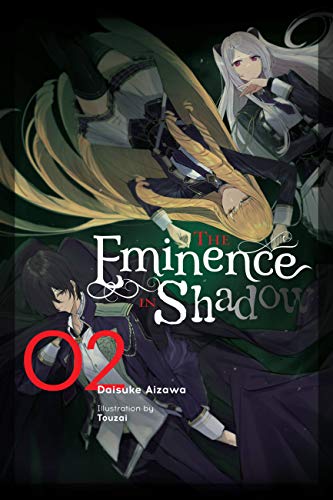
The Eminence in Shadow, Vol. 2

By Daisuke Aizawa and Touzai. Released in Japan as “Kage no Jitsuryokusha ni Naritakute!” by Enterbrain. Released in North America by Yen On. Translated by Nathaniel Hiroshi Thrasher.

I may have to eat my words again. Last time I said this is the sort of story that could only work as a comedy. But in this second volume, I’m finding that I’m more interested in the actual conspiracies and backstory than I am in Cid being goofy chuuni guy. I will admit this book is not as funny as the first one, though it has its moments that made me laugh out loud. But when it’s focusing on other characters, particularly Rose, the princess who gets put through the wringer in this book, it actually makes me wish that it could work as a real book. The key there, however, would be that it would have to have a cast that did not include Cid or his minions, and that’s not going to happen. And, to be fair, it would deprive us of that most shonen of cliches, the tournament arc, which Cid tries to game for his own amusement and mostly succeeds.

The book is essentially divided in half. The first part has Cid, invited by Alpha, headed to see an event where fighters try to call up ancient heroes and do battle with them. Most fail. That is, most fail to even call up ANY spirits. Naturally, Cid/Shadow ends up calling up one of the most deadly. There’s also a hidden conspiracy involving the Church, which frankly should not surprise anyone reading this book. After this he decides to enter the local tournament battle, which his sister is also competing in, as well as Princess Iris. Unfortunately, while this is happening Rose, another princess, is set to be married off to a man who is so evil that he’s named “Perv Asshat”. She tries to kill him, then flees, but we know that’s not going to work out. She’s going to have to sacrifice something…

The funny parts of the book usually involve Cid when he’s trying to be edgy, or when he’s reacting in surprise to something that he set up and forgot about. (There’s a running gag of him thinking he’s finally met another isekai’d person, only to find out it’s one of his minions just publishing stories he told from our world, or music he played. It’s a much funnier running gag than Cid always crassly saying he has to “hit the can” before vanishing to be Shadow.) I was also amused at the hate/hate relationship between Alexia, Cid’s tsundere from school, and “Natsume”, aka Beta, one of Cid’s minions. They really can’t stand each other, and it can be funny. That said, Rose’s plot is not played for laughs at all (OK, the tuna wrapper was funny), and while Perv Asshat may have a very stupid name, he’s clearly got the villain thing down pat, and unfortunately survives to fight in another book.

So it’s not quite as silly a comedy as the first book, but I find its skeleton more compelling than I did in the first. Fans should still enjoy it either way.

I Reincarnated As Evil Alice, So the Only Thing I’m Courting Is Death!

By Chii Kurusu and Minato Yaguchi. Released in Japan as “Akuyaku Alice ni Tensei Shita node, Koi mo Shigoto mo Houki Shimasu!” on the Shōsetsuka ni Narō website. Released in North America by Cross Infinite World. Translated by Emma Schumacker.

As with a lot of recent isekai titles, I’m starting to wonder if the “reincarnated in an otome game” authors are using that device as a way to get people to read their work. The reincarnation part of the book involves our heroine getting run over while rescuing a kitten, and she ends up in her favorite otome game. The trouble is, she’s in the expansion pack version – which she never played as it was only announced the day she was killed. So while she has all the common “romance” routes from the original game memorized, they aren’t working this time around. What’s more, the otome game she played was notorious for putting in more and more bad ends as you got closer to each romance. It comes up throughout the book, don’t get me wrong. But honestly? This is a perfectly good, fun supernatural romance series. It didn’t need to otome game itself up.

Our heroine is Alice Liddell, a name that may seem familiar. This one, though, is party of a Victorian SWAT team that fights enemies on behalf of the Queen. She’s smart (especially once the rather awkward “huge fan of otome games” prologue finishes) and does not take crap from anyone, and for good reason – her entire family was massacred three years earlier, and she’s trying to carry out their legacy. Her current case involves young women falling asleep and not waking up, and the prime suspect appears to be the very eccentric – and handsome – Dark Knightley. Together with her team of Jack (butler to her family and the other survivor of the massacre), Leeds (androgynous and the first person that Alice saved) and the Tweedle brothers, Dum and Dee (strong fighters but also adorable little boys), she’s determined to get to the bottom of this. Mostly as she has a bet with Dark as to who will solve it first!

As you can see, the book is not very subtle. There’s a lot going on here – I didn’t even mention the contracts with demons or superpowers most of them have – and fortunately most of the “Alice in Wonderland” stuff is kept to Alice’s name, the twins, and the fact that Dark wears a lot of fancy top hats. (An Alice romance where the love interest isn’t the Mad Hatter? Heavens forbid.) The villain is also super, super obvious. But that’s OK,. because the only reason anyone would read a title like this is for the interaction between the two leads, and that’s excellent. Alice makes a very good heroine, kicking ass and carrying a gun but also able to act the part of a Victorian lady, albeit one disliked by the other Victorian ladies. She’s actually reincarnated as the heroine of the otome game, which is probably a good thing given the fate of the “otome game villainess” in this book. As for Dark, he’s eccentric without being annoying, doesn’t have that “I am overly possessive” vibe a lot of romantic heroes tend to get, and has his own tragic backstory to boot. They make a good couple.

If you’re looking for deconstruction of the otome game archetypes, look elsewhere. And I hope you side with the landed gentry over those who buy their titles. But Evil Alice manages to be a breezy romance with mystery and horror overtones, and is perfectly pleasant.