Is It Wrong to Try to Pick Up Girls in a Dungeon?, Vol. 15

By Fujino Omori and Suzuhito Yasuda. Released in Japan as “Dungeon ni Deai o Motomeru no wa Machigatte Iru Darou ka?” by GA Bunko. Released in North America by Yen On. Translated by Paul Starr.

This volume is similar to Volume 8, in that it is essentially a short story collection with wraparounds. The stories are all (almost) on a basic premise, which is “let’s lay out the backstories of how everyone arrived in Orario and how their lives have improved 8000% now that they have family and friends”. As such, there is an air of melancholy to this book, as while we do admire how far everyone has come, we’re seeing a depressed Bell, a rejected Hestia, an abused Lilly, a disillusioned Eina, a frustrated and angry Welf, a bitter Lyu, and… well, we’ve mostly gone into Mikoto and Haruhime’s stories already, so theirs is the exception to the rule. And then there’s Aiz, who doesn’t show up till the end, but who provides the perfect capper to the book, even if it leaves you with an ominous feeling. After several volumes in a row that are just dungeon fights, this one also seems happy to give everyone a chance to rest.

Bell and Hestia are on the cover, and they get the first flashbacks, as they (independently) recall how they arrived in the city. Their stories are downbeat, but end on a high note as they meet each other. There’s a later mirror of them with Lyu’s story, which features similar beats – she really needs to join a Familia, but her preconceptions and prickly nature are driving everyone away. Lilly’s story was a high point – showing off how wretched her life has been from the moment of her birth (sorry, Soma, giving Lilly potato puffs once does not make me forgive you) while contrasting it with the glee and happiness she feels as Hestia tells her that she’s gone up to Level 2. That said, when it comes to her past, she’d still prefer to deal with it indirectly rather than confront it head on. Which is her own choice, of course.

Welf’s story is fairly predictable, and Haruhime and Mikoto’s suffers from being the ‘light’ story in the book (though it is nice to see Haruhime slowly try to get herself out of “clumsy foxgirl” status – the maid stuff really doesn’t help). The epilogue, though, is the true best part of the book. It features the one day a year when the city mourns all its fallen, something that has to be explained to Bell (who, we are reminded, has not even been there a year yet). Seeing the funeral elegy being sung by everyone – even those such as Freya – was hauntingtly beautiful. That said, Bell and Aiz are not headed down the same path, and this epilogue serves to underscore that. Aiz is not here to be anyone’s hero. And, while Sword Oratoria readers already have a good inkling of her past secrets, here Bell finally connects the dots, and is stunned.

Unfortunately, the 16th volume only came out in Japan two months ago, so we may have another long wait. And, given the cover to 16 has Syr and Freya on it, Aiz may not even be the focus. Still, for a collection that was written as “take the short stories from the anime releases bonus DVDs and create wraparound material”, this is surprisingly solid.
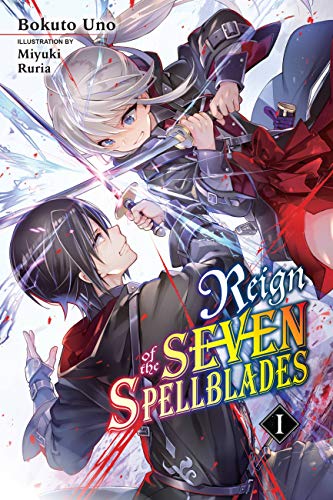
Reign of the Seven Spellblades, Vol. 1

By Bokuto Uno and Miyuki Ruria. Released in Japan as “Nanatsu no Maken ga Shihai suru” by Dengeki Bunko. Released in North America by Yen On. Translated by Alex Keller-Nelson.

This was one of the two “big names” licensed a while back, and it had a huge amount of buzz to live up to. It not only lived up to the hype, it sailed over any other hurdles. This book is good. Really, hard-to-put-down good. This is all the more surprising given that it runs on some very common fantasy novel themes. Our heroes are first-years who are arriving at a prestigious magic school in not-Britain. Most of the characters will be a recognizable type, but this doesn’t make them annoying or boring, rather it makes it easier to identify and sympathize with them. The exceptions are our two lead protagonists, both of whom clearly have a lot more to their backstories than our first meeting would initially suggest. They go to school, learn magic, learn swords (more on that in a bit), and end up in trouble about every 30-40 pages or so. That said… this is surprisingly dark.

Our group of first years are: Oliver, the main protagonist, a serious young man with a talent for intricate spells; Nanao, the other main protagonist, a foreign student who knows nothing in the world except fighting to the death; Katie, the daughter of demi-human rights activists who shares their activism; Guy, a goofy everyman sort; Pete, who comes from a nonmagical family and is here to study and prove himself; and Michela, the noble girl with princess curls who, for once, turns out to be the nicest person in the book. They get into adventures right off the bat when a troll goes berserk at the run-up to the opening ceremony, and can’t seem to stop stuff happening to them after that, from getting trapped in the labyrinthine hallways after school to fighting a duel that goes horribly awry to finding that most of their upperclassmen are completely, 100% bonkers.

As I said, this book is darker than you’d expect. It’s made very clear at the start by the headmaster that a lot of the students die. We also see several fourth and fifth years who are happy to torture, battle, or experiment on anyone that catches their fancy. It’s also a school that combines swordsmanship with magic, after a magical duel in the past ended in death because the mage was no good at up-close fighting. The “spellblades” in the title are legendary blades that are essentially “one hit kill” blades, and there are not many on the world at all. It’s not hard to guess who’s going to be spellblading by the end of this book, but that’s OK. Plus there’s a lovely twist at the end that throws a lot of what we were assuming about one of the characters out the window, and makes me wonder if this cute romance I was hoping for is going to end at all well.

There’s more I could talk about. Nanao is, as I said, trained only for battle, but she’s surprisingly innocent and goofy otherwise. There’s a nasty rival character who appears to be set up to just be a constant antagonist, but then is dealt with and starts becoming a better person. There’s everything about Chela, who may be my favorite character in the book, despite essentially being Rin Tohsaka with Luvia’s hair. (There are a lot of characters who you could say are “essentially __________”, and you will note I have avoided mentioning a certain series that will come to mind.) Most importantly, the book is gripping and makes you want to read fast and immerse yourself in the world, despite being pretty lengthy (it’s over 280 pages). This is absolutely worth the hype.

Yona of the Dawn, Vol. 26

By Mizuho Kusanagi. Released in Japan as “Akatsuki no Yona” by Hakusensha, serialization ongoing in the magazine Hana to Yume. Released in North America by Viz Media. Translated by JN Productions, Adapted by Ysabet Reinhardt MacFarlane.

It can be hard to find the perfect cliffhanger o end a manga volume. Of course, with most ongoing series there is a cliffhanger of sorts, particularly in action series such as Yona of the Dawn. There are several obvious examples in this volume alone, each of which could probably have served perfectly well as the cliffhanger, particularly the second to last chapter in the volume. But there’s something so deliciously satisfying about this one, the sort of ending that gives the reader what they have wanted all along but not ENOUGH of it. Yona of the Dawn is usually a pitch perfect blend of political intrigue, action adventure, and a dash of romantic tension, and for most of Vol, 26, the focus is definitely on the first two. Even when we get to the romantic tension, it looks like the usual “misunderstandings abound!”. So we are both cheering and also laughing hysterically at how said misunderstandings are cleared up. You DESPERATELY want to read more.

As for the politics, not to spoil too much, but there is one less death than I was expecting when I finished Vol. 25. As it turns out, things can mostly be resolved with negotiation, though it takes a few more sacrifices and also everyone ganging up on the evil priest. This actually leads to the other great moment in the book, one that relies very much on Su-Won and how he is choosing to rule. The priest (whose name I keep forgetting, mostly as I tend to call him Wormtongue in my head) points out that Kouren captured and imprisoned the Legendary Dragon Warriors, to which he gets a “so what?” response. The priest is stunned that he does not want to use their magical cool powers to strengthen his position. (Technically this is what Yona is doing, but she is not doing it in the way the priest wants it to happen. The priest’s stunned face as Su-Won cuts all his arguments off at the knees is hysterical.

Other things to mention: Riri is here and awesome, though not as awesome as her retainers, who manage to gang up on Kouren and make sure she can’t tragically die leaning against a building or some other samurai thing. The other guys spend most of the book unable to move, alas, though they’re on the road to recovery by the end. It also helps sell that this is a problem that CAN be resolved with discussion and negotiation, rather than “I have a guy with a big hand, medusa eyes, a big kick, and Zeno.” Although it led to Yona’s misunderstanding, I really liked Hak’s chatter among his Wind tribe friends – she’s right, he acts like a totally different person around them, and while I don’t think it’s entirely her fault she’s never seen it, it does show off why they’re still not quite ready to get any closer than they are.

OR ARE THEY? Cannot wait till the next volume, which thanks to my backlog is already out. There’s always so much to talk about and love with Yona of the Dawn.