In the Land of Leadale, Vol. 1

By Ceez and Tenmaso. Released in Japan by Famitsu Bunko. Released in North America by Yen On. Translated by Jessica Lange.

I have to admit “it’s sort of like Overlord meets Kuma Kuma Kuma Bear” is not a sentence I thought I’d be typing, and yet here we are. In the Land of Leadale manages to use a bit of the premise and a few of the logistics of Overlord, but is decidedly non-evil in tone, and in the end is far more concerned about its heroine walking leisurely around this world and being superpowered. Indeed, its “isekai” premise doesn’t come up as often as I’d expect – it’s there mostly for Cayna to make comparisons about how things were in the game compared to her life in the land she now finds herself in, and to occasionally go overboard with stats (as this genre is wont to do), but Cayna is for the most part quite happy to be in Leadale, especially as she is now, and her goal, after realizing how different things are now from the game proper, is simply to go around and talk to people. And occasionally show that she is superhuman compared to everyone else. Much like Kuma Kuma Kuma Bear.
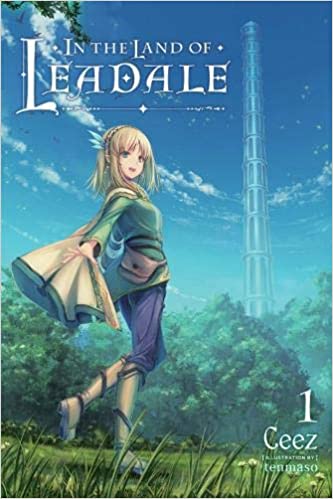
We only get a few bits and pieces of the life Keina Kagami had in Japan before this. She apparently has lost her parents, and is in a hospital bed, where she has been for several years (she mentions not getting to the end of elementary school). Fortunately, she has the VR game Leadale to entertain her, and she has grown to be one of the thirteen strongest players. Then one day a power outage takes out her life support briefly, and she dies… only to be reborn in Leadale as Cayna, her high-elf character. She is rather puzzled as to how she’s in a world based on her game, especially as this world seems to be two hundred years AFTER the game’s own timeline. Now she has to go around, investigate, track down the NPCs she made… erm, pardon me, her three children, and see if she can figure out what happened. Then, when she does get an explanation, she moves on and decides to simply live here as a superpowered ancient high elf woman (who still looks like a teenager, of course.)

The character voice of Cayna is tremendous, and kudos to Jessica Lange, the translator. Admittedly you might call it a flaw – Cayna sounds nothing like a bedridden, near-death Japanese teen might sound, but sounds exactly like you’d expect a flighty and practical high elf to sound. She’s mostly unflappable, though there are things that can set her off, such as when she unintentionally shows off her kick attack by shouting the attack name like a 13-year-old. She starts off in a backwater village and rapidly starts helping to cleanse its forest of monsters, upgrading its wells, and adding a public bath. By the end of the book she’s gone to the capital to meet her kids (two other high elves and an adopted dwarf), each of whom are still alive by dint of being from long-lived races. Unfortunately, what she finds is that the game ended, and that the 12 other top players all gathered for a final farewell, lamenting they weren’t thirteen. (This is why I mentioned Overlord.)

So what happens next? Well, she can always be an adventurer – she helps to catch an errant Prince who is constantly running away from home, and the end of the book has her guarding a merchant party from bandits (and suggesting that there may be other people here she knew from the game). Mostly, though, you want to read Vol. 2 and more because it’s fun to listen to Cayna’s narrative voice and see her going around being ludicrous. An excellent addition to the “slow life” genre.

High School DxD: Diablos of the Old School Building

By Ichiei Ishibumi and Miyama-Zero. Released in Japan by Fujimi Fantasia Bunko. Released in North America by Yen On. Translated by Haydn Trowell.

Sometimes a series is released at exactly the right time to catch fan’s interest, gain momentum, and rise to the top of everyone’s list. Had High School DxD’s light novel come out in North America in 2014, around the same time as Yen On debuted Sword Art Online, I’ve no doubt it would have been quite popular. Indeed, the manga version came out around then, and I assume was probably popular. It’s got cute and sexy demons, battles between heaven and hell, harem building, some cool battle scenes, and lots of fanservice. That said, this is coming out in late 2020. It’s even late in being released after the announcement – everything else announced last year by Yen has long since come out, this was the lone straggler. As such, it can be hard to get into the mindset of remembering that this was quite influential and popular at the time, and not think “what’s the fuss all about?”. Particularly in regards to Issei, who is supposed to be a more perverse than usual LN hero but comes across as pretty nice, really.

Issei is a typical high school student in these sorts of series. Messy brown hair, thinks mostly of boobs, and has two male friends who are even worse than he is. Then one day… a girl confesses to him! Such bliss! Sadly, she turns out to be a fallen angel in disguise, and kills him dead. The remaining 155 pages are blank. Well, OK, no. He’s resurrected by his upperclassman Rias Gremory, who turns out to be a demon… and now Issei is as well. Turns out Issei has a Sacred Gear, i.e. a superpower. Quickly joining the Occult Research Club, which is a front for Rias and her fellows (sweetly sadistic Akeno, tiny and stoic Koneko, and token guy Kiba), Issei goes around trying to make deals with humans – i.e. demonic contracts. He’s not all that good at it, to be honest. Then he meets a young nun, Asia…

This is pretty solidly written all around, to be honest. The fanservice, while present in the illustrations, doesn’t really make its way into the text – there was less “boobies!” talk than I expected. Issei is the classic “I talk about girls all the time but am secretly a nice guy” protagonist. The rest of the cast is not as fleshed out – there’s hints of tragic backstories that will no doubt be covered in later books, but the only one we get here is Asia’s. The villain is the fallen angel who tricked Issei in the first place, and she’s the classic bad guy, to the point where Rias notes that Issei defeating her could only have happened because she talked too long and let him power up. I’m not a fan of the overly moe art style, but that’s not too much of a problem.

So the series ends up being pretty good, and I’ll probably read more, but after a number of years of titles that explore the same sort of characters, it’s not really groundbreaking at all. The most startling thing might be the fact that the cast seems to genuinely like the hero, so recommended for those who hate tsunderes, who are absent here.

Also, what does DxD stand for?

Ascendance of a Bookworm: I’ll Do Anything to Become a Librarian!, Part 3: Adopted Daughter of an Archduke, Vol. 2

By Miya Kazuki and You Shiina. Released in Japan as “Honzuki no Gekokujou: Shisho ni Naru Tame ni wa Shudan wo Erandeiraremasen” by TO Books. Released in North America digitally by J-Novel Club. Translated by quof.

Let’s face it, Rozemyne has done a lot for the world she now lives in. From all of her printing achievements, which have the potential to change the world as everyone knows it, to even such things as shampoo, the footprint of Myne/Rozemyne is everywhere. However, there is a limit to what she can achieve. Ehrenfest is not going to slowly become modern-day Earth. What’s more, there is a disconnect between a) the way nobles think, b) the way Rozemyne thinks as a commoner who was raised into the nobility; c) the way Urano thinks as a former modern-day Japanese woman who’s been reincarnated with her memories; and d) Rozemyne’s natural eccentricity. As such, sometimes she doesn’t get how other people think, and other people assume that she is familiar with things that she absolutely is not. This becomes a big problem in this book, where Rozemyne taking some abused orphans from a local mayor turns out to have many, many repercussions.

Of course, Rozemyne has an additional problem that she has to deal with, which is that Ferdinand is not only assuming that she gets all the nuances and subtleties with which he speaks, but is also, in his own way, as eccentric as Rozemyne. He is the definition of “it would be easier if I just did everything myself”, and the fact that he can only makes life harder, especially as Rozemyne also falls into that category a lot. This leads to her having a near emotional breakdown when he tells her to solve the problem that she’s gotten herself into, implying that the entire TOWN has to die because of her actions. While Benno and the others are able to help Rozemyne flip the problem on its head (don’t think about how to kill the mayor, think about how to save everyone who is NOT the Mayor), Rosemyne and the reader are left with the harsh reality of a world that does not run on modern-day ethics and morals.

Fortunately, the rest of the book is not as serious as this. There’s a cool action scene as Rozemyne goes to the forest to get ingredients for the potion that will help her Devouring and the forest is overrun by monsters. More importantly, Wilfried once again whines about how easy Rozemyne has it, and she proposes changing roles for one day. This serves as a massive splash of cold water to the face of everyone involved with Wilfried, especially his father, who had been spoiling him without realizing that that had led to a young man who could not read, write, play any instruments, etc. There is some blistering dialogue here about how to educate young people, particularly those with short attention spans. It also shows off Sylvester as a very imperfect Archduke – he’s not a happy camper here, especially when his wife hears about this. Fortunately, Wilfried DOES have a good memory when he bothers to use it, so all is not lost.

There’s not as much of what made Bookworm tick in the early volumes – Benno and Lutz are here, but in supporting roles, and papermaking/bookmaking is also a side project compared to everything else. But it’s the expansion of Rozemyne’s world, and the fact that this world can be terrifying, that makes this arc of Bookworm the best yet.