Silver Spoon, Vol. 15

By Hiromu Arakawa. Released in Japan as “Gin no Saji” by Shogakukan, serialized in the magazine Weekly Shonen Sunday. Released in North America by Yen Press. Translated by Amanda Haley.

It took a long time for Silver Spoon to draw to a close in the pages of Weekly Shonen Sunday. Chapters would come out 2 or 3 at a time and then the series would go on hiatus for another 6 months. Rumor had it that the author was dealing with personal issues (and she was also drawing The Heroic Legend of Arslan at the same time). That said, the announcement that the series would be ending came as a surprise to fans, who found the ending a bit rushed. Thankfully, it reads better in volume form, and it’s a good ending, although having paired up Hachiken and Mikage at last Arakawa is prepared to lean back on making fun of them, which she’s far more comfortable with – by the final chapter the two still aren’t married, even while others from the series have children already. Still, it was never really about the romance, it was about the farming, and there’s plenty of that here.

This assumes, of course, that Hachiken can pass his exams. As always with him, it’s not his actual intelligence that’s the issue but his hideous luck, which is even worse than usual – he’s hit by a car and breaks his leg, and the exams are in the deep snow. Fortunately, he does indeed pass and everyone gets to graduate, with several pages of the main cast spouting off where they’re headed next, ranging from college (Hachiken, Mikage) to taking over the family farms (most of the others) to unemployed, as Yoshino was not able to hook up a cheese-related job that wasn’t suspicious by graduation, so is simply moving to France for a while. We then flash forward a few years, showing everyone’s futures, and see Hachiken heading into Russia for his business, where he’ll be working with a very familiar face…

I enjoyed the fact that Komaba appears at the end here, and is still interested in baseball. His arc was so important for the development of Hachiken and Mikage, and also served to reinforce the idea that financial success in a business like farming is not remotely guaranteed. The other fates of the character range from amusing (Yoshino’s French boyfriend, Tokiwa being married with a kid) to a sort of happy stasis (Hachiken and Mikage, who want to wait till he has financial stability till they get married, so have essentially stayed exactly the same). And Hachiken’s future is also in pigs, and farms, and Silver Spoon, in the end, has been about modern farming and the ways to keep it going even as technology, economic crises, and other problems make the job of “farmer” more of an anachronism. I think Hachiken will make it eventually… though he’d better factor is luck into their business plan somewhere.

At last all of Silver Spoon is out in English, after years of me begging Viz to license it. It ended up with Yen Press instead, who did a good job with it – my constant tweets of “why is this not licensed – right, it’s a farming manga” proved wrong but also right. It has been licensed. And it’s an amazing farming manga.

The Devil Is a Part-Timer!, Vol. 17

By Satoshi Wagahara and 029. Released in Japan by Dengeki Bunko. Released in North America by Yen Press. Translated by Kevin Gifford.

Even more than the last volume, this one gives off the feeling of an author who has been told precisely when his series will be ending. We have five more to go, including this one. As such, it’s far more concerned with the future of the main cast than previous books, as well as pointing blinking arrows at one of the main unanswered questions of the series: why is Maou so dedicated to working his way up the McRonald’s ladder? Shouldn’t he be more worried about Enta Isla? The ongoing battle against God gets shunted to the last fifth of the book (which is quite good, don’t get me wrong), leaving the bulk of it focusing heavily on Maou having the 23-year-old equivalent of a mid-life crisis. He still hasn’t answered Chiho, Emi continues to give him the most mixed signals imaginable, and he’s also reached a crisis point at his job: he failed the managerial exam. Like most huge corporations, they won’t tell him why. Does Maou have what it takes to lead?

It’s a bigger problem than you’d think. He can’t retake the exam for a year. And he has to be recommended again, which is a problem, as Kisaki, who graces the front cover, is being promoted. She’s not leaving the store per se, but she won’t be managing anymore, meaning she won’t be able to help guide Maou’s career. Indeed, she seems far more concerned about her own dream of opening an upscale coffee bar. That said… that dream might include Maou. As well as Sariel, surprisingly, who Kisaki points out is very good at managing money, hopelessly devoted to her, and won’t actually lay a hand on her – the perfect lackey. (This seems cruel, but Sariel is really too pathetic to sympathize with.) That said, Maou simply can’t accept right now – not with everything else in his life up in the air, including monstrous lizards invading Japan, injured chickens, and White Day chocolates needing to be purchased.

One theme of the entire series has been that Maou is excellent at leadership skills when they involve concrete things that need doing, but he’s very bad at reading the emotions and hearts of anyone he deals with. This is especially proven in the scene where he gives out the White Day chocolates – he thinks of everything, including getting chocolate for people who only gave it to him indirectly (coughEmiliacough), then proceeds to ask Emilia to help him go to the demon territories, which sounds to everyone (including her) like he’s taking her on a date and going back to his place. He is dull when it comes to love and romance. Which is why he hasn’t answered Chiho either. Fortunately for him, the crisis at the end of the book will likely make it OK to forget about that again for a bit. They really DO need to clear up Enta Isla first.

There’s even a bonus short story here, which was not in the Japanese volume, showing off Maou’s terrible fashion sense. Assuming Devil Is a Part-Timer fans have not spoiled themselves on what happens next, this should be a great pickup for them.

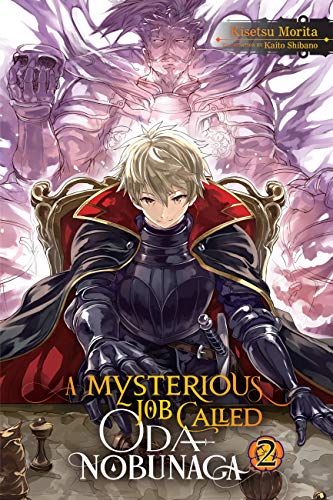
A Mysterious Job Called Oda Nobunaga, Vol. 2

By Kisetsu Morita and Kaito Shibano. Released in Japan as “Oda Nobunaga to Iu Nazo no Shokugyou ga Mahou Kenshi Yori Cheat Datta Node, Oukoku o Tsukuru Koto ni Shimashita” by GA Novels. Released in North America by Yen On. Translated by Alex Wetnight.

I feel like this review should be very short. It should essentially be “everything I said last time, but EVEN MANLIER”. I’ve said this about a few light novels in the past, but the Job Called Oda Nobunaga series really does feel like it’s written for a very specific type of fan. They hang out on internet forums, wondering why the male leads in these books are all such weak-ass wimps. They read harem manga and ask themselves why he doesn’t just bang everyone. They want a hero who kicks ass, takes names, makes love… I have very good news for them. Aside from cutting away before actual sex scenes, this book is basically exactly what they’ve been yearning for all this time. Alsrod, over the course of the 6-7 years or so this book takes place in, ends up as Regent to the King that he’s basically helped install, while finding time for some more wives and lovers.

Last time I mentioned that Alsrod had finally met someone who also had a famous Japanese warrior as their profession, and wondered if they might actually force him to fail or do badly at something. I feel embarrassed for even mentioning it, because by Page 7 or so he’s already won her to his side and bedded her. Over the course of the book he also takes as a lover his werewolf spy, weds the King’s younger sister (who, thankfully, has to wait for the loving – apparently 15 is old enough but 13 is not), is enchanted by a dragonewt tea merchant who he also beds and proposes to (she says no), and towards the end we get a meek and self-deprecating young woman, the daughter of another of his vassals, who simply wants to be a good mother to strong children. Given all these women (remember, he still has his childhood friend, the strong-willed daughter of another Lord, and another concubine from a northern area), it’s a wonder he finds the time to keep conquering. However, no fear, there’s plenty of that as well.

Again, this falls into the “this sounds absolutely vile but is strangely readable” category. It helps that most of the women he ends up with are also in major positions of power – indeed, his childhood friend and the Akechi Mitsuhide general both don’t want to be an official wife because they want to fight at his side. Oda Nobunaga is there as well, of course, in the back of Alsrod’s head, but he is getting strangely less and less relevant, and as the book goes on his advice is getting heeded less and less. Possibly the most interesting part of this book is that we meet three more “occupations” along the same lines – Kunitomo Shuu, Sen no Rikyuu, and Takeda Shingen – and it seems that this land is essentially an afterlife for these famous folks. As for the battles… well, they’re OK. They’re sword fights. You know how it goes.

The end of the book has another rival appear, Takeda Shingen, but given Alsrod has already captured the girl with that “job” by the end of this book, I suspect she will simply be added to the pile of wives. That said, I’m not entirely certain this book will end with Alsrod triumphant. It continues to mirror somewhat events in Nobunaga’s life… which did not have him winning the day in the end. The third book is the final one – will it actually kill Alsrod off to teach readers a lesson about hubris? Or will he stand victorious with his many, many women at his wide? If this were a long-runner I’d be dropping it, but three volumes seems just about right.