How a Realist Hero Rebuilt the Kingdom, Vol. 12

By Dojyomaru and Fuyuyuki. Released in Japan by Overlap Bunko. Released in North America digitally by J-Novel Club. Translated by Sean McCann.

Sadly, my begging to the author did not help, as Machiavelli is cited again in this volume. It was originally written in the webnovel version interspersed with Vol. 11, but they decided to split it up for book publication. Which is fine, but it does mean this book is very short. And what’s worse, it still needs side stories to make up the length… and has to start Book 13, to the point where the chapter numbering actually resets. Basically, in terms of bang for your buck, this is pretty slight. Fortunately, it does a little better when it comes to actual plot, introducing us at last to the Zem mercenaries and finding that they are not QUITE as villainous as the book has painted them to date. More importantly, though, we meet the late Duke Carmine’s daughter Mio, who is determined to get to the bottom of why her father did what he did. Souma had been planning to try to clear Georg’s name anyway, so this works out, but there are some other things to consider.

War is tough, after all, and though Georg did his best to try to keep casualties to a minimum, there are still soldiers who were killed in a battle that turns out to have been part of a massive con game, and their families won’t be happy with that. More importantly, of course, is the presence of Kagetora, the tiger-masked bodyguard who is absolutely not secretly Georg Carmine, no way, uh uh. Mio’s seriousness and general anger is something that Souma tries to curtail by the shortest route, and he does so by having Kagetora and Mio face each other in battle, something that manages to clue her in – and only her – as to what’s going on. (Less successful is Mio after this cathartic moment, when she becomes more comedic and starts throwing herself at Finance Minister Colbert… the author really does want to pair up absolutely EVERYONE, huh?)

The other big event in this book, aside from the cliffhanger that leads into Book 13 (which I’ll just discuss when that comes out) is the first in-person meeting of King Souma and Empress Maria. He needs the Empire’s help with their upcoming war, and knows that such a conversation can’t happen over video conference call. I liked that this showed off Maria being exceedingly clever, seeing what Souma is actually planning immediately, and also showcasing Jeanne’s frustration at being unable to catch up to her genius sister. That said, Maria’s (unheard by the reader) request of Souma is worrying, as it certainly sounds along the lines of “when I die, do this”. And here I was thinking they were going to work out a way to add her to Souma’s wives… oh yes, and the mad scientist group discusses the need to add drills to everything, which I still maintain is just a big Maria-sama Ga Miteru joke.

So, despite its slightness, this book succeeds at what it wants to do, although (like many, many light novel authors) the attempts at humor are not all that funny here. In any case, next time we get mermaids and dragons, and see another clever plan of Souma’s upended by a heroine inserting herself into the narrative.
Monster Tamer, Vol. 1

By Minto Higure and Napo. Released in Japan as “Monster no Goshujinsama” by Monster Bunko. Released in North America by J-Novel Club. Translated by Hikoki.

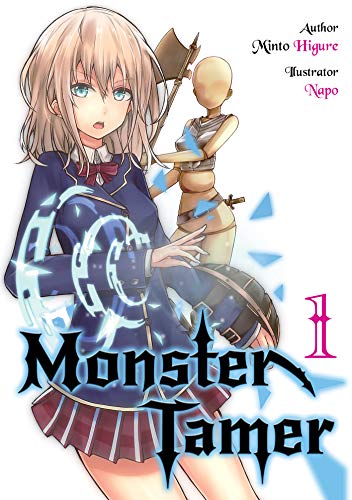
I will admit that the sole reason I gave this series a try was the Japanese light novel label it came from. A series from Monster Bunko! Titled Monster Tamer! Would there be… monsters? Rest assured, this book from the monster publisher with monster in the title has monsters in it. You may have guessed from the cover… possibly. Turns out the cute girl in the uniform is actually a monster as well. That said, what this genre really ends up being is the grim and gritty “abandoned by my classmates, I must soldier on, brooding and filled with hate, and monsters are the only ones that understand me” genre. Arifureta fans will find this very familiar. That said, Arifureta also has a heaping helping of humor that this book lacks. It wants to be taken seriously. Which is fine, but I must admit that emo teen’s emo narration made me rub my forehead a bit. There’s only so many times you can talk about how much you hate humanity, y’know?

Our hero (not on the cover as he’s a standard dull light novel protagonist guy) and his entire school are transported to another world one day. Some have cool, strong powers… and some do not. Very soon everyone starts to try to kill each other. Majima is essentially run over by a stampede of fleeing classmates and left for dead. He crawls to a cave and starts to get eaten by a slime… but then discovers he DOES have a power, as the slime is now his servant. His “monster party” ends up being the slime (who eats the corpse of fellow student Miho, which is why she looks like that on the cover), a ‘puppet’ monster that basically looks like a ball-jointed doll (helpfully, she makes armor with ‘breasts’ so we know she’s also female), and a non-monster, Mana, Miho’s underclassman and friend who they rescued from sexual assault by other classmates. Together they try to leave this forest and find other, non-murdering classmates… and avoid monsters that Majima can’t control.

As you can see, this book is the very definition of a high school kid wearing black so that he can be “edgy”. Majima does not let a chapter go by without telling us either a) he’s lost faith in humanity and hates them now, or b) how he has thrown aside his morals and become a terrible person. Certainly he does kill a few people, but as you’d expect with a Japanese light novel by now, they’re all rapists and bastards. Somewhat to my relief, the relationship between him and his monster servants is framed as more familial than romantic, at least on his end. The third monster we meet comes near the end of the book, and is… well, exactly what you’d expect given her monster type, but I assume we’ll develop her more in the 2nd book. I also appreciated that our hero’s power does not in fact mean he can fight at ALL – all the fights are his monster girls fighting to protect him.

That last bit might turn off other edgy teens who subscribe to the “I want my hero to win all the battles and bed all the women” school of thought. And honestly, given this is 16+ volumes and counting in Japan, I feel no need to read more. For those who enjoy this sort of “revenge/found family” story with a dark-ish tinge, this book will serve those needs quite nicely.

Didn’t I Say to Make My Abilities Average in the Next Life?!, Vol. 10

By FUNA and Itsuki Akata. Released in Japan as “Watashi, Nouryoku wa Heikinchi de tte Itta yo ne!” by Earth Star Novels. Released in North America by Seven Seas. Translated by Diana Taylor. Adapted by Maggie Cooper.

I sort of shot myself in the foot in my last review by talking about how the author has been making Mavis more and more the co-star of these books along with Mile, and that’s a shame because it’s even more true in this book. I was expecting that she’d feature in the start, given the last book ended with a cliffhanger featuring her, but she also has a big role in the middle of the book. More to the point, while the author does say that Reina and Pauline’s magic is better than most, and we see that to a degree, Mavis is the one heading deep into Mile-only territory here. Sometimes this isn’t a good thing – we’ve given up on chiding her for her abuse of magical steroids – but sometimes it can also combine moments of tragic horror with utter silliness, such as when Mavis has her left arm completely destroyed by an elder dragon… and becomes, as Mile pastiches, the Six Million Dollar Woman.

We pick up where we left off, with Mavis making a Last Stand against the evil nobles trying to kill the princess… erm, the noble lady who is not a princess at all, ha ha ha. Naturally, despite Mavis thinking she did this on her own, the rest of the Crimson Vow are not far behind, and things are quickly settled, though not before a few more “a girl is crushing on me and this makes me uncomfortable” jokes. After that, as noted, they get challenged by three elder dragons, because their new leader is a young punk who wants to make a name for themselves. Naturally, the three dragons are taken out by the Crimson Vow, though not before Mavis loses her left arm defending Pauline, something that briefly causes Pauline to be devastated before it’s revealed Mile is a walking plot device. Finally, they meet up with the team that fought them for their academy exams, and for once get along with everyone, which is good as they have to face ANOTHER dragon.

Make no mistake about it, FUNA knows what we are here for, and it’s not drama or character development – possibly why Mavis’ addition to magical steroids is dropped here. The high point of this book, sorry to spoil, is everything about Mavis’ new bionic arm, which Mile whips up in an emergency so that she can continue to fight, and then leaves on because Mavis thinks that it’s cooler than regrowing her old, ordinary arm (which Mile can do as well). Again, this beggars belief were it not for the previous nine volumes of this series, and reminds you that there are other isekai OP protagonists, there is a big gap, and then there is Mile. That said, even Mile is not perfect, and I liked the end story showing that her “sure, let’s let the kids from the village trail along quietly” attitude can be deadly. Fortunately, well, Mavis has a bionic arm now.

As I said, this has, to an extent, come at the expense of Reina and Pauline, and I do hear that Vol. 11 focuses on the latter more. That said, this time around please enjoy the fact that, when they’re on the same wavelength, Mavis and Mile can be utterly bonkers and also complete powerhouses.