Is It Wrong To Try To Pick Up Girls In A Dungeon? On The Side: Sword Oratoria, Vol. 12

By Fujino Omori and Kiyotaka Haimura. Released in Japan as “Dungeon ni Deai o Motomeru no wa Machigatte Iru Darou ka? Gaiden – Sword Oratoria” by GA Bunko. Released in North America by Yen On. Translated by Dale DeLucia.

This is not the final volume of this side series, the author hastens to reassure us in the afterword. There are more stories they want to tell. Which is fine, but it certainly FEELS like the final volume, and there’s no Vol. 13 on the horizon in Japan. It’s the longest volume in the entire series, and manages to once again pull off the specialty of this particular author in that it has a fight take up about 350 pages and still remain interesting. I have some grumps, many of which may be familiar to those who read my previous review – see below – but for the most part this hit the right buttons, has a few fakeouts and a few fake fakeouts, and shows us the good side of some antagonists gods and the bad side of some other gods. And the protagonists, Aiz and Lefiya, both grow stronger emotionally and physically, though Lefiya’s actual recovery may have to wait till future books.

The biggest fakeout impressed but also annoyed me. Last time I talked about media’s habit of the ‘dead lesbian/evil lesbian’ trope, and I wondered if Lefiya might turn a bit dark, but I must admit I was not prepared for Filvis being both the dead AND the evil lesbian. (Yes, yes, they’re not explicitly said to be gay, but come on.) It’s somewhat well prepared, pointing out the many times recently where Lefiya, accompanied by Filvis, has been noticeably in less danger than everyone else. That said, Filvis’ ability, which allows her to essentially clone herself an evil twin, feels a bit too on the nose, the sort of ability that was set up just for the climax of this volume, where Filvis can argue with herself about whether Lefiya has to die or not. Better done was Filvis’ relationship with the main God villain, who is a truly nasty piece of work (I guessed their identity, despite an attempt to distract, but I don’t think the mystery was the point), and the abusive and toxic nature of a “father” figure and his daughter.

The cast of the main series feature more prominently in this one, with Bell getting the big final critical hit in just like he does in the main series (Hestia only has a few scenes, but let’s face it, she’s the Index of DanMachi). As with prior volumes of both series, I remain fascinated by the interplay between Finn and Lilly, who is tacitly forgiven for her deception a while back by being allowed to disguise herself as Finn and take over the logistics of one or two of the battle points. It shows off Lilly’s growth as a tactician, but also really demonstrated Finn’s trust in her – again, if it weren’t for her love for Bell, these two would be an amazing power couple. Most of the rest of the extended cast also gets an attempt to show off, and we get introduced to a few more of Freya’s family, which is good timing as her spinoff is out in a couple of months. And of course there is Aiz, who is able to reconcile her feelings towards monsters, humans, and when it’s right to kill.

This started as an Aiz spinoff but rapidly changed into one about the Loki Family as a whole, and it’s for the better. That said, I don’t mind taking a break here. It’s been a bit exhausting lately, and these volumes got a lot more tragic than the main series. Still, fans of Sword Oratoria should find this a satisfying payoff.
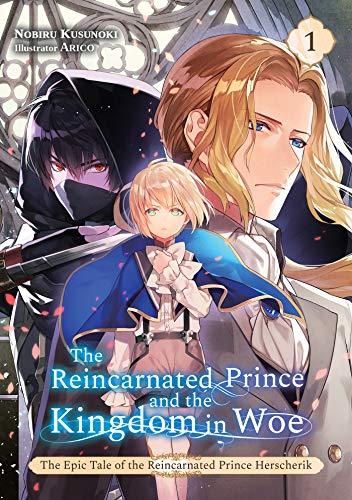
The Reincarnated Prince and the Kingdom in Woe

By Nobiru Kusunoki and Arico. Released in Japan as “Herscherik” by M Novels. Released in North America by J-Novel Club. Translated by Adam Seacord.

It has to be said, after a year that seems to have been filled with nothing but Japanese office ladies dying and being reincarnated in various games, it was somewhat startling to realize that’s not what’s going on here, and that The Epic Tale of the Reincarnated Prince Herscherik (the series name overall) is simply a normal reincarnation isekai – albeit one where our hero is reincarnated as our hero. If I was to ask what the ‘gimmick’ is with this series, that would be one of the three points. The second would be that the hero’s adventures in this book take place from age 3 to age 5 years old. There may be a timeskip in later books (the series is a total of five volumes), but certainly not here, where the prince needs to learn to get things done while being an even smoller bean than Myne. Possibly most importantly, there is very little to no humor in this book. The kingdom is in danger from its corrupt officials, the king is powerless, and good people die. Herscherik is going to need all his OL skills.

Unlike a lot of these sorts of ‘otaku lady in another world’ stories, the life in Japan plays a large role in the story, with Ryoko’s past life sometimes making Herscherik function almost the way Tanya von Degurechaff does, with Ryoko’s own thoughts sometimes seeming separate from Herscherik. Ryoko is a relatively successful office worker who specializes in oversight and checking to make sure everything balances. She is the eldest child, but isn’t married despite her younger sisters both having partners. But she’s reasonably happy, and has a love of games which makes her rush through the rain to get a preorder… which leads to the inevitably car accident that causes her death. There are flashbacks that show her interactions with her family, and we see what her funeral may have been like. It’s quite touching, and it’s also nice to see someone in a reincarnation isekai who got on well with their loved ones.

There is a LITTLE bit of humor in the book – I was amused at Herscherik noting how handsome he is, and then seeing the rest of the royal family, each of whom are far, far more gorgeous. That said, for the most part the book runs on intrigue and thriller, as our little prince rapidly realizes that his kingdom is going to be destroyed and that his father the King is too beaten down and cowed to do anything about it. (We get some scenes with the king, and he’s nice enough, but yeah, Herscherik is needed.) The prince may be only a few years old, but thanks to Ryoko’s knowledge he’s able to figure out who the bad guy is and who the bad guy’s minions are. We don’t take out the big bad here – this feels like a series that was entirely plotted out before it was started – but at least we get a minion humiliated and blackmailed. Oh yes, and Herscherik gets a butler-cum-assassin, who is exactly what you would expect an assassin-turned-butler to be like.

If watching Full House made your eyes roll at the precociousness of the Tanner kids, this may do the same. That said, Herscherik at least has Ryoko’s memories and life experience as an excuse. Other than that, though… this is simply well-written and gripping. Epic Tale fits it nicely.

The Hero Is Overpowered But Overly Cautious, Vol. 4

By Light Tuchihi and Saori Toyota. Released in Japan as “Kono Yuusha Ga Ore TUEEE Kuse Ni Shinchou Sugiru” by Kadokawa Books. Released in North America by Yen On. Translated by Matt Rutsohn.

As I said last time, it’s been hard seeing this two-volume series continue into Volumes 3 and 4. The author knows they can’t just walk things back, but at the same time a different path forward is hard to take. For the most part in this fourth volume, Seiya is much the same as he always is – verbally trashing everyone and anyone while also creating the most perfectly prepared plans. We get a lot of that here as well. He abuses another God who’s hiding a dark secret that turns out to be more embarrassing than anything else. He distrusts almost everyone else around him, including the zombie general (who Rista is too weak to send to his eternal reward) and a machine person with the personality of a meek young girl. And of course Rista supposedly spends most of the book in ‘lower than a weed’ status, even though she’s gotten to the point where she no longer wonders why he does the things he does. That said, there’s a tiny bit here and there showing other sides to him.

This applies to Rista as well, who is not simply there to be a tsukkomi anymore (though when she is called upon, she does manage to step right back into the role – the scene with the giant Rista golem is the funniest in the entire book, and reminds you that above all this is still meant to be a comedy). She follows Seiya’s orders without questioning now. Unfortunately, she also wants to try to help in a way that is not simply following instructions, and that’s what leads to danger and trouble, as she ends up cursed by the villain simply because she took the initiative for once. (She also fails hard when meeting the God of Wealth, where her need for some way to help Seiya causes her to give in to their pyramid schemes even as she knows that’s what they are.) And she knows she needs to step up despite all this, because Seiya is clearly doing too much.

In the first half of the book, we see Seiya seemingly panicking, something egregiously out of character for him, and it turns out, unsurprisingly, to have been part of his plan all along. This makes the impact much greater in the climax of the book when he falls unconscious and turns out, yes, to be genuinely unconscious. (This leads to the second best joke of the book as well, when the instructions he leaves behind are a Choose-Your-Own-Adventure style manual for every possible problem.) The villain in the book isn’t as memorable as the last few, though I will grant that she is creepy, particularly when consuming her other selves. They do leave a nasty curse on Rista, and there’s a cliffhanger suggestion that tragedy awaits (though I’m not as convinced as Rista is that she is Seiya’s Most Important Person.)

The 2nd arc ends with the next book, and it might be a good point to see whether the series is one that I should continue or not. I’m still sort of on the fence. But till then, please enjoy giant Mega Rista.