High School Prodigies Have It Easy Even in Another World!, Vol. 1

By Riku Misora and Sacraneco. Released in Japan as “Choujin Koukousei-tachi wa Isekai demo Yoyuu de Ikinuku you desu!” by GA Bunko. Released in North America by Yen On. Translated by Nathaniel Thrasher.

There are series where you want to concentrate hard on the worldbuilding, characterization, and moral quandaries. And then there are series that you want to read like popcorn, where you are not in the mood to think hard about anything. If you want one of the latter, then this new LN series is right up your alley. Thinking too hard about anything going on in this first volume, from its questionable “heroes” to its tendency, as with so many other light novels, to have its villains be the worst of the worst in so many ways, to its annoying White Man’s Burden viewpoint of isekai, you will probably end up finding this series quite annoying, especially as I don’t think it’s doing anything interesting with any of those issues. If you just sit back and enjoy the isekai candy and cool fights/schemes, then it’s a hell of a lot of fun. Check your brain at the door.
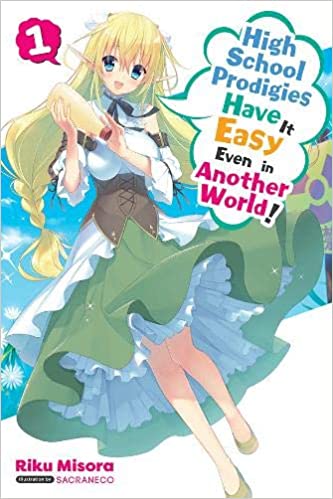
The gimmick here is that it’s an isekai times seven. Seven of Japan’s most powerful people, who are all teenagers and all friends, are swept away while on a plane trip to another world. We meet stereotypical samurai Aoi, morally terrifying doctor Keine, cowardly magician Prince, introverted inventor Ringo, arrogant businessman Masato, Prime Minister of Japan (in high school) Tsukasa, and “journalist” Shinobu, whose specialty is really being a ninja. Some of these are, obviously, more important than others in this first book, which focuses on Masato (in this volume) and Tsukasa (likely for all of them, he seems the “primary hero” sort). We also get Lyrule, who is the elf who is on the cover. She’s sweet, has a mysterious past, has a great figure, and she and Tsukasa bond almost immediately. In any case, this book focuses on them settling in with the village that rescued them and saving it from the local nobles, who are Very Bad Guys.

The author is also the writer of Chivalry of a Failed Knight, which is for magic academies what this is for overpowered isekai. Which is to say, the author wants to play in a fantasy world playground. There’s lots of ridiculous fun in this, from Ringo being able to build a nuclear power plant from scratch in about three months to Masato taking down the monopolistic trade company in the space of ONE DAY, to basically everything Shinobu says or does. (Who are secret ninja always named Shinobu?) We get a sense that each of the prodigies has their own tragic past – Tsukasa revealing his own father’s embezzlement leads to abandonment by his mother, and Masato’s father killed himself due to lack of money. I’m sure more will come in later volumes. And there’s also a lot of fun action sequences here as well, mostly due to Aoi, who is so terrifying bears run away from her, but also Tsukasa, who turns out to be well-protected against assassin’s bullets no matter what the world.

This series will, I anticipate, always be ethically suspect and have a tendency to fall apart if you look at it closely. But I had fun reading it, and will definitely get the 2nd book.
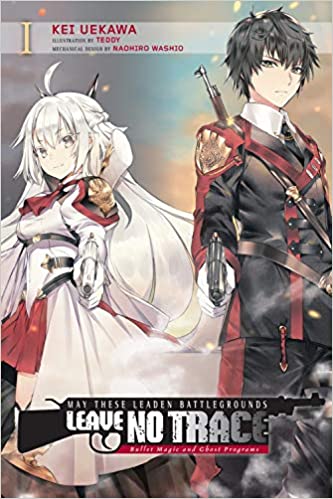
May These Leaden Battlegrounds Leave No Trace: Bullet Magic and Ghost Programs, Vol. 1

By Kei Uekawa and TEDDY. Released in Japan as “Uchinukareta Senjou wa, Soko de Kieteiro” by Fujimi Fantasia Bunko. Released in North America by Yen On. Translated by Roman Lampert.

It’s hard not to think about 86 when reading this new Yen On series, and I do wonder if war-torn teens fighting hopeless battles and getting blown to bits’ is a new light novel trend like villainess otomes. That said, if it’s trying to be another 86 it’s not too bad, getting a majority of the parts right. The main plot itself runs on a plot device I personally dislike, and there some tonal dissonance about a third of the way through, but when the book is being serious it’s very good at ramping up the tension and showing us a young, driven man who wants to end war and the white-haired, mysterious girl who is here to help him do so – and also tease and mock him, because it’s still a light novel. We even have an unlucky childhood friend of sorts. And while it doesn’t hit on ‘war is hell’ quite as much as 86, certainly war is not portrayed in a positive light here at all.

We open with Rain, a military academy soldier who manages to escape certain death by way of mysterious silver bullets he finds on the ground. Indeed, this war is run on ‘magic bullets’, each of which have a different function. The bullets Rain finds, when they kill a person, erases them and everything they achieved from existence. Later he discovers the owner, a young girl named Air, who arrives at the Military Academy where he normally is when war is not omnipresent and proceeds to explain that she is a ghost that is being forced to return whenever war is at its worst. She wants to use Rain to stop this endless cycle. Unfortunately, his partner and not-quite-girlfriend Athly is not happy with this, and what’s more, just eliminating the right people from history does not always solve the problem.

Let’s start with the issues I had. First of all, the ‘if you kill the man who invented cars there won’t be cars’ rule of time travel is very, very dumb. To be fair, near the end of the book we see that her analogy is not all it’s cracked up to be, but it’s still bad. Secondly, the section of academy life about 1/3 of the way through the book, which is meant to be a light-hearted bit of breathing space in an otherwise grim book, feels like it belongs in a different novel entirely. That said, setting up Athly as the cute normal girl with a crush on our hero does end up paying off later on down the line. As for Rain and Air, I am hoping, based on plot spoilers that I won’t get into, that they avoid their own romantic relationship. Honestly, romance seems secondary here to warfare, and that’s fine.

To sum up: this is a decent, solid debut for those who like grim war stories and fantasy/magic-based soldiering. I’ll be getting the next book.

Tearmoon Empire, Vol. 2

By Nozomu Mochitsuki and Gilse. Released in Japan as “Tearmoon Teikoku Monogatari” by TO Books. Released in North America digitally by J-Novel Club. Translated by David Teng.

A majority of the fun in Tearmoon Empire 1 was the dissonance between Mia’s actions, Mia’s reasons for those actions, and the narrator caustically calling her out for the reasons for those actions. That’s still very much present in the second volume – in fact, if anything the narrator’s malice is even more prominent. But something strange happened, because suddenly I ended up being less interested in Mia’s headspace and the silly misconceptions of the people around her and more interested in the world that’s been created here and what’s going on with it. And with good reason, too: here we find that Mia may have jumped back in time to try to make it so she isn’t executed, but that doesn’t mean that the forces behind the scenes are not still gunning for her, or that they don’t still need revolution to happen. Mia, after all, was not the Big Bad in the old world, just a selfish Royal. So can she not only save herself, but the future of multiple countries?

Mia has a lot to do here. It may be summer vacation, but she has to stop arrogant counts from destroying the forest of the tribe that ends up fighting against her in the future; deal with the man who personally executed her; and worst of all, her not-quite-boyfriend Abel’s country is undergoing a very familiar revolution. Fortunately, she still has the magic ability to have her every word and deed misunderstood in the best possible way, and it’s still just as funny. That said, as with the first book, sometimes the misunderstandings have a serious core, as we see her avert a genocide and, yes, stop a revolution, but also force the future rulers of these kingdoms to change the way that they think, and not be so quick to turn to execution and unforgivable actions. That said, don’t worry, the narrator is here to remind us that Mia is shallow and only thinks of herself.

(My pet theory is that these are books commissioned by a future Mia to counteract the slavish hagiographies that are being written about her.)

The narrator, as ever, is sometimes correct but also sometimes full of it, and even they have to occasionally stop and say “OK, Mia was being genuinely good here”. (For a great analysis of the narrator in this book, see this Beneath the Tangles article.) Actually, my favorite scene in the entire book shows us the bad future that Mia originally came from, where a desperate Ludwig is trying in vain to stop her execution, and he points out that Mia, once actually taken in hand and shown she’s being vain or arrogant, is taking pains to actually learn from her mistakes. (It also contrasts with King Sion, who in this bad future did not have Mia’s words to misunderstand and take as well-meant advice.) That said, as I indicated, the plot is the best part herre, with a lot of tension, some good action scenes, and a terrific denouement where Mia takes out the villain as only Mia can.

As with My Next Life As a Villainess, this book feels complete at two volumes, with the main future having definitely been changed and everyone being quite happy. Also as with My Next Life As a Villainess, there’s more books to come, and next volume may see Mia having to face an even more startling future. Till then, this remains an absolutely terrific series. The author recommends in the afterword it be used for book reports. Sounds good to me.