Der Werwolf: The Annals of Veight, Vol. 7

By Hyougetsu and Nishi(E)da. Released in Japan by Earth Star Novels. Released in North America by J-Novel Club. Translated by Ningen.

For the most part, Der Werwolf has been one of those reincarnation isekai series that tends to ignore the reincarnation most of the time. Veight’s old life in Japan is still mostly a blank to us, and aside from bringing in a few modern ideas to medieval fantasy land, it hasn’t really impacted this story either. That may be changing soon, however, as the cliffhanger at the end of this book seems to show us another Japanese reincarnation, someone who’s looking for Veight specifically. Before that, though, Veight has to finally wrap up this long story arc, helping Eleora to ascend to the throne, fighting off even more plots to try to usurp it from various lords and family members, march through sewers and jump out of windows like a boss, deal with a rival group of werewolves and also a few vampires, and, most importantly, get back home in time like he promised before Airia kicks his ass. He accomplishes… most of these things.

After a number of books that have slowly been killing off the royal family one by one, the theme of this book is trying to solve problems with the least amount of bloodshed. Veight is called “soft” a few times for this, and it’s not inaccurate, but it’s also very politically savvy. The book starts with Ashley on the throne, but he’s a bad emperor for these warlike times. There’s a lord who is clearly plotting… something, and the great joke about him is that every single thing he says is so suspicious that it’s impossible to know how many plans he’s got in his pocket. (Answer: a lot of plans.) There’s also the eldest princess, Dillier, who has grown tired of waiting for a perfect political marriage to be arranged for her and has allied herself with Lord Shallier, thus making one of the most awkward pairing names in some time. (ShallDill?) She’s not evil so much as fed up, so is a lot less difficult to stop.

This book is rather light on its usual tropes. Veight only mentions being a humble vie-commander once or twice, and may even be getting used to people thinking well of him. It helps that he runs into a bishop who is essentially his religious equivalent. Speaking of religion, these books have not been kind to the devout, and that doesn’t really change here, even though the church are not the bad guys this time around. Editing scripture to guide people into doing what you want is a total villain move, but here it’s being used for good. the book is light on Veight being oblivious to everyone being in love with him, too. Eleora clearly is but duty comes before love, so she lets him go. Airia clearly is and I suspect is wondering if she can ask for a kiss or something given Veight promised he’d do a favor for her (as punishment for being late in returning).

And there’s also the shrine maiden we meet in the cliffhanger. Is she going to fall for Veight’s charms? And we we finally get more details about why Japanese folks keep popping up in this world? Not sure, but Der Werwolf remains very well-written and confident. It’s one of the best under-the-radar J-Novel Club series.
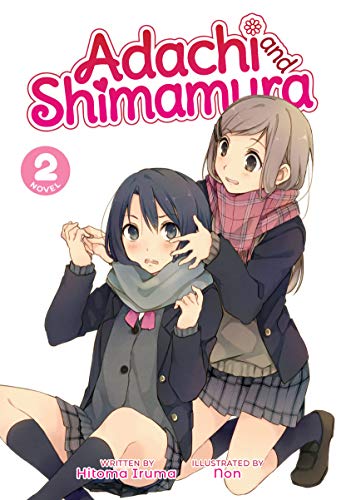
Adachi and Shimamura, Vol. 2

By Hitoma Iruma and Non. Released in Japan by Dengeki Bunko. Released in North America by Seven Seas. Translated by Molly Lee.

When I started this book, I had a very low bar I wanted it to clear, and to its credit, it did. I said on Twitter I was looking for Shimamura to be slightly more interesting and for Adachi to be slightly more gay. On one of those points, the book sails over the bar easily – Adachi’s freaking out about her love for Shimamura, what that says about her, what that says about Shimamura, trying to confess while also desperately hoping she is never found out, and (towards the end) realizing that yes, there is a physical desire in this love as well is probably the highlight of the book. As for Shimamura, sadly, she still narrates a large chunk of the book. She works best when around people more interesting than herself (i.e. the rest of the cast) and especially when she is dragged in an odd direction, which she just goes along with because she’s that sort of person. We saw this last time with the alien girl, and we see it here with her friend Nagafuji.

The book revolves around Christmas in Japan, meaning it’s a lover’s holiday, and also you eat fried chicken. Adachi, trying to convey her feelings without actually doing so, wants to invite Shimamura out to spend the day with her. The first third of the book or so has her working up the courage to do this. The second third splits our heroines into odd pairings – as I noted above, Shimamura and Nagafuji go to get a nice present for… well, for Adachi, but Shimamura, who is not completely clueless about what’s going on here, says it’s for her little sister. Meanwhile, Hino, the other half of “those two girls”, goes to the same mall with Adachi to help her get a present for Shimamura. In the final third, the two go on their not-date, have a relatively nice time, exchange presents, and Adachi tries to confess but doesn’t quite make it.

As with the last book, I think the strengths here lie in the unexpected making an appearance. In this book it’s the boomerang, a ridiculous present to give but also one that appeals highly to Shimamura, who falls in love with the image of Adachi throwing it. (Adachi isn’t wild about it, but it’s a present from the girl she likes, so it’s fantastic. She frames it on her wall. No, really.) I was also somewhat surprised that the book may be trying to pair the spares already, which given its tiny cast makes sense, I suppose. There are a few tiny scenes where you get the sense Hino and Nagafuji are also edging closer to each other, but again, they aren’t quite there. The entire book contrasts comfort (the same old thing every day) with danger (a risk of losing it all, but a big reward if successful. In the end, Adachi chooses to try to fall between the two poles, asking if Shimamura is not just her friend, but her BEST friend. Which, well, she is. For now, I guess Adachi will make do with that.

The flaws of this book are obvious: it still tends towards the dull and ordinary, and even the space alien girl is proving to be just another one of the cast now, hanging out with Shimamura’s younger sister. Oh yes, and there’s a jarring scene at the start when Shimamura, swimming at a fitness center, spots a creeper watching the little kids getting swimming lessons and saying “ew”. It’s meant to be slice of life, and I’m sure this does happen in Japan, but it felt out of place, and I wanted Shimamura to do something about him. Overall, though, if you liked the first book you should like the second. I do wonder how long it can string this out till Adachi finally confesses, though.

There’s No Way a Side Character Like Me Could Be Popular, Right?, Vol. 1

By Sekaiichi and Tomari. Released in Japan as “Yujinchara no Ore ga Motemakuru Wakenaidaro?” by Overlap. Released in North America by Tentai Books. Translated by Alejandro de Vicente Suárez.

One thing that needs to be made clear about this book’s basic premise is that it only works if our protagonist is using anime/manga terms to talk about real life. Tomoki goes on about the fact that he is a ‘side character’, the best friend to the real protagonist Ike (two syllables, I believe). Ike is handsome, popular, does well in school, etc. Tomoki, on the other hand, has the classic “resting bitch face” that makes everyone terrified of him, rumors of a violent past, and has trouble making friends. Um… Tomoki, I hate to break it to you, but Ike’s type is never, EVER the main character. You are. I therefore assume that he means the ‘main character’ of real life, sort of what the Japanese term ‘reajuu’ – someone who has it together. I will admit that between this, the artist ignoring all Tomoki’s descriptions in the text and drawing him as darkly handsome, and Tomoki’s obliviousness, this didn’t start well for me. That said, it was intriguing, so I read on, and it ended up being pretty decent.

The plot starts when Ike’s younger sister, Touka, a first-year, comes up to Tomoki and asks him to be her boyfriend. She has similar issues to her brother – popular, pretty, good in school – and has a desire to get rid of potential suitors, so needs Tomoki to fake date her. Or at least, so she says. In reality, she’s a lot brattier (and more interesting) than she lets on, and is doing this to try to divide Ike and Tomoki’s friendship. She runs into the brick wall that is Tomoki’s ability to read the room, however, so it doesn’t work, and his essential decency and ability to see her as a real person rather than as “Ike’s sister” lead her to gradually develop real feelings for him. This is upsetting to others, notably Kana, a girl who Tomoki sees as “constantly terrified of him” who, to the reader, clearly has a massive crush on him instead; Kai, Touka’s classmate who has a crush on HER and sees Tomoki as a thug; and Chiaki, their teacher, who… well, we dunno.

As I said, there are some things wrong with this book. It doesn’t start strongly, so bored readers might drop it. More importantly, it can’t decide if it’s a stand-alone or an ongoing series. We get little hints of backstory in regards to Tomoki, particularly from his teacher, who seems sad about something, and Kai, who at some point saw Tomoki beating up a bunch of folks (we see that as well on one of his dates with Touka – the guys are assholes trying to pick her up who go after him first). In other words, Tomoki clearly has a backstory desperately trying to be told. What is it? We don’t really find out here, sadly. On the bright side, Touka is great, striking just the right amount of “I am a brat but also cute” and showing greater depth than I anticipated. And, while initially aggravated at Tomoki’s cluelessness, I really liked that it’s explicitly supposed to be a function of his lack of social skills from ostracization, rather than a comedy “the girls are in love with me and I don’t get it because I am a protagonist” bullet – though it’s partly that as well, of course.

This is a debut from Tentai Books, and the translation seemed decent enough – if a bit over-colloquial at times. (That could simply be me disliking the phrase “smell you later”. On the other hand, “we live in a society, bro”? *chef’s kiss*) I’ll be interested in their other title as well, now. As for the book itself, good and bad, but in the end I did enjoy it, and want to read more, if only to find out what’s been going on before this story began. (That said, the 2nd volume has Kana on the cover, making me worry this will be a “save one heroine per book” series.)