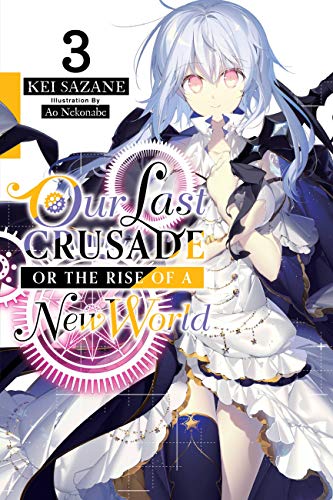
Tomo-chan Is a Girl!, Vol. 6

By Fumita Yanagida. Released in Japan as “Tomo-chan wa Onnanoko!” by Star Seas Company, serialized on the online site Twi 4. Released in North America by Seven Seas. Translated by Jennifer and Wesley O’Donnell. Adapted by T Campbell.

After the first volume, as I do with most series I follow, Tomo-chan Is a Girl! moved to Bookshelf Briefs. But sometimes you have things to say that cannot be condensed into 150 words, and this volume is a very good example – it’s almost the perfect Tomo-chan volume. We resolve Carol and Misaki’s romance, and given Carol possibly the best material she’s ever gotten, as Misuzu’s attempts to “break” her work all too well. The marathon chapter is one big long take on the Japanese saying “idiots don’t catch colds”, which Tomo proves wrong, to everyone’s shock and horror. And we get two chapter’s worth of flashbacks, showing how we got to the present setup – Tomo and Jun’s middle-school years, Jun’s own realization of his feelings, and possibly the most disastrous couple in the history of manga. If you love this manga series, this may be the pinnacle – there’s two more volumes after this, but it’s hard not to argue that this is the high point.

Carol has sort of been the breakout star of Tomo-chan, and her default reaction is, of course, smiles and good cheer. Now we, as the reader, and also Misuzu, have seen that cheer fall sometimes – notably when thugs were threatening Misuzu and she tried to protect Carol by saying they weren’t friends. But Misaki doesn’t see this, partly as Carol will never deliberately show that side to him, and partly as he’s scared to look further for fear there’s nothing behind her smile. Now, arguably Misuzu’s action here are appalling – something she realizes immediately. But they do work, and we get, as Tomo says, a wonderful few pages that show us that Carol can have real human emotions as well. (I was also amused at Carol’s mother cutting her off before she can go in for a kiss – given Ferris had Carol when she was thirteen, you can see why she’s going to step in. That said, given the omake chapter at the end, Ferris has little to worry about on Misaki’s end.)

I will admit that the two flashback chapters do run on a very old and creaking cliche, which is that Jun does not realize, for years, that Tomo was a girl, despite seeing her literally using the girls’ bathrooms at events. It always makes the main lead feel a bit too stupid, and it does here as well. But what follows is all too real and familiar, as Jun cuts himself off from Tomo after he doesn’t know how to be around her, and she too is hurt and retreats. Jun then realizes he needs to make an effort here, and does so… in a bizarre way. The brief, a few days relationship between Jun and Misuzu feels so wrong you want to scream, and both of them know it. Despite that, I loved that even though they knew that, both acknowledged that dating another person, having those feelings, felt good.

So we now have all the backstory, all we need to do is get Tomo and Jun on the same page and confessing. This has taken 6 volumes and we’re still not there yet, but the good news is that the end is in sight. Till then, Tomo-chan Is a Girl! is one of the best 4-komas I’ve read in some time. Funny and sweet.

Beatless, Vol. 1

By Satoshi Hase and redjuice. Released in Japan by Kadokawa Bunko. Released in North America digitally by J-Novel Club. Translated by Ben Gessel.

This is a doorstopper of a book, and I think my largest issue with it is that it could easily have been split into two normal-sized books. There’s a lot going on in it, yes, with a large number of very cool action set-pieces, but the book also wants you to know that it’s going to be talking about what hakes a human and what makes an artificial intelligence, and it does. In great detail. It’s quite interesting, but after a while it can be exhausting. I also wish we had spent a bit more time with hIEs (that’s the series name for the artificial intelligences mankind has built) other than the five main modern units, as they’re clearly meant to be more special and more human than the usual shopkeeper hIEs and the like. It’s a bit difficult to hear one of the cast talking about them as if they’re cars that can be sold when you get to see their POV briefly and see they do have wants and needs beyond their owners.

This takes place almost a century from now, where humanoid intelligences (hIEs) have gotten to the point where they’ve started doing the “drudge” jobs for humanity and also are hard to tell apart from humanity. Our hero is Arato, who at times almost seems a parody of “generic anime protagonist”. He’s aggressively normal, except for the fact that he always wears his heart on his sleeve and tries to think of everyone as basically kind. He’s also kind to hIEs, seeing them as people, which his friends Ryo and Kengo certainly don’t. His father is a major player in the hIE world, but we barely meet him. His sister is even a classic anime little sister. That said, it all changes when, coming across a bizarre flower attack on the hIEs in the street, he’s rescued by Lacia, a clearly far more advanced than the usual hIE who asks him to become her “owner”. He agrees, but she also has a lot of secrets – like how she’s connected to five hIEs who broke out of a lab and are being hunted down.

This book does get a lot of things right. Arato is simple and earnest without being boring, and you get why people naturally like him. Yuka is a spoiled little sister but also not annoying. Ryo, his best friend and the heir to a hIE organization, is probably the most interesting and nuanced character in the book, and we watch him slowly go from being Arato’s best friend to a villain in stages so gradual you barely notice it. The action movie set pieces are fantastic, the best being a massive firefight at an airport that also involves one of the cast trapped in a slowly burning limo. It does, however, love to have everyone and their brother talk about the role of hIEs in society, and whether they are like people (Arato’s view) or like toasters (seemingly everyone else’s view). Towards the end the book even becomes a zombie survival novel, but never lets go of the nature of hIEs even then.

Given its length, there’s a lot more I didn’t get into here, like Lacia’s modeling career, or the somewhat abbreviated terrorist career of Arato’s other best friend Kengo (who is then mostly removed from the rest of the book, presumably as his function is finished). I think it might read better if you pace it out over several days. I do recommend it for fans of action-filled works, near-future SF what-ifs, and of course those who have seen the anime.

Silver Spoon, Vol. 12

By Hiromu Arakawa. Released in Japan as “Gin no Saji” by Shogakukan, serialized in the magazine Weekly Shonen Sunday. Released in North America by Yen Press. Translated by Amanda Haley.

You can tell that the new year is starting in Silver Spoon because there’s a new freshman, and she’s interested in horses. This despite being in the dairy program. Again, it’s great to see that even at an agricultural school like Ezo, you don’t have to necessarily be slotted into the drawer that your family farm and/or business puts you in. It also once again shows the value of trying even after failure (she tried to get in on the science track, failed, and tried again on the ‘general’ track), which is good, as Hachiken is also dealing with some repeated failures in his life as well. On the positive side, his father is reading his business proposals and taking them seriously. On the negative side, they’re still not good enough, and he’s still not investing any money in them. That could change as we see the start of something that seems obvious but was never thought of much before: Hachiken needs to earn money and invest in his own business.

Of course, sometimes taking that once-in-a-lifetime chance can also lead to failure in the end – there’s a two-week student program in France that’s offered to Hachiken but he passes it on to cheese-loving Yoshino, who jumps at it… and then finds that for the two weeks, she’s at a high school specializing in fish. And yet, even with this obvious punchline, she manages to eat lots of French cheese and has a better idea about the direction she wants to go in. Any experience is good experience if it can show you a better way forward. That also applies to Komaba, who9 still has everyone telling him not to simply give up and abandon all his dreams, including his own family, and Mikage – indeed, the scene between him and Mikage is possibly the best in the volume.

As for Hachiken, he’s sticking with what he knows best – which is to say, pigs. Pigs and pizza. The section of the book dealing with pasturing pigs, free-range style, is fascinating, as with most of the “here is how you do agriculture” stuff in this series. He’s also found a way to solve the problem of Ookawa’s ongoing awfulness – hire him as company president, as when he’s working he’s far more reliable. It’s a character development that makes sense and is hilarious. As for romance, well, it’s pretty much on the back burner until Mikage manages to get into college – though that’s not stopping others (Sakae) from trying to get them to “go all the way”. And there’s also a suggestion that more equestrian action may be in his future – this despite the fact that he’s not picked for the preliminaries. They’re saving him! Again, seeing Hachiken from Vol. 1 and comparing him to this Hachiken is like night and day.

I’m not sure what to add. Another very good volume in a stellar series. Read it.