Seriously Seeking Sister! Ultimate Vampire Princess Just Wants Little Sister; Plenty of Service Will Be Provided!

By Hiironoame and Siso. Released in Japan as “Tonikaku Imouto ga Hoshii Saikyou no Kyuuketsuki wa Mujikaku Gohoushichuu” by TO Books. Released in North America digitally by J-Novel Club. Translated by David Evelyn.

I’ve talked before about how publishers can sometimes choose a title for a series that makes me want to run away rather than look forward to it when I reviewed Is It Wrong to Try to Pick Up Girls in a Dungeon?, a series that I think has lost a few readers who think it’s just a dumb harem series. (It *is* a harem series, but…) Similarly, when I saw the title of this book, I described it as ‘dire’. I owe it an apology; it has a few issues, but it’s actually pretty fun, and is not what I thought it would be, which was “vampire girl constantly glomps and feels up other girls”. In fact, consent is rather important in the one sorta relationship that exists in this book. (The amount of yuri you perceive in the book may depend on how you feel about “sucking blood = sex” motifs in vampire fiction.) No, what this is is another in the genre of “ludicrously OP girl boggles everyone’s minds”.

Ristia is a young vampire girl who is tired of being treated like a cute little sister by her powerful vampire family. She wants her own little sister to dote over! Sadly, vampires don’t procreate very often, so she decides to seal herself in stasis in a cave and wait for her little sister to wake her up. A millennium passes, and she’s women by Nanami, member of an adventuring party that’s run afoul of a dragon. Ristia can slay the dragon. Ristia can also get rid of morally bankrupt men, pull entire luxury houses out of her Item, Box, and create magical amulets that will literally regrow arms. But, she reassures Nanami, she’s just a normal girl. She ends up working for, and then taking over, an evil orphanage after purging it of its villains, and rebuilds it. To a ludicrous extent. And then starts a maid cafe. She can do anything… so why will no one see her as a little sister?!?!

A word of warning here, one of the girls in this book is a rape survivor, and it’s a function of her character and plotline. It actually felt rather odd to have a character like Maria is a story like this, which otherwise really enjoys leaning on the “silly” side of the fence. It should also be noted that Ristia looks like an older teen girl but that’s as a human; in vampire terms she starts the book pre-pubescent, and it’s her hitting puberty that also triggers part of the plot. My other major issue with the book is that it reads like it needed a better edit. The author comments on how they kept losing story contests for “bad structure”, and it’s still not that great; in particular, it reads like we get a little sister only to abandon her midway for a more interesting one. Don’t replace your cast halfway through a book.

That said, if you don’t mind OP characters, and can tolerate the word “normal girl” repeated so much it will make you sick (Nami from Zetsubou-sensei must be livid), this is a cute and fun read, and yes, has a little bit of fanservice and yuri, though not nearly as much of either as the title implies. So far this is the only volume, but there’s more of the original webnovel. I wouldn’t mind seeing more of Ristia.

Do You Love Your Mom and Her Two-Hit Multi-Target Attacks?, Vol. 3

By Dachima Inaka and Iida Pochi. Released in Japan as “Tsujo Kogeki ga Zentai Kogeki de Ni-kai Kogeki no Okasan wa Suki desu ka?” by Fujimi Shobo. Released in North America digitally by Yen On. Translated by Andrew Cunningham.

Since the last volume of this series came out in North America, the anime has started, and as such the series is even more well-known than it was before. Unlike some other Summer 2019 debuts I could mention (coughArifuretacough), the anime of Do You Love Your Mom? does not seem to have annoyed anyone who’s not already annoyed with the premise in the first place. I have been seeing a lot more criticism of Masato, though, and this isn’t a surprise. Indeed, it’s called out by the villain in this book. Shouldn’t he be the hero? Shouldn’t he get to do a cool thing once in a while? Shouldn’t Wise and Medhi be falling for him/competing for him? The answer, of course, is no, becausde the whole point of the series is that it isn’t that. This is a series where the mom takes over. That’s the PLOT. Masato’s journey, if anything, is to get on with him mom.

It’s a journey that may take a while – the entire series, in fact. Now, compared to everyone else in the series, Masato and his mother have a warm, loving relationship. But it’s clear that “my mom is embarrassing” is combining with “my mom is stealing my spotlight” to make for a very frustrated young man. In this book, he and his party reach a 100-floor tower with lots of monsters. A standard dungeon crawl. But there’s not much of that. Instead they take over an inn and fix it up, try to stop a bunch of thugs from blowing up the town, and (of course) deal with a whole bunch of NPC moms and their overly mom traits. The author in the afterword has to spell out that while these are stereotypical moms in every way, they’re not meant to be MEAN characterizations. The book is on Team Mom. Which is why the villain, a clumsy and rather airheaded women who wants to abolish all mothers, is as lame as she is. Well, that plus it’s funny.

As for the core cast, they’re much the same. Wise and Medhi sniping at each other can be funny, and I’m somewhat relieved that the sniping is not as one-sided as I feared it would be. As for Porta… yeah, there’s that implication towards the end. Porta being a sleeper agent for the bad guys is pretty much my number one theory right now, and the villain in this book does nothing to dissuade it. After all, we still know absolutely nothing about her own situation (is she even a PC?), and it would not surprise me if she winds up evil. That said, you know Mamako will just hug the evil out of her. Suspense is not the name of the game here, nor is adventuring and fantasy. The name of the game is watching Mom smother her boy with love while being ludicrously over the top – be it in killing monsters or in washing clothes.

I suspect the anime will end with this volume, and it’s a decent ending place given each book is mostly self-contained. Fans of Mamako will enjoy her being more Mamako than ever, and there’s lots of silly fun to be had here.

How a Realist Hero Rebuilt the Kingdom, Vol. 9

By Dojyomaru and Fuyuyuki. Released in Japan by Overlap, Inc. Released in North America digitally by J-Novel Club. Translated by Sean McCann.

While Souma is the focus of these books, he’s not the only ruler in town. We’ve seen some of them taken into his orbit, like Kuu. Some are allied with him but for their own reasons are separate, such as the Empress Maria (who I still say may eventually get into the Souma wife battalion eventually but not just yet). Some, like the Chima leader we meet in this book, are there to make deals using their popular and talented children as bargaining chips and marriage pawns. And then there’s Fuuga Haan, the leader of Malmkhitan, who by his sheer presence, inspirational qualities, and sheer power is the most terrifying of all. He’s compared to Oda Nobunaga and Napoleon in terms of the sort of leader who sets out to conquer. Which is not good news for Souma, who is not that sort of leader at all. Fortunately, Fuuga is on Souma’s side. For now. Fortunately, we also have Ichiha, the youngest child of the Chima ruler, who has a talent that no one recognizes. We know Souma loves those types.

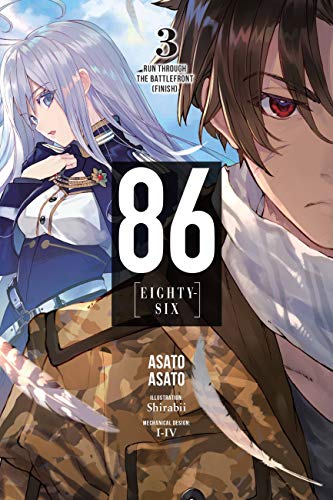
That’s Fuuga Haan on the cover, by the way. No, he’s there in the background, lurking like a Kirito in a Kirito-less book. In the foreground is his little sister Yuriga, who is introduced to us when Tomoe, who has come a long way from her shy little sister days of the early books, goes exploring in the Chima castle. There she runs into Ichiha, who she discovers is not only an excellent artist for his age but is also classifying the monsters into types and seeing what they have in common. Needless to say, Souma LOVES this. No, he’s not taking Ichiha as a spouse, Ichiha being a 10-year-old boy, but he was already going to be sending Tomoe to school, so Ichiha (otherwise useless to the Chima dynasty) gets to come along. But wait, you ask, what does the little sister to Fuuga Haan do? She’s there to be a tsundere. That’s… really it. But she’s also going to the school, and given how obsessed the author is with pairings, I would not be surprised to see her, Ichiha and Tomoe hooking up when they’re of age.

Yuriga is not the only little sister we get in this volume. The main plot of the book takes up about 2/3 of it, the rest being short stories set away from Chima. We get to meet Maria and Jeanne’s younger sister Trill, who should be romanized as Drill, I expect, except it would be one cutesy name too many. Trill is a mad scientist who’s obsessed with inventing new things and blowing holes in the castle by accident, not in that order. Naturally, she too gets packed off to Souma’s kingdom of babysitters, where she can be apprenticed to Genia, their own resident mad scientist, and do mad science together. Which in this case involves building a drill. Which means they need Kuu’s not-quite-girlfriend for the steel. Realist Hero is very good at interconnecting the huge cast it has, which is good as it makes it slightly easier to remember them.

Oh yes, and I forgot to mention: Souma and Liscia’s twins are born, a boy and a girl. Also, motherhood as converted Saber Red into Saber Lily. Now that the mother and children are healthy, there’s nothing stopping the wedding, which I suspect will happen next volume. It should be fun, as this volume was.