Cocoon Entwined, Vol. 1

By Yuriko Hara. Released in Japan as “Mayu, Matou” by Enterbrain, serialization ongoing in the magazine Comic Beam. Released in North America by Yen Press. Translated by Amanda Haley.

Hair.

I suppose I should go into a LITTLE more detail, but honestly, after reading the first volume of this new series, “hair” is going to be what everyone takes away from it. It is hair-drenched and hair-permeated, a story about a private Japanese Girls’ Academy whose very uniforms are created using the hair of their seniors, but even there you get the sense that the story is somewhat irrelevant, an excuse to simply draw hair in every possible way. Even the cover art gets into it – the front cover may look relatively sedate, but turn the book over and you can see the hair of the two leads tangling into each other, trying to be the best metaphor that hair can be. Which is good, as hair gets to be a metaphor for a lot here. In addition to hair, the story focuses on three students at the school, two of whom are what you’d expect, and one of whom seems to have wandered in from some other manga.

Saeki is the girl who crosses over into both storylines, the “prince” of the school because the school needs one, rather than due to any desire of her own, though she plays the part even as it exhausts her. She gets closer to Yokozawa, who is our “normal girl” viewpoint character, though Yokozawa’s tongue is a lot more acid than this sort of character usually is. They like each other. The third cast member is Hoshimiya, the granddaughter of the headmistress, who spends her days locked in her room and seems to have a far more casual attitude towards hair than the rest of the school (seriously, you can be expelled for your hair being too short). Hoshimiya seems to be ethereal to the point of ridiculousness, and even when she and Saeki escape the school and go all the way to the local docks, there’s no real escape.

This is, of course, meant to be a yuri manga. Yokozawa clearly likes Saeki, and the book ends with a kiss, albeit the usual “they’re sleeping but I can’t resist” sort. Saeki and Hoshimiya also clearly have doomed chemistry in that Sei-and-Shiori sort of way. That said, you could also argue that the story is horror. Aside from a few exceptions like Saeki, most of the cast is the traditional long black haired heroine, which fits the private school setting but is also a trope in Japanese horror stories. The gimmick of the student’s shorn hair being used to make the uniforms of the incoming students is milked for all its worth, with the uniforms seeming alive and described as breathing, and it is meant to be dream-like and erotic but also a bit creepy. Hoshimiya herself also makes me think of horror, and it’s worth noting that we never clearly see her face. Don’t be surprised if she ends up being a ghost or a Zashiki-warashi of some sort.

This was a riveting if somewhat baffling read. I’m definitely getting the second volume, but I’m not sure if we’ll stick with this cast or see it expand to other couples. That said, you don’t read this for the couples, you read this for the hair. Hair will definitely star in the second book.

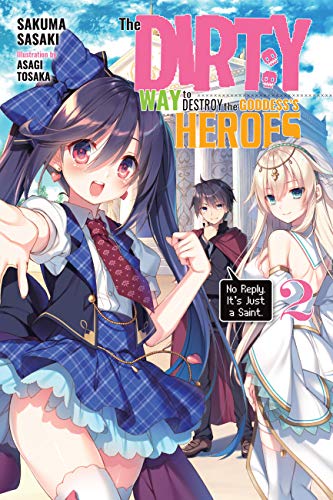
The Dirty Way to Destroy the Goddess’s Heroes: Damn You, Heroes! Why Won’t You Die?

By Sakuma Sasaki and Asagi Tosaka. Released in Japan by Famitsu Bunko. Released in North America by Yen On. Translated by Jordan Taylor.

I didn’t have high hopes for this title going in. Despite assurances from the publisher that it wasn’t THAT kind of dirty, the title still didn’t inspire confidence. It was also the most traditional “isekai” of this month’s debuts. But as frequently happens with things I read, as I got further into the book I found myself warming up to it. This is mostly thanks to the main hero, Arian, who is bright and shiny and yet also lonely and needs a friend. Had the book gone with the original set of heroes we meet, who are rather quickly dispatched, it might have been unbearable, just watching a Japanese guy with nothing to stop him become a sadist because it’s fun. (Indeed, we’re seen other light novels like this, though mercifully few have been licensed.) But Arian’s inner goodness causes Shinichi, the protagonist, to reach down and find his inner ethical sense, and so the last third of the book is actually pretty good, despite the appearance of yet another lecherous and corrupt bishop from a questionable religion.

Our hero is Shinichi, a standard young Japanese protagonist whose backstory is merely hinted at, but who seems to relish the opportunity to let loose in the situation he’s now in. He’s been summoned by the demon king to a) eliminate the heroes who keep attacking, and b) find delicious food for his cute daughter, as all the demon world food tastes awful. With the help of a sharp-tongued maid who rains abuse on him at every opportunity, he’s soon able to dispatch the first group of heroes through his prior knowledge of old-school RPGs and also by being a complete and utter bastard. However, the remaining hero that’s left to attack is not only far more talented than the previous heroes, but she’s also cute and a kind, good-hearted person! Can he find it in himself to trick her and save the demons?

There are, of course, still a few big flaws in the book. Despite a last-minute attempt to give him some inner monologue, the bad guy of this volume is (apologies for spoiling, but it’s obvious the moment he appears on the page) your standard corrupt and evil priest, in this case a bishop. Celes, the dark elf maid who accompanies Shinichi on his tasks, is so much like Ram from Re: Zero that I was almost calling the hero Barusu. Possibly as, while he shows signs of depth that may be explored in future books, Shinichi really doesn’t do much to stand out until, as I said, the last third or so of the book, where he uses his sadistic cleverness for good rather than evil. Well, OK, for the good of the demons, but they’re more interested in better food than attacking humans. On the bright side, I liked the relationship between Arian and Shinichi, though I’m sure it will be walked back a bit in the next book. Her immediate infatuation feels in character.

This isn’t the greatest light novel out there, but it gets better as it goes along, and there’s hints of some depth down the road. Recommended for isekai fans.

The Saga of Tanya the Evil: Nil Admirari

By Carlo Zen and Shinobu Shinotsuki. Released in Japan by Enterbrain. Released in North America by Yen On. Translated by Emily Balistrieri.

Sometimes war can be filled with pitched battles, back and forth action and excitement, and sometimes war can be filled with not a heck of a lot happening except people talking about tactics. The same holds true for Tanya the Evil, especially in this sixth volume, where action scenes are kept to an absolute minimum in favor of dialogue, inner monologue, and a lot of grumbling about the futility of war. Which, it has to be said, makes for a book that’s a bit of a struggle to get through at times. Most of the time Carlo Zen balances his dry military tactics prose with other scenes that pick up the pace, but we don’t have that here, so some of this book is simply boring. But not all of it. There is, once again, the threat of peace on the horizon, and Tanya is all for it, though she’s not the one in charge, and you get the sense that von Zettour is not simply going to agree to anything that isn’t “we win, and then discuss terms”. Winning, of course, is not happening right now.

The title is Latin once more, and means “Nothing Will Surprise Me”. That’s put to the test in this book, which sees the nation of Ildoa getting involved – seemingly to be a neutral broker for peace, but in reality looking to get the best deal for themselves by playing both sides. As the Empire is not-Germany, Ildoa is not-Italy, though their political leader seems to be nothing like Mussolini so far – Carlo Zen is avoiding the main Axis villains in this series. The Empire is understandably rather wary of Ildoa, who put on a show of strength that actually shows off that they don’t have much strength to back it up. Still, an overture for peace is a start. Certainly it’s what Tanya wants, to the surprise of everyone – possibly the funniest scene in the book is when she talks with Visha, Weiss and the others in her unit and realizes how they’re all warmongers, not realizing who trained this into them.

On the other side, we have the Commonwealth and the Federation still making very awkward allies, as they come to the realization that the Empire is far stronger than they had expected. (The Empire, of course, is coming to the same realization about their enemy.) Colonel Drake appears to be the Lergen of the Allied side, and he has his own Tanya analogue in Lieutenant Mary Sue, still bright and idealistic and shiny and driven by sweet, sweet revenge. “The Saga of Tanya the Evil” is a Western title, albeit one approved by the author, I believe – the Japanese title, Youjo Senki, translates as “The Military Chronicles of a Little Girl”. Tanya is evil in the sense that she’s working for the Empire, and she can be morally reprehensible at times, but she knows about war and why things happen. Mary Sue, though, can’t believe everyone doesn’t think the way that she does, and she’s a headache to everyone around her. I really want to see her and Tanya fight again – perhaps I should watch the movie.

So there’s a lot of talking but little forward movement in a book which sees Tanya’s unit going from the Federation to the Empire Homeland and then up towards the Entente Alliance in an effort to win the war. Which Tanya knows isn’t happening, but she can’t convince anyone else. A necessary read for fans of the series, but it’s really dry and dull at times, I admit.