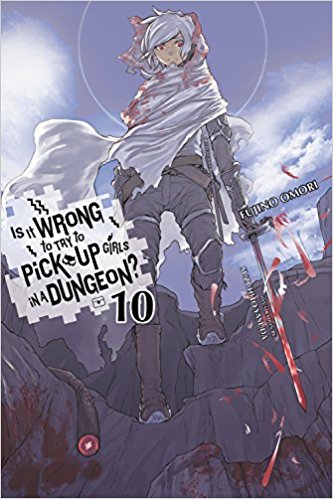
Is It Wrong To Try To Pick Up Girls In A Dungeon?, Vol. 9

By Fujino Omori and Suzuhito Yasuda. Released in Japan as “Dungeon ni Deai o Motomeru no wa Machigatte Iru Darou ka?” by Softbank Creative. Released in North America by Yen On. Translated by Andrew Gaippe.

DanMachi is not a game world per se, but it runs on game mechanics. Adventurer’s levels are literally written on them, and most of the plot involves killing monsters, drinking healing potions, etc. And this means that the villains tend to be mindless, unthinking monsters. Which makes for good fight scenes – in fact, it has to. If you hesitate or lose it for a moment, you’re dead. We’ve seen Bell Cranel and his group come perilously close to this several times. Be swift, be strong, and kill the monsters. That’s how you survive. So when Bell comes across a newborn monster that not only is not trying to kill him, but is crying – and can talk! – his world is upended a bit. And so is the reader’s, as it’s made clear that this is a game-changer.

The girl on the cover is the monster in question, a vouivre, which may require a little googling – it seems to be related to wyverns. In any case, she shows consciousness, awareness, and intelligence, something previously unknown in the dungeons. Bell being Bell, he decides to take her back to the mansion with him, much to the chagrin of everyone else, who would probably protest more if it weren’t for the fact that they’ve all been rescued from bad situations by him in the exact same manner. Naming her Wiene (not sure how this is pronounced – I went with “vine-uh” while reading), she learns incredibly rapidly, and also bonds with most of the family (sorry, Lilly, you’re destined forever to be the grumpy suspicious one) very quickly. The difficulty is with what she is. If monsters have intelligence now and can be nice, will that make adventurers think twice before killing them? That will lead to a lot of dead adventurers. How do you tell a populace born and raised on ‘monsters are evil’ that some aren’t? And if you spend your life devoted to killing monsters, and now some are folks like Wiene, are you a murderer?

DanMachi 9 doesn’t focus on these questions quite as much as I’d like, but it’s also not finished – the author apologizes for this being a two-parter, and says that the next volume will resolve the subplot. It becomes clear that this is an ongoing thing, and that some of the gods are trying to advance it – using Bell’s ever-loving kindness as a catalyst – so that monsters and humans can live together. Easier said than done, though. Speaking of catalysts, Hestia serves once more as an exposition catalyst, though honestly that’s preferable to some of her former jealous antics. She learns what’s going on, and what price her family could now pay… a price that I think the next volume may deal with.

As always, DanMachi is well-written, with excellent fights, nice characterization (less fanservice than usual this time), and smooth prose, so that you don’t tend to notice how much larger these books are compared to some other light novels. Is this new development going to change the course of the series? Or will everything turn tragic in Book 10? Luckily, as Vol. 9 was pushed back a month, we only have a 3-month wait to find out. Ignore the gimmickey title – this is one of Yen On’s best series.

Shojo Fight!, Vol. 1

By Yoko Nihonbashi. Released in Japan by Kodansha, serialization ongoing in the magazine Evening. Released in North America digitally by Kodansha Comics. Translated by Rose Padgett.

One of the benefits of the wave of digital-only titles we’re seeing in 2017 is the glut of a genre that was almost invisible until a few years ago – sports manga. Kodansha in particular has been pouring out titles devoted to soccer, baseball, soccer, rugby, soccer… and now we have women’s volleyball, with the emotionally gripping Shojo Fight!. You’d expect, given that all the male-oriented soccer manga run in either shonen or seinen magazines, that this might be a shoujo title. The title might also make you think that. But no, this runs in Kodansha’s Evening magazine, a counterpart of the mainstream Weekly Morning and the otaku-oriented Afternoon. So Shojo Fight! is reaching an older male audience. Fortunately, this does not mean that the series is filled with cheesecake. Shojo Fight! is a sports title first and foremost.

The series seems to begin in medias res, but it turns out that the first volume is about the end of middle school, and we’re setting up for high school to be the main event. Our hero is Neri, a strong but short young woman with a natural talent for volleyball and a tragic past, which keeps her mostly benchwarming. Her teammates include Koyuki, who is the school idol but whose volleyball skills don’t measure up as much, and Chiyo, who is absolutely furious at Neri and yells at her all the time in that “I am only angry because I see you have given up” sort of way. Neri is in danger of getting cut from the team, which prioritizes tall girls, and she seems to be OK with that, despite pushback from various others. One accidental injury later, however, and Neri is playing in a real game. Can she keep her emotions under control and not let the driving need to play volleyball take over?

It seems to be a sort of cliche to mention that the art in this looks a bit like OEL, so I will say that as well. More to the point, though, the art fits the subject matter. The volleyball matches that we see are straightforward, lacking the ‘cool’ art that we see from titles such as Haikyu!, but being quite understandable and easy on the eyes. I also really liked Neri’s facial expressions, particularly when she’s traumatized in the second half of the book. That dazed, emotionally hollow look makes your heart ache, and you’re grateful for her future coach (I assume) from coming by to stop her making a choice that would be terrible. I’d mentioned the lack of cheesecake: Neri’s male friend Shigeru is a massage therapist, and when Neri strains her back he massages her – in the girl’s bathroom stall, as student’s aren’t supposed to fraternize. It’s quite innocent, but turns into a nasty rumor that gets people punished, and the art shows both the innocent act while signposting how it’s going to be viewed.

It looks like the cast is going to expand vastly in the second volume, not unusual with sports titles. There are some eccentrics in the high school team, and I have to admit the idea of a barbed-wire volleyball net made me laugh. The series isn’t perfect (some of the exposition about the tragedy was really shoehorned in), but it was highly enjoyable, and I can’t wait for future volumes to see if Neri comes into her own as a player.

My Youth Romantic Comedy Is Wrong As I Expected, Vol. 3

By Wataru Watari and Ponkan 8. Released in Japan as “Yahari Ore no Seishun Rabukome wa Machigatte Iru” by Shogakukan. Released in North America by Yen On. Translated by Jennifer Ward.

In many ways this third volume of OreGairu actually moves backwards: having seen Hachiman seemingly blow up his burgeoning friendship with Yui in the second book, much of this third one consists of he and Yukino trying to get Yui to return to the Service Club, if only as the teacher demands a certain number of people in the club. They are impeded by Yui’s hurt awkwardness, Yukino’s inability to really interact with people normally, and above all Hachiman being who he is. The point of this series to a degree is amusing the reader with Hachiman’s narration and analysis of himself and others, and I am frequently amused. But I do hope that eventually we get some sort of deconstruction of this mindset or attempt to take it apart, because it also reminds you how incredibly annoying this kind of guy really is. For someone in their late teens, Hachiman must seem awesome. He frequently exhausts me.

Yukino, on the other hand, does get quite a bit of attention devoted to her as well, and we start to see a few reasons why she is the way she is, first and foremost being the appearance of her older sister. Haruno is bright, vivacious, communicative, and seemingly nothing whatsoever like Yukino… except Hachiman, who is quite clever in ways that don’t involve himself, realizes is a false front. I’m not sure if Haruno is meant to be a villainous character here – she doesn’t actually seem to be secretly needling Yukino as you’d expect if she were, and the delight over Yukino having a boyfriend seems genuine, false front or no. Yukino is also more apparently making an effort to get closer to Hachiman, though because of who he is and who she is, this doesn’t go far at all, even with Hachiman’s sister trying to set them up.

The book ends with a “bonus chapter” that is the novelization of a drama CD included with the volume, but you get the sense that if it hadn’t come with a drama CD the author would have included it anyway, as it’s in no way irrelevant. By the end of the story Hachiman and Yui have made up and gone back to baseline, they’ve all had a cute birthday party at a karaoke place, and Hachiman has had romantic thoughts about his cute male friend Saika about 80,000 times, which has gotten less amusing as the book go on, and I wasn’t all that amused by it to start with. That said, there are also some very funny jokes here as well – I loved Yui completely misreading Hachiman’s present to her, as well as the brief narrative from Shizuka’s POV, showing that the teacher is every bit as bad as the students who she’s trying to rehabilitate.

The main reason to read this is still Hachiman’s first person snark and the jokes. But so far if I wanted to read a series about a quirky cynical narrator and a frosty socially awkward brunette beauty, I have the Monogatari Series. I’m hoping that in the next book we try to do a bit more with these people than just circling each other warily and grudgingly getting along.