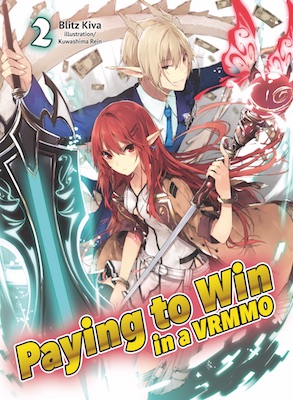
Paying to Win in a VRMMO, Vol. 2

By Blitz Kiva and Kuwashima Rein. Released in Japan as “VRMMO wo Kane no Chikara de Musou suru” by Hobby Japan. Released in North America digitally by J-Novel Club. Translated by Elizabeth Ellis.

Having established its premise and characters in the first book, the Paying to Win series goes about trying to tweak and fix a few things that weren’t as strong as they could be in the second. This involves a) introducing a new potential love interest who isn’t in middle school and Ichiro’s cousin, and is also able to be a little more critical of Ichiro’s callous lack of tact; b) have a flashback to show us how he managed to get so ridiculously leveled up before Asuha was able to join him, and also explain things like how he got a suit of armor that is literally a business suit. But most importantly, and most effectively, this second volume doubles down on showing you how obviously, knowingly, and teeth-grindingly irritating Ichiro is to everyone and everything around him, and the effect this has on both the secondary characters and the reader.

I cannot emphasize this enough: holy Mother of God, Ichiro is annoying. You will want to punch him in his cool, smug, self-satisfied face multiple times as you read this book. It’s far more clear in this second novel that it’s deliberate, and reader sympathy is meant to be with the young gamer and wannabe fashion maven Iris rather than him. He is the sort of character that, were he an antagonist or a villain, would receive the absolute best retribution possible, possibly while screaming “THIS CANNOT BE!!!”. Sadly, Ichiro is the hero, and the book’s whole purpose is that he really is this good at everything. Only King Kirihito was able to actually challenge him in the game, and since this is a flashback to the previous week, you know that he’s going to succeed at everything ridiculously easily here. That said, I liked his insistence that it doesn’t matter if Iris’ butterfly brooch is aesthetically good or not – he likes it, so therefore it’s fine.

Iris herself is a good character, far more developed than Asuha/Felecia, mostly as she gets to express everything the reader wants to. Every time Ichiro praises her creations, it sounds like he’s really calling them awful, simply due to how bluntly he speaks all the time. I liked the glimpses of her real-world life, and showing off how talented kids who are used to being the center of attention can get crushed when they go to a school that specializes in talented kids and realize other people are, in fact, better than they are. She also has a nice sense for biting retorts, as I’ve said. The author’s afterword says that webnovel readers have nicknamed her “the Evil God”, and I look forward to seeing why, though I can hazard a guess or two.

Other than Iris, the main reason to plow through this book despite Ichiro is the writing style – it’s funny and assured, and the narration has its own distinct voice, something I always enjoy. This is also due to the translation, of course, which is excellent – probably my favorite J-Novel Club translation to date in terms of noticing the quality (though Sera did get gendered at one point, which only serves to remind us how ridiculously difficult it is to avoid giving away gender in English). Recommended to anyone who loves seeing smug jackasses win effortlessly and be smug about it. Also, bonus points for having Voltron show up, only one volume after the SAO sentai team parody.

The Water Dragon’s Bride, Vol. 1

By Rei Toma. Released in Japan as “Suijin no Ikenie” by Shogakukan, serialization ongoing in the magazine Cheese!. Released in North America by Viz Media. Translated by Abby Lehrke.

Holy catfish, this is dark. Don’t be thrown off by the cutesy picture of the heroine looking adorable on the cover, this is a fantasy that comes close to pure horror at times. Starting off with every parent’s worst nightmare, we move from crisis situation to crisis situation, and it’s a small miracle that Asahi (the aforementioned heroine) manages to be as strong as she does throughout. The water dragon in question is one of those “what are these strange things called human emotions” types, who has to be reminded of things like “humans eat in order to stay alive” She manages to find a good friend in a small village, but sadly Subaru’s mother comes from the School Of Evil Moms (TM) and Asahi ends up in probably worse trouble than if she’d just stayed hidden. There’s a lot going on here, so it’s a good thing you can’t tear your eyes from it.

We actually start off in modern times, as Asahi is a normal and seemingly somewhat spoiled girl who ends up being literally dragged into her family’s backyard pond by a wave of water and winds up in a fantasy-style world. (I have a sneaking suspicion the parents will never be seen again, and shudder to think of their reaction to their daughter literally vanishing when they turned away briefly.) Luckily, she meets Subaru, a nice young kid about her age. Sadly, she has pink hair and purple eyes, something that this world does not seem to have run across, and therefore must be EEEEEVIL. As a result, they perform a ritual to the local Water God and offer up Asahi, which is to say they tie a large rock to her ankle and throw her to the bottom of the lake. Then she meets the Water Dragon, who reminds me a bit of Ayame from Fruits Basket. Sadly, it’s Ayame before he grew up and wised up, so he’s pretty much a callous jackass.

Things move on from there, and I won’t keep describing the plot, but I will once again say that there’s some amazingly traumatic stuff in here, and the artist captures it beautifully. Asahi’s sacrifice, the starvation, the skeletons in the water, the hallucinations of each other that she and Subaru see… there’s a good reason this runs in shoujo/josei hybrid Cheese! and not, say, Ribon. That said, it’s not all doom and gloom, mostly thanks to Asahi’s basic spunky personality, as even when she’s despairing she still tries hard. And there are a few laughs in the book, mostly involving the Water God getting roundly mocked by the other nature gods for being, well, a petulant manchild. I have no doubt that his maturation, with the help of Asahi, is the point of this book. That said, Asahi is about 8-9 years old, so if it does end up being a romance I’m rooting for her kid friend rather than the God. I suspect a timeskip in the near future.

In short, I was somewhat blown away by this new series. Dark it may be, but I can’t wait to read more.

Assassination Classroom, Vol. 15

By Yusei Matsui. Released in Japan by Shueisha, serialized in the magazine Weekly Shonen Jump. Released in North America by Viz. Translated by Tetsuichiro Miyaki. Adapted by Bryant Turnage.

(This review talks about *that* spoiler, the one everyone already knows, but I thought I’d warn you anyway.)

Now that we have the North American Weekly shonen Jump magazine, serializing the popular series at the same time they come out in Japan, surprises are very difficult to hold on to. Doubly so here, as the anime has also aired. But at the time when the Kaede Kayano revelation came out, it was quite a surprise, trust me, and everyone went back to look at their previous volumes to see if this was something truly planned fro the beginning or something that the author came up with on the fly. He helpfully tells us that it’s the former, showing us tiny specs of art that hinted that Kayano was Not What She Seemed. And this extends forward as well, as Kayano is in reality the younger sister of the class’ former teacher, who she alleges that Koro-sensei killed. How that happened is apparently part of the next volume. Yusei Matsui really ties this together beautifully, making it one of the best volumes in this already excellent series.

I’ve complained a few times about how, given she’s the closest thing we get to a female lead among the students, Kayano’s character has been somewhat flat. Now it turns out that this was not only deliberate but engineered on her part, trying not to attract too much attention and therefore setting herself up as the cute but plain friend of the real “main character”, Nagisa. The flashbacks not only show the lengths she went to to engineer her attack on Koro-sensei (who, as she reminds us herself, she named in the first place), but also the tremendous pain that hiding her altered state has caused her over the past several months. It’s been the perfect acting job. That said, sometimes you can get too caught up in your role, and Nagisa sees what Kayano isn’t letting herself – that she really has had fun in this class, made true friendships, and most importantly, has seen that Koro-sensei is maybe not the sister-murdering monster she thought.

This leads to the funniest scene of the volume, where Nagisa has to stop a dying Kayano from burning out her brain due to overuse of her tentacled form. He does this by a callback to Irina’s ‘foreign language techniques’, essentially kissing her into submission. Not only is this great ship fodder for fans of this pairing (and no doubt very annoying to Nagisa/Karma fans), but we also see Irina saying that he could have done better, the other students muttering that *they* could have done better, and Karma and Rio getting pictures and video of the whole thing on their cellphones, because they are glorious assholes. The entire scene just calls out how well-written the whole series is.

There are other things going on here, mostly in the first half. We learn about the principal’s past, which shows – surprise! – that he’s a former idealist who had tragedy turn him to the dark side. And the Peach Boy play, which is hysterical and also features a glorious moment where they discuss Kayano acting in a lead role, and she quickly ducks and says she’ll be in charge of props. (Highlights of the play discussion also include Irina suggesting the student’s do a strip show, and Karma suggesting Nagisa act in drag as Sada Abe (which Viz, wisely probably, forces the curious to Google). If you avoided the series before because it looked too silly or the premise was sketchy, you should definitely catch up, as it’s top tier Shonen Jump. And if you already read the weekly chapters and saw the anime, buy this anyway, as the reread factor is high.