Platinum End, Vol. 1

By Tsugumi Ohba and Takeshi Obata. Released in Japan by Shueisha, serialization ongoing in the magazine Jump Aquare. Released in North America by Viz. Translated by Stephen Paul.

The creator team of Ohba and Obata has brought Japan and North America some of the most iconic manga out there in Death Note and Bakuman. In addition, Obata’s art has also been seen in Hikaru no Go, All You Need Is Kill, and, erm, School Judgment. OK, possibly not that last one, but otherwise, they’re all acknowledged hits and big influences. So I always feel guilty that I’ve never really warmed to any of them. I found Hikaru no Go pretty dull, Death Note’s nihilism wasn’t my bag, and Bakuman’s casual sexism rubbed me the wrong way. Yet hope springs eternal, and here they are with a new series. Can they build on the strengths of past works, or will I be grinding my teeth again?

platinum1

A little of both, really. I’m not as familiar with Death Note as most other readers are, mostly as I didn’t warm to its premise so never really read it, but it strikes me that a lot of the same themes I hear that it had are cropping up here. Our hero, Mirai, begins the story as, sadly, many manga protagonists do, by resolving to kill himself. He ends up being saved by an angelic being, Nasse, who explains he’s been chosen to participate in a war of sorts to see who gets to become the next God. He also has powers to a) fly, and b) make someone fall madly in love with him… for 33 days. Naturally, there are other participants as well, from the sleazy (a guy who decides to use the love arrows for orgies) to the so-called moralistic (the guy who becomes a vigilante superhero), to the girl Mirai has a crush on (who is the cliffhanger ending).

Ohta and Obata love grey, morally ambiguous works, and this is no exception. The star of the volume is without a doubt Nasse, who would love it if Mirai simply used his newfound powers a lot more indiscriminately. She’s supposedly an angel, but is 100% fine with murder and other morally reprehensible acts. Luckily, Mirai isn’t, and after his first horrific but accidental use of his powers, tries to think seriously about what to do and how to use them carefully – especially as he realizes that the God War involves killing off every other candidate. Nasse, though, is fine with absolutely anything as long as it gives him “normal happiness”, whatever that is, because that’s what he wished for from the start. It’s really creepy, to be honest.

Where the manga succeeds is where all Obata manga succeed – the art is fantastic, with dynamic poses, violence and fanservice when it’s appropriate, and a nice ability to read the character’s emotions from their expressions rather than just the dialogue, something many other artists have issues with. And the premise looks like it could go to interesting places… or nasty ones. The odd morality of the angels, though, reminds me more of Franken Fran than anything else, and likely will determine if I continue this series or not.

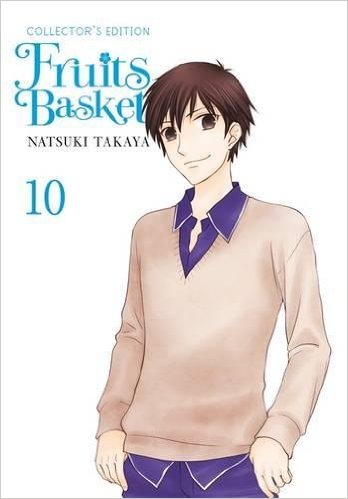
Fruits Basket Collector’s Edition, Vol. 5

By Natsuki Takaya. Released in Japan by Hakusensha, serialized in the magazine Hana to Yume. Released in North America by Yen Press. Translated by Sheldon Drzka.

Fruits Basket is, in large part, about a family and its cycles of abuse, and how it makes everyone suffer and endure. That’s why it’s so nice to see, in this omnibus, that there are at least one or two of the main characters whose families are not torn apart by physical abuse, hatred, neglect, suicide, or death. Hanajima during her childhood is, unlike what I talked about with Hiro last time, going through something that the reader is not going to understand, and she really needs to have someone that’s in her corner besides her little brother. I love the fact that immediately after Hana decides to be friends with Tohru and Uo, despite the fact that she may hurt them, she gains control over her powers, as if a switch is flipped. And then there’s Hiro’s mother, who is not only the one Sohma who unreservedly loves her child, but is also pregnant again, which makes everyone happy because the kid can’t be cursed, as all the Zodiac exist already. (More on this later.)

furuba5

There’s actually quite a lot of setup for future plots and pairings here, as clearly Takaya has been told that this is a big enough hit that she can take as much time as she wants. (Ironically, this is also where she hurt her hand, so a long hiatus came between the last volume and this one. The art style will eventually be greatly affected by this, but not just yet.) We meet another Sohma, but not via Tohru and her all-loving heart – this time it’s Uotani, who runs into a handsome yet absentminded young man in her part-time job and seems to fall for him immediately. (The fact that she says he reminds her of Tohru does not help Furuba’s yuri fans at all.) But Kureno seems to be more attached to Akito than the other Sohmas are, and therefore nothing really happens with it.

And then there’s Mayu, who we’ve met as the teacher of Tohru’s class, and were also told was close friends with Kana, Hatori’s lost love. Here we learn that she was in love with Hatori herself, but was so determined not to get in the way that she ended up dating Shigure, even though they’re clearly toxic for each other. (I suspect Shigure enjoyed this more… he seems to love toxic relationships.) Hatori is the stoic type who’s unable to grieve, and so Mayu is the one that grieves for him, for the life that he was never able to live. And Shigure is the manipulator who enjoys both messing with people for the lulz and also giving hem a push whether they want it or not. It’s quite interesting that this arc ends with a flashforward that shows Hatori and Mayu, many years later, together – things will change soon.

There is, of course, drama here as well, most of it stemming from the trip to the beachhouse the Sohmas take during their vacation. (We do meet Kyo’s father, and it is important to Kyo’s character, but he’s so unpleasant and awful I’d rather just not talk about him.) Hiro continues to lash out at things he finds annoying, and Tohru, who is effortlessly close to Kisa in a way he can’t seem to manage, is the biggest thing. It’s quite telling that Hiro is upset at Tohru’s obsession with her late mother – he’s the only one in the entire group who’s always had a warm and loving mother, and so he can’t possibly understand why she would be like this. Kyo, whose mother, it is heavily hinted, killed herself, gets Tohru far better, and immediately figures out that a) Tohru isn’t her usual self, and b) it’s probably because Hiro was rude. He’s maturing rapidly.

The book ends on an ominous note: Akito has followed the Sohmas and is at a neighboring beachhouse, and they all have to go visit – bar Tohru, who is thankfully not invited, and Kyo, who’s always excluded. Kisa being thankful Tohru won’t be there as she worries that Akito will abuse her is one of the saddest moments in the entire book, and will carry over directly into the next omnibus, where Akito decides to pay Tohru a visit after all. Again, if you haven’t read Furuba before, do so, and if you have, these omnibuses are a good opportunity for a reread.

My Pathetic Vampire Life, Vol. 1

By Ishikawa Rose. Released in Japan as “You no Ataranai Koide-kun” by Futabasha, serialization ongoing in the magazine Monthly Action. Released in North America by Seven Seas. Translated by Amber Tamosaitis. Adapted by Carol Fox.

This is, of course, one of the most inevitable titles ever. Japan loves vampire manga. Japan also loves its laid-back school comedies where nothing happens over the course of several volumes. Why not combine the two? But this particular title I think leans a bit too hard against the latter rather than the former. A complete lack of conflict, despite creating many obvious points where conflict could be achieved, makes this manga seem very underwhelming, as if it’s content to simply ride along on its premise: what if a couple of vampire bros had to live the same year in school, over and over again?

pathetic1

Koide is the main character here, a vampire who is governmentally mandated to stay in high school, since he’s still 16 years old. It’s just that this is the 150th year in a row he’s been 16. And of course, being a vampire, just being near the sun is enough to make him collapse. Luckily, he has a few things going for him. His friend Miura is three times his age, so you’d think would be suffering even more, but seems to have come to terms with it. (He’s a bishonen, which helps – Koide has more of a “I just got out of bed” look.) This could be Koide’s year, though – his classmates seem less concerned than usual about his being a vampire (put politely – put impolitely, they’re a bunch of clueless idiots), he has a couple of girls who seem to like him (though he’s mostly completely indifferent to them), and his teachers are there to help him out (even if the school nurse is a bit creepy). What’s not to love?

You know a slice-of-life title is having trouble when I keep wishing that it would turn darker and more serious. There’s lots of ways this series could have done that. The mere fact that there’s a government crackdown on vampires is a fascinating backstory that’s mostly just used as an expositional gag for why they can’t turn the nurse (who desperately wants to become a vampire, as he’s part of “the Haruhi generation” and would like more excitement). You’d think a lot of the plot would revolve around keeping their true nature hidden from the class, but no, the entire class knows they’re vampires, and are totally cool with it. Even Miura’s somewhat serious backstory of being beaten by farmers in the middle ages is used for humor value.

There are certainly amusing moments throughout – I like Koike’s accidentally antagonistic relationship with the girl who sits next to him, as keep depressing each other without meaning to. The class rep’s attempts to have the class get to know Koike are both well-meaning and awful in the best way, and the ‘i have never seen a photograph of myself for obvious reasons’ chapter has a terrific punchline. But I cannot help wanting to shake the author and say “you could have done so much more with this!” It’s a perfectly acceptable slice-of-life comedy that is content to coast.