Haganai: I Don’t Have Many Friends, Vol. 14

By Yomi Hirasaka and Itachi. Released in Japan as “Boku wa Tomodachi ga Sukunai” by Media Factory, serialization ongoing in the magazine Comic Alive. Released in North America by Seven Seas. Translated by Ryan Peterson. Adapted by Ysabet Reinhardt McFarlane.

(Note: please do not post light novel spoilers in the comments.)

Most harem manga these days have to walk a very thin tightrope, especially in a modern, internet-forum friendly world. readers want the hero to end up with the girl they like best, and every time that things return to the status quo they are upset. Writers and editors want this to be successful for as long as possible, which means stringing things out and returning to status quo without making it look too obvious. With Haganai, the Neighbors Club has been the way to do this, as each of the cast is so socially inept that even basic interaction is a challenge, much less having a significant other. Or at least, that’s what Kodaka tells himself. In fact, Kodaka is very good at lying to himself and others, and the astute reader of Haganai has, through several books now, been feeling more and more like Rika, watching this play out and getting increasingly angry. This is the volume where that rage finally explodes.

haganai14

This kicks off with a seeming resolution of the perpetual love triangle between Kodaka and the two female leads. Yes, there are more than two love interests, but at heart it’s always been about Yozora vs. Sena. More on Yozora later, but I felt that Sena’s confession was first rate. Yes, it started out as her seemingly talking to herself while gaming, as if practicing for later, but once she realizes what actually happened, she doesn’t back off. This makes a start contrast to Kodaka, who literally runs away as fast as possible and hides from the rest of the club for days. His desire for stasis has never been more contemptible than it is here, particularly given that he spends said days with the Student Council, the Neighbors’ Club’s mortal enemies. To his surprise, they don’t view him as a thug and a bad person, and we see just how much of Kodaka’s self-worth problems are his own doing.

Then comes the scene with Rika. (Yes, there’s a nice scene with Yukimura as well, but while it’s heartwarming, it’s all setup for that one gag. You know the one I mean.) Rika already confronted Kodaka last time about his perpetual “Huh? What was that?” response, and was seen to be barely holding it together. Now she explodes, and it’s glorious. Kudos to Itachi, by the way: the art in Haganai has frequently taken on a sketchy, exaggerated look at times, particularly when it’s funny, and it doubles down on that here, with some amazing faces that would not look out of place in a horror title. Rika beats the shit out of Kodaka (scientifically, of course) as she rants about what she learned from Sena. She’s absolutely right, of course. Of all the girls in the series, Sena has gotten twice the romantic subtext as anyone else. And he’s running away from this because he can’t face up to her actually liking him as more than a friend.

Haganai is caught up with Japan, so it will be many months before we see the next volume. But now that Rika and Kodaka have admitted hey are indeed friends, can he man up and listen to Sena? More importantly, what about Yozora, who seemingly heard this entire exchange, and whose devastated sobbing face ends this arc? The artist notes that the manga may be a bit different from the light novels, though it’s unclear if that means additions or actual changes. In any case, for those who were waiting for the payoff in Haganai, here’s where it starts.


The Isolator, Vol. 3

By Reki Kawahara and Shimeji. Released in Japan by ASCII Mediaworks. Released in North America by Yen On. Translated by ZephyrRz.

It is rather startling how little time the main events of The Isolator are taking place over. The eyes descended to Earth three months ago, despite the presence of what seems to be a long-standing secret organization dedicated to harnessing their power. It’s only been a day or two since the events of Book 2, as well, and this book also only takes a couple of days. And at the end, they’re discussing invading the enemy’s stronghold. I’m not sure how long Kawahara intends for this series to go, but I don’t think it’s meant to be that long. Though, given there’s an anime coming out this Winter, that may change if it gets popular enough. In any event, a new volume of The Isolator, and hey, a new cover girl.

isolator3

Yes, after getting the first two covers to herself, Yumiko is forced to give way to Suu, who really should be invisible on the cover, but a) that would give the game away, and b) that would mean there is no cute girl on the cover. Yes, Suu us a teammate of the group who can turn herself invisible (with the exception of her pupils), and as with all the other characters, it stems from past personal trauma. I was wary of getting too attached to her – literally everything she did from the moment she showed up to her final sacrifice screamed “I am going to die so that the main guy can learn a valuable lesson”. Fortunately, she doesn’t quite die (though if Book 4 takes place right after 3, she may not appear much), but the lesson is still learned.

Minoru and Yumiko continue to be the stars of this book, thoguh Suu obviously steals Yumiko’s spotlight a bit, something she is keenly aware of – her discussion with Minoru about her jealousy is possibly the best hart-to-heart they’ve had so far. And Minoru continues to find new ways to use his talent, turning the ability to isolate yourself in an impenetrable sphere into an actual dangerous weapon. Which is good, because the new villain of the book we meet, Trancer, manages to get away along with his boss, who is more of an arc villain. (You can tell that we’re not done with Trancer as we still haven’t heard his tragic backstory beyond that apparently he has his childhood friend frozen in ice somewhere.)

The Isolator continues to have the same strengths and weaknesses the previous two books had. The strength is the action scenes which are really first rate – it’s a short novel, but the pacing is perfect, and there’s lots of cool superhero moves on display. The weakness continues to be that, despite best efforts to try to inject levity into the series at odd points, this is still the most straightfaced and serious of Kawahara’s books, and given the incipient tragedy at the back of everyone’s lives, it can get a bit depressing if the reader isn’t prepared for it.

I’m not sure where the series goes from here – the next volume isn’t scheduled in Japan yet, so it will likely be at least a year till we see it – but I’m still on board. I just wish we could add a goofy ditz or a perverted best friend or something to take the edge off.

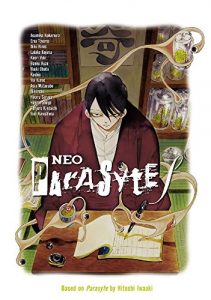
Neo Parasyte f

By Various Artists, based on the manga created by Hitoshi Iwaaki. Released in North America by Kodansha Comics. Translated by Kumar Sivasubramanian

I have fond memories of Parasyte, despite never having actually read it. It was one of the first four titles that Tokyopop put out when it began, along with Sailor Moon, Magic Knight Rayearth, and the long forgotten Ice Blade. Unlike Ice Blade, Tokyopop actually finished the series, but it was always a sort of cult hit over here, known mainly for its odd sense of humor and its startling decapitations. I was pleased when Kodansha decided to release the updated Japanese version in 8 volumes, and that sold considerably better than the first time around, as the market was much better prepared for it. And now we have this anthology, which on the face of it is even more bizarre: taking a horror series that runs in a seinen magazine and giving it to various Japanese shoujo creators, to see what they make of it.

neoparasyte

Of course, anyone who knows Japanese shoujo knows that they are very familiar with the horror genre. Indeed, some of the artists in this anthology are best known over here for their shoujo gore, such as Kaori Yuki, whose tale of a twisted love triangle and a spoiled princess would not feel out of place in her other works. Parasyte filled a number of niches, and this anthology does a very good job of showing off why people liked it. There’s actually very little pure horror, as for the most part the artists try to do their own thing. As you’d expect given the genre, there are quite a few high school romances in here, some tragic, some heartwarming, and some with a twist that is both predictable yet also startling – Parasyte’s stock in trade. Miki Rinno’s story of a genki girl whose mind has broken a bit by the slaughter of her family as well as a parasyte inside her is particularly good.

That said, I think it may be the humor that draws in readers, and there’s a lot of that. From a fujoshi who uses her Parasyte to pair up hot guys (by Ema Toyama, the author of Missions of Love), to Parasyte cooking shows and otome games, there’s a lot of simply having fun with the premise. And for those who wonder if it’s all original characters, fear not: Shinichi and Migi are sprinkled throughout the book. Indeed, the story by Mikimaki of Migi shifting himself into various shoujo girls may be the funniest in the book. And sometimes I laughed even when I may not have been supposed to – Asia Watanabe’s somewhat disturbing take of a young girl in the thralls of puberty and her teacher, a priest (both of whom harbor parasytes) features a dizzy blonde girl named Luna, and it’s impossible not to see her as Luna Lovegood from the Harry Potter books.

So if you loved Parasyte, you’ll get a kick out of this book. But even if, like me, you never actually read the original, you may still find something here. The art is striking throughout, and there’s a lot of really good stories – I hadn’t even talked about the story by Kashio about a telepath who runs into a transfer student with a parasyte, which is tense and thrilling. I’d love to see more of these Anthologies from Western publishers.