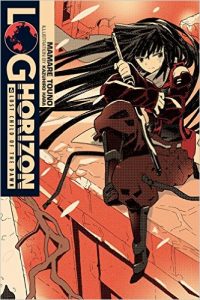
Log Horizon: Lost Child of the Dawn

By Mamare Touno and Kazuhiro Hara. Released in Japan by Enterbrain. Released in North America by Yen On. Translated by Taylor Engel.

While Log Horizon is well known for its large cast, and has featured chunks showing us the viewpoint of other characters, there’s no doubt about the fact that Shiroe is the star of the series. He’s the planner, the blackmailer, the one who achieves things for the best. And yes, he also dithers and frets, mostly due to his non-outgoing nature. Still, we’ve become fairly comfortable that a new volume will have us getting inside his head again. But this volume shakes things up a bit, as Shiroe (along with Naotsugu, I assume) is away for the entire volume, off on a secret mission. And with Krusty and his group also away on a mission, Akihibara is, with the exception of the harem leader Soujiro, almost entirely female this time around. And that’s definitely a good thing.
loghorizon6

The lost child in the title is Akatsuki, who gets the bulk of the narrative this volume. She’s still reeling from the revelations from the last volume, and the absence of Shiroe is not helping matters. Akatsuki is naturally shy and introverted, and even though gaming is, as she’s said, a way to be something that isn’t yourself, now that they’re actually IN the game, it’s still hard for her to interact with others. And that’s actually affecting her growth as an adventurer as well – she’s never done raids, and so hasn’t gotten any of the elite weapons and other loot that drop only during those group activities. She knows this, but can’t move past that wall she’s achieved, and it’s coming out as a giant pile of self-hatred. Fortunately, Shiroe has asked her to watch over Reynesia, as have several other guilds, which leads her to be forced to interact with others. Less fortunately, a murderer has come along to force her to change or die.

Of course, Log Horizon doesn’t have permanent death, but they do lose memories. And death also hurts. And, well, the idea of an unstoppable killer walking around at night is just scary. The climax is the best part of this book, as we get to see a lot of the characters we’ve come to know over the last few books (as well as some new ones, like Rieze, one of the subcommanders of Krusty’s group showing off their strengths and also showing off the character development for Akatsuki: you need to be able to ask for help, and you need to be able to accept that help from others. Akatsuki learns that, and is rewarded by being the one who gets to deliver the final blow (as well as a really cool new sword, which is nice as well.) Meanwhile, Reynesia is busy learning the opposite message: sometimes you can’t push things off onto others, but you have to take responsibility yourself. She’s maturing into an excellent leader.

Those who watch the anime of this series may be a little startled. Not only is it only the Akatsuki plot, with Shiroe absent, but the anime added a lot of comedy and a lot of extra scenes (the book ends very abruptly with the end of the murderer – the anime expands on the mentioned pajama party afterwards). But that’s the benefit of different mediums. Those who enjoy Log Horizon’s action and drama but feel that sometimes it’s a bit TOO light-hearted can revel in the angst-ridden monologues many of the characters have here, most of which didn’t make it to the screen. I think next time we’ll find out what’s up with Shiroe and have a book from his perspective, minus the Akihibara crew. But for now let’s rejoice with Akatsuki.

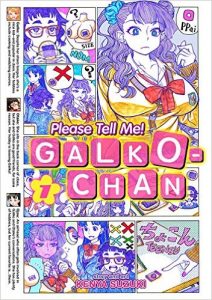
Please Tell Me! Galko-chan, Vol. 1

By Kenya Suzuki. Released in Japan as “Oshiete! Gyaruko-chan” by Media Factory, serialization ongoing in the online site Comic Walker. Released in North America by Seven Seas. Translated by Jennifer McKeon. Adapted by Lianne Sentar.

As I’ve occasionally mentioned before, I am the opposite of most fans. Most fans, from what I gather, watch only anime, and seem rather surprised to find that a manga or light novel exist, and uninterested if they do find out. Whereas I read manga or light novels, and for the most part don’t really watch much anime at all anymore. On the bright side, this can lead to surprises. For example, this series, which I knew nothing about. At first the description made it sound fairly slice-of-lifey. However, as those who’d seen the anime know all too well, it has a lot of sex talk sprinkled throughout. This was what I discovered when I first started to read it, and my general thought was “oh dear, time to plow through this.” Luckily, as the volume went on, despite the sex talk Galko-chan proved to be more what I originally thought it would be.

galko1

The premise is light as air, as are the characters, who all have nicknames related to their specific stereotype (a flashback chapter shows it’s actually deliberate, which is amusing). Galko-chan is the titular character, a Gal in the Super Gals! vein, who is also possessed of very large breasts, which is actually one of the driving plot points as there are many discussions of said breasts. Galko-chan is not quite a 4-koma series, but it’s very much in the vein of such comedies, with little character introductions every single page offering little facts about each character. (Haruchi-chan’s manga has this as well). And because her best friends as Otako, a bookish girl who knows a lot about sex from reading about it and uses that to jump-start conversations, and Ojou, a young rich well-bred girl who’s described as an airhead but who I think is simply sheltered and goes along with any topic no matter what it is, sex comes up a lot.

Each page heading has a specific question that one would ask of high school teens, ranging from “Do friendly sisters borrow each other’s clothes a lot?” to “Is it true that intense exercise can break a girl’s hymen?”. Honestly, they’re more the latter than the former – be prepared for a lot of discussion of breasts, pubic hair, periods, labial size, etc. While this has the potential to be awful, it’s generally not, mostly as all three girls are, despite the saucy talk, really quite innocent – this isn’t even on the level of High School Girls. When not discussing sex, they do normal 4-koma things like go shopping, go to the pool, and worry about school, with the help of their other classmates, who get less attention but still have names that define their stereotype. They’re just… nice kids. Who talk about women’s bodies all the time.

I suspect those who dislike slice-of-life, ecchi stories, and 4-koma style humor already avoided this, but just in case, let me warm you it is all those things. (There isn’t much boke and tsukkomi style humor, though, which is a pleasant change.) It’s also in full color, and the colors are nicely chosen and artistically striking, and the faces are mostly also very good, though Ojou needs to stop having her default expression 90% of the time. This was a cute read, not as ecchi as you’d think t would be, and should please fans of the anime. Which I still have not seen.

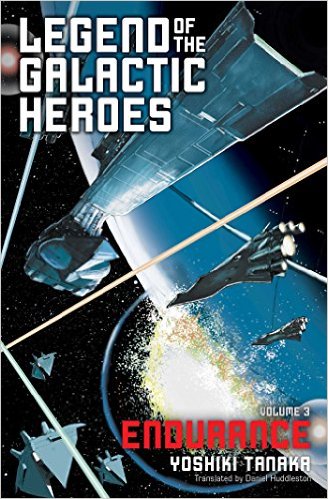
Legend of the Galactic Heroes: Endurance

By Yoshiki Tanaka. Released in Japan as “Ginga Eiyū Densetsu” by Tokuma Shoten. Released in North America by Haikasoru. Translated by Daniel Huddleston.

When we last checked in with this epic space opera, I was saying that this book would show us which direction the series was going to go, and I’m not sure that ended up being the case. Don’t get me wrong, this is an excellent book, with great battles and character examination, but at the end of 300-odd pages I am left with the feeling that not much has changed since we started. Except there are a lot more soldiers dead. Because above all else, Legend of the Galactic Heroes wants to tell us about the folly of war, specifically war for the sake of war. And it does this quite well, whether it be via Yang Wen-li having a long inner monologue about what history has taught us about the military or an evacuation order leading to the deaths of hundreds as panicking soldiers kill other panicking soldiers in their efforts to flee a doomed Death Star.

logh3

Of course, it’s not called a Death Star in the book, but a giant circular battle station that functions as a planetoid for its inhabitants is going to make one think of Star Wars, especially as Japan released this volume in 1984, when that sort of thing was at its height. The plot that kicks off this volume is an ambitious technical general coming up with the idea of building a 2nd Death Star, warping it into position, and then fighting it out with Iserlohn, the old one currently occupied by Yang and his Republic forces. It’s an all-or-nothing plan, and normally Siegfried would be around to try to talk Reinhard into being more sensible. But Siegfried is dead, and while Reinhard is trying to do his best to imagine what the young man would recommend to him (we see this later when he spares the life of another young general), he’s still not very good at it, and spends most of the book unemotionally doing his job and closing himself off from most human contact.

Reinhard and Yang are usually compared and contrasted, and Yang also spends a good deal of this book cut off from his allies. Not by his own design, though, as the Republic have called him in for “a court of inquiry”, which is different from a court martial in that they don’t have to tell anyone or have any actual charges. In point of fact, they imprison Yang for weeks because they just don’t like him, and it drives everyone to distraction – especially the people back on Iserlohn, who are now forced to fight for over a month against the enemy without their tactical genius. The book does especially well in paralleling the Empire and Republic, Reinhard and Yang this time around. They both have corrupt glory hounds, they both assume that people who hold respect and are held in high regard will want absolute power (after all, it’s what they would do). And they both have beautiful young secretaries who have designs on them, though Yang is a little ahead here – he and Frederica are more like awkward teenagers, whereas Hildegarde is having difficulty getting Reinhard to even admit emotion exists after Siegfried’s death.

This was great fun to read, but again, after the whole book we’re mostly in the same place we were. We do learn a lot more about Phezzan, though, which has designs in trying to eliminate one side and prop the other up – as puppets for their economic tyranny. Oh yes, and there’s still the Church. I suspect the next book will have a lot more politics to it. And we get a next book, as Haikasoru have picked up the next three in the series. Great news.