Monthly Archives: December 2014

Sword Art Online, Vol. 3: Fairy Dance

By Reki Kawahara and abec. Released in Japan by ASCII Mediaworks. Released in North America by Yen Press.

The novels are still running a bit behind the manga here in the West, so much of this review will be discussing how the light novel differs from the first two volumes of the manga that I’ve already reviewed. They mostly hit similar notes – Suguha’s crush on her brother is in full force, Asuna is still trapped in a birdcage, and Sougo is an over-the-top villain – but the ability of prose to let you get inside the heads of its leads allows for a greater depth than the manga had, particularly with Kazuto and Asuna. There’s also some nice discussion of Kazuto’s family beyond his sister, as we see his working mother, who he apparently got his obsession with games from. That said, once Kazuto becomes Kirito, we’re back to this series’ raison d’être, which is watching the boy do awesome things.
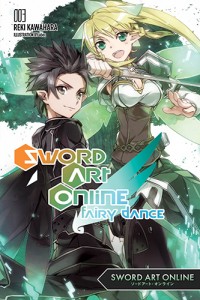
fairydance1

The contrast between Kazuto and his MMORPG self didn’t come across as much in the manga as it does here, and it may have been my favorite part of the book. Now that he’s not in Sword Art Online, we’re left with a young teenage boy who’s weaker than he’s been the past two years, unable to decide what to do with his life, and with the one thing he cherished more than anything – Asuna – still far away from him. After meeting Sugou, and hearing about Asuna’s arranged marriage, he almost completely falls apart, sounding nothing like the character we’ve known, not even after the death of Sachi in the previous volume. It’s only when he reached ALfheim Online, the successor to SAO, and can become Kirito again that things change. And change they do – Kirito was pretty confident in the first two books, but here he’s almost cocky, showing off his skills (ported over from SAO, for reasons unknown to him) and cleaning house.

As for Asuna, her POV also benefits the story. She goes through the same crisis that Kazuto did earlier in the book, being trapped with only the monstrous Sugou for company and not even being sure if her love is alive. Once Sugou attempts to break her will by saying he is (cartoon villains always seem to make this mistake), she gains new strength, and it’s immediately put to good use – her use of game mechanics and environment to find a way to escape her cage is brilliant, and shows that she’s more than just a prize waiting for Kirito to rescue her here. (Sugou also gets to be even more horrible here – the scenes of him touching her, trying to go far enough so that she’ll punch him and thus “justify” using his supposed mind control on her sooner, are true nightmare fuel.)

Suguha/Leafa is the new character here, and like the other two we enjoy getting inside her head. She’s startled at her brother’s sudden kendo skills, picked up by sheer muscle memory from his days in SAO. The family revelations, which he knew about but didn’t tell her about, also have thrown her off kilter, and that combined with the onset of puberty has led to her accepting that she has feelings for Kazuto – but she can see he’s clearly in love with Asuna. She’s very similar to her brother, and it’s no surprise that when she plays ALO in an attempt to understand what he enjoyed about it, she too got very good very fast and is one of the top players in the game.

If you hated the Fairy Dance arc of the anime, then reading the light novel will probably not change your minds. If you enjoyed aspects of it but felt it fell short, given this version a try. It may read like wish-fulfillment fanfic, but there’s nothing wrong with that if it interests the reader, and I’m still greatly enjoying Kirito, Asuna and Leafa’s adventures. This is a 2-part book, so in April we’ll find how things wrap up.

Is It Wrong To Try To Pick Up Girls In A Dungeon?, Vol. 1

By Fujino Omori and Suzuhito Yasuda. Released in Japan as “Dungeon ni Deai o Motomeru no wa Machigatte Iru Darou ka?” by Softbank Creative. Released in North America by Yen On.

For those who see that title and roll their eyes, the commonly agreed on abbreviation, from the Japanese title, is ‘DanMachi’. We’ve seen a few of the cliched light novels with titles as long as their content in manga and anime format before, but this is really the first time we’ve seen one as a light novel. As you’d expect, the longer the title the more likely that this is a romantic harem comedy, and that’s true here. It’s also a fantasy, though, one closely connected to the world of role-playing games (though it’s not players trapped in a game, for once). I think that the fantasy gamers will likely find it easier to appreciate this title than the harem comedy fans, though both will find things to like and dislike. One thing I think everyone will agree on is that the cover blurb is pretty misleading: Bell stops being a ‘damsel in distress’ almost immediately.

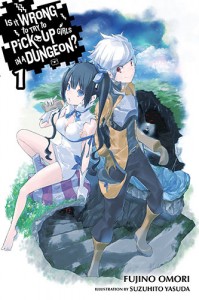
dungeon1

That is where we start, however. Bell is our narrator for most of the book, though it does switch off when the author wants to tell scenes without his presence to a third person style. He’s young and naive, wanting to become an adventurer in order to meet girls and get a harem, but he mostly wants that because this is what his grandfather (now deceased) taught him was the way of all things. In reality, he can’t catch a clue when it’s thrust in his face, really. The other protagonist is his sponsoring god, in this world where gods have come down to the real world and form gangs of adventurers to entertain themselves. Hestia has only one adventurer – Bell – but it’s clear that she just needs to mature. It’s also clear that she’s head over heels for Bell, and is somewhat frustrated at his lack of interest. As the book goes on we see more women – the big sister trying to convince Bell not to be stupid, the young waitress with an immediate crush on him, another goddess who wants him mostly to amuse herself – but it’s apparent from the start who the ‘lead girl’ is.

The fantasy aspect fares better, though I don’t really game so it’s possible I’m missing stuff. Bell fights increasingly tough monsters, and when he defeats them gets gems to exchange for money, or ‘drop items’ that might be useful. It honestly takes a little while to get used to the fact that this is meant to be a real world – adventurers have their ‘stats’ printed on their back in runes, for goodness’ sake. But the fights are well-written and go fast, and there’s a nice feeling of suspense to them. The book read very quickly and smoothly, which was nice, and lacks a lot of the self-important narrating we’ve seen in other books this year. There’s also a surprising lack of fanservice – surprising as the color artwork inside the front cover is filled with it. Hestia gets the nickname ‘loli big boobs’, which is unfortunate, but other than that the emphasis here is on the story for the most part.

I may have made this sound more interesting than it is – there’s nothing here that really gets me fired up for another volume. But it’s pleasant enough, and a nice quick read. Harem fans will be annoyed at the obliviousness of the hero and the possessiveness of the heroine, because they always are. Fantasy fans might be entertained by the ‘RPG in real life’ aspect, though, and may want to give it a shot. And fans of the Durarara!! light novels or the Yozakura Quartet manga will recognize the artist. It’s also available digitally, and an anime is due out soon.

Love at Fourteen, Vol. 1

By Fuka Mizutani. Released in Japan by Hakusensha, serialization ongoing in the magazine Rakuen Le Paradis. Released in North America by Yen Press.

Sliec-of-life can be very difficult sometimes in the West, particularly if it also has romance in it. The genre tends to involve a laid-back quality, with lots of chapters devoted to normal kids doing normal things, and recalling the nostalgia of your teenage years. It’s the antithesis of a title like Naruto or Parasyte. But when done right, slice-of-life can bring a smile to your face, making you want to turn the pages faster so that you can bask in the warm glow of the cast’s feelings. Love at Fourteen is definitely slice-of-life done right; I lost track of the number of times I said “Oh my God, they’re adorable” about halfway through this first volume.

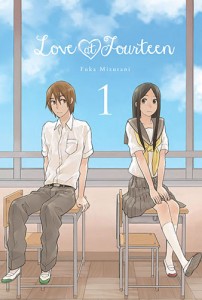
fourteen1

The premise of this volume will not seem unfamiliar to readers of another Hakusensha series, His & Hers Circumstances. Kanata and Kazuki are both the most admired kids in middle school, both having an air of ‘maturity’ about them that sets them above the pack. Of course, that maturity is also what keeps kids from getting too close to them. However, the pair have a secret – they’re childhood friends, and have been “acting” mature as it’s expected of them, when frequently they want to do nothing but relax and let their emotions hang out. The troubles start when the class points out, independently, how gorgeous Kanata’s hair is, and how deep Kazuki’s voice is, things which had never really occurred to two young teens who have hung out for years.

And so they start to realize they’re in love with each other, and are not quite clear how to deal with it. What follows are a series of chapters with lots of heavy blushing, frustrated desires, and sweet reunions. The drama is minimal, mostly as these two don’t make their own drama. “Acting” mature has been the norm for so long that they find they’ve actually *become* mature. What’s more, it’s never stated outright, but I suspect like most Japanese middle schools open relationships are heavily frowned on, so all this has to be kept a secret, which is a pain when you’re having trouble keeping your hands off each other.

I had thought that there was going to be a bit of drama towards the end of the volume, as one of their trysts is observed by Nagai, the class troublemaker. However, before he can start an obvious blackmail attempt he is quickly caught up in problems of his own, stemming from the class music teacher, who’s trying to get him to stop being truant and start singing. I’m a sucker for teachers who can wrap teens around their fingers, and so this was possibly my favorite chapter, and I really hope we see the two of them in the next volume.

In the end, though, this is really Kanata and Kazuki’s series, and there’s an abundance of them to enjoy here. It’s early on, and we haven’t even had a first fight chapter. Things are developing slowly and sweetly, as you’d expect from two kids who’ve known each other so long and now have to redefine each other… and themselves. The book has little definitions interspersed throughout on puberty and developing a sense of self, and you can see our leads develop accordingly. Most importantly, after reading this you will have the biggest goddamn smile on your face you’ve ever seen. Highly recommended.