Monthly Archives: February 2017

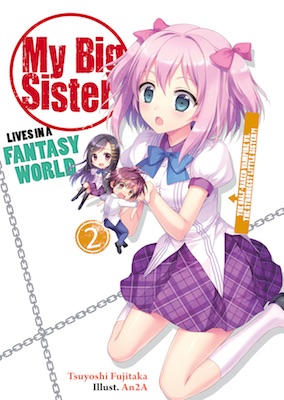
My Big Sister Lives in a Fantasy World: The Half-Baked Vampire vs. the Strongest Little Sister?!

By Tsuyoshi Fujitaka and An2A. Released in Japan as “Neechan wa Chuunibyou” by Hobby Japan. Released in North America digitally by J-Novel Club. Translated by Elizabeth Ellis.

The second volume of a series like this one was always going to be tricky. The seeming big reveal of the first book was that Yuichi, the supposed “average high school student” protagonist you get in these sorts of harem stories, was not remotely average. In fact, given the oddballs we saw in the first book, I had mentioned that the closest we had to a normal person in the cast was Aiko, who happened to be a vampire but was otherwise the fairly typical “shy cute girl” stereotype. Of course, as we find in this second volume, Aiko is far from normal either, even if she towers over the other eccentrics in her family in that regard. “Half-Baked Vampire” is your first impression, and the book tries hard to make it stick at the end, but I’m not buying it.

I’d argue this book isn’t as good as the first. The character of Yuichi’s younger sister Yoriko seems to be added for the sole reason that series like these always have little sisters who love their big brother just a little too much, and she doesn’t play any role in the plot besides getting jealous of Aiko and being too clingy. (You’d think she was the “Little Sister” in the second part of the subtitle, but no, as we find out, that is not the case.) There’s a lot of rambling discussion of the nature of murder and various other thought experiments by Mutsuko, whose tendency to exposit whenever it’s needed is her worst character trait. Girl who likes isekai continues to get so little to do that I can’t even remember her name. And poor Natsuki, the villain of the first book, is now reduced to playing the straight man role that Aiko played in the first book, as Aiko is too busy being the heroine.

Where the book succeeds is in analyzing the plot and character tropes you find in “Middle School Syndrome” types and, if not exactly deconstructing them, at least making you think about them in a different way. Honestly, much of the time the book reads as if it was written by Mutsuko herself, being the sort of self-insert you get from first time fanfic writers in their teens. Mutsuko may be the most interesting character in the series, which is fitting given she’s in the main title. I loved her discussion with Natsuki of those downbeat endings that seek to be dark for the sake of gritty realism, and how much she hates them – I agree 100%. At the same time, as Natsuki gradually realizes just what training Mutsuko has given her little brother, and how little it occurs to her to wonder if this is actually abusive or insane, we begin to see a dark core to Mutsuko, which I’m not sure if the author intends or not. She gets the final scene to herself, taking out the “power behind the throne” villain with a literal railgun, as suits her personality. She’s horrible and fascinating, which is fitting given that she’s an expy of Haruhi Suzumiya, who was the same.

In the end, this is still a silly harem series, but I enjoy it best when it’s taking a look at the stereotypes of such series, or asking us to examine the characters further to see how seriously we’re supposed to take them.

One Piece, Vol. 81

By Eiichiro Oda. Released in Japan by Shueisha, serialization ongoing in the magazine Weekly Shonen Jump. Released in North America by Viz. Translated by Stephen Paul.

In almost all respects, this volume of One Piece is leagues better than the last one. It’s the start of a new arc, which means that the chaos that Oda now writes as a matter of course is a bit more tightly controlled. There’s amazing fights, mostly in flashback. There’s great humor, mostly involving the two leaders of Zou and their animal characteristics. Our heroes get to actually be heroes, and we are reminded once again that Luffy’s piracy is not about raping and pillaging. There’s also surprising drama, as we find out about the extent of Big Mom’s power (complete with a shout-out to the movie Se7en) and her reach. And, perhaps most important of all, Sanji gets a last name.

This is more important than it sounds. Of the original ‘main’ cast of One Piece, it was noteworthy that three of them were never given family names, which might imply there’s some lingering backstory to be had in the future. After all, we never met Nami’s birth parents, and Usopp’s father is still presumably bumming around with Shanks. And then there’s Sanji – or rather, Sanji Vinsmoke, who happens to be one of a family of famous assassins. We don’t actually get too many details here, and I’ve no doubt we’ll be meeting them soon, but I like that Oda is able to riff on details that he wrote literally over 70 volumes ago in an “I meant to do that” way – namely that Sanji was born in North Blue, and getting from North to East (where he met Luffy and the others) is not an easy thing, As for Sanji’s decision to leave the Straw Hats in order to forcibly be married off… well, that’s what this arc is about, no doubt, and I don’t doubt he’d sacrifice himself to save the crew. (Note Capone threatens Nami first – he knows Sanji well.)

We also see the Sanji side of the Strsaw Hats arriving at Zou in the aftermath of the battle with Kaido’s underlings (we’ve still not really dealt with Kaido much, but as is pointed out, no doubt they will need to face him soon – along with Big Mom), and right away they’re making a humanitarian effort to save lives and help people. I always enjoy it when the Straw Hat Pirates show off their innate goodness, and this isn’t even in a “we’re saving the kingdom” way – if that had been the case they’d have arrived earlier. There’s also a tremendous reveal right at the end of the volume, which I won’t spoil, but Usopp and Nami’s tears, as well as Luffy’s huge grin, pretty much spell out how I felt about it. It was amazing.

So all in all we’re back to excellent volumes of One Piece, and I couldn’t be happier. Next time we get more anthropomorphs, and try to decide which direction the plot will go next – there are many ways it could go.

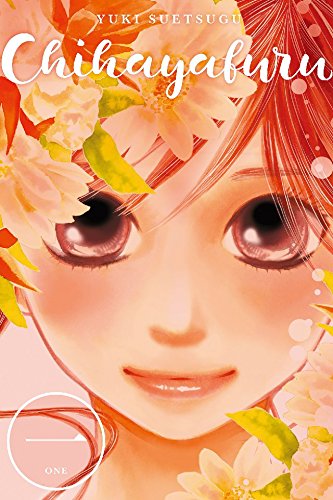
Chihayafuru, Vol. 1

By Yuki Suetsugu. Released in Japan by Kodansha, serialization ongoing in the magazine Be Love. Released in North America digitally by Kodansha Comics. Translated by Ko Ransom.

It has become very difficult these days, as manga fandom expands and grows more varied, to state outright that a series will “never be licensed”. Sure, there’s still a few holdouts that can boast that – I’m looking at you, Hajime to Ippo – but for the last few years we have lived in a renaissance of “oh my God I never thought we would get this title!”. In particular, seeing josei series on a regular basis is something that is welcome and heartwarming. And, in fact, Chihayafuru pulls off a troika. It’s josei, running in Kodansha’s Be Love, which has almost never been mined for licenses; it’s a big comeback for the author, whose career was on ice after a plagiarism scandal – this is her magnificent return. And it’s also a sports manga, something which may not be obvious when you look at its cover, but really sinks in after reading the first couple of chapters.

Of course, you could argue we’re overlooking another big reason why this was an unlikely license, which is the subject matter. This is a manga about a group of kids and their love for Hyakunin Isshu Karuta, a Japanese game that combines memory with one hundred famous poems – you’re given the start of the poem, and need to find the card with the second half of it. It requires speed, smarts, and a certain amount of guile – there’s a lot of smacking of cards here that made me raise an eyebrow and wait for a foul to be called, but that never happened. Playing this game is our heroine, Chihaya, whose name is similar to the start of one of the poems. She’s a brash tomboy who tends to always say what she’s thinking, which gets her in trouble. She’s friends with Taichi, a smart young kid with an oppressive mother – he carries both a chip on his shoulder and a crush on Chihaya. And then there’s the new student Arata, made fun of for his heavy local dialect (which is nicely adapted here by Ko Ransom – I’m reminded somewhat of the way Sweden has been translated in Hetalia, only more coherent) but a whiz at karuta. He gets the other two kids involved, and Chihaya in particular discovers that her speed and acute hearing are a boon.

Fans of the anime may be surprised to see that this entire volume takes place in elementary school – the adaptation made this a flashback after introducing her in high school. It’s still a good start, introducing the strengths and weaknesses of our leads, and having a romantic triangle that pretty much isn’t yet because they’re kids, but you can see it bubbling anyway. Unfortunately, everything comes to an end with Taichi going to a different middle school, and Arata having to move again due to the health of his grandfather (a world-famous karuta player). Will they ever meet again? Signs point to yes. In the meantime, with its engaging characters, dynamic art, and the ability to explain a complex sport/game without getting bogged down in exposition, Chihayafuru is a must read. It’s digital only, but if enough people get it, print may be feasible. Go get it, it’s worth it.