Monthly Archives: February 2017

Overlord: The Bloody Valkyrie

By Kugane Maruyama and so-bin. Released in Japan by Enterbrain. Released in North America by Yen On. Translated by Emily Balistrieri.

There is a glut of light novels at the moment based on the game stats premise, be it “trapped in a game” or that the world simply works like a game. This includes Overlord, which manages to be a combination of both. At its best, Overlord shows us the cognitive dissonance between what Ainz is thinking in his head and what is actually happening, or what his minions are actually doing without his knowledge. At its worst, it gets bogged down in long grinding fights that are simply collections of spell moves. Overlord seems to be very much in the Dungeons and Dragons mode, which is fine for worldbuilding, but to keep the mechanics of it as well means that for non-gamers, the climactic fight can get amazingly tedious at times. Which is not what you want to hear about what you’ve spent the entire book building to.

This book also spends a large amount of time away from ainz – he doesn’t show up till a third of the way in – and thus also shows that the book is best when it focuses on him. I can see why we had the extended prologue – the plot is that his minion Shalltear has been mind-controlled, so we need to spend a fair amount of time with her at the start so that we actually get a sense about what the mind control really means and can try to care about her. Unfortunately, this is Overlord, a series made up of evil villains. And so Shalltear is a monster, who only seems sympathetic because the humans that she lays to waste here are a bunch of thugs who like to rape and rob young women. Her best moment was when she ran into one of the humans Ainz met in Book 2, who has one of his potions. This accidentally saves the girl’s life, as Shalltear has no idea why Ainz gave it to her, and so doesn’t dare kill her.

We are at the “this is successful, go ahead and expand your subplots” point in the series as well, so we get a few characters who show up and I suspect will be plot-relevant later on. This includes the somewhat ineffectual king, whose only ally seems to be his noble soldier (who we met in Vol. 1 thanking Ainz for defending the village). There’s also the king’s young daughter, who is gorgeous and beloved and I suspect has a lot more to her, and the daughter’s somewhat overly serious and twitchy bodyguard. And there is the unfortunately named Brain (it’s OK, the bodyguard’s name is Climb), who has spent much time training to be the strongest only to run into someone who completely breaks him to bits with no effort at all. The humans in this book tend to be cannon fodder, but he actually gets away, so we’ll see if he shows up again.

As I indicated, this is best when focused on Ainz and his inner monologues, meaning it’s the middle third that held my interest most. Overlord is still a series well worth reading. But it could stand a good editing, and eventually I will have to get used to the fact that it’s a bunch of bad guys power-tripping.

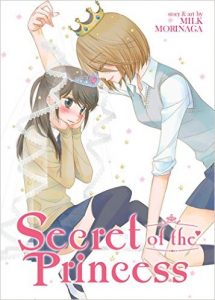
Secret of the Princess

By Milk Morinaga. Released in Japan as “Ohime-sama no Himitsu” by Shinshokan, serialized in the magazine Hirari. Released in North America by Seven Seas. Translated by Jennifer McKeon, Adapted by Shannon Fay.

Morinaga Milk’s books are simply nice. They’re sweet. They put a smile on your face. They are not the most original books in the world – in fact, they sometimes have so many cliches that they rack up a Yuri Trope Bingo before they’re halfway done – but they’re smooth reads, and you don’t have to worry about serious tragedy befalling anyone. There is angst in this volume, don’t get me wrong, but it’s the sort of book where one of the heroines threatening to kill herself by jumping off a roof is treated as a loving confession rather than an actual suicide attempt. If you try to attack too much reality to this, it begins to come apart, but that’s the point. It’s yuri fantasy.

Stop me if you’ve heard this one before. At an all-girls school, Fujiwara is the tall, athletic, cool, one-quarter Western beauty who all the girls admire. She’s also just accidentally destroyed the principal’s expensive vase. This is witnessed by Miu, a girly young first year whose mother has drilled into her that the secrets to catching a good husband. Of course, at an all-girls school, men are thin on the ground, so Miu has no idea how actual dating works. So, in exchange for her silence, she asks Fujiwara to pretend to date her so she can discover how this all works. Of course, she doesn’t consider the jealousy of her fellow students, or Fujiwara’s own loneliness and need for the social interactions that she gains with Miu, or, of course, her own growing and conflicting feelings.

Miu can be a weak part of this book – she’s a bit hard to take and frustrating, though she improves as the volume goes on. This is complete in one book, and a short book at that, so there’s not really much time to slowly develop anything. Fujiwara fares better, having a home life that seems to be mostly filled with maids (of course she lives in a rich mansion, have you read this genre before?) and her friend Hirosawa, who is also a short-haired beauty with a fan club but is second to Fujiwara. (The shoujo dynamic of the blond taking second place to the brunet lead seems to be reversed for Yuri titles.) Other than that, there’s not much to talk about – they date cute, break up when they start feeling guilty about the “falseness” of things, get back together dramatically, and end up in bed (though fleetingly – for the most part, this is pretty squeaky-clean.)

So it’s not mind-boggling, but it’s nice to see some sweet titles coming out here after a year of Citrus and Netsuzou Trap. And we have more from this author coming up next month as well. I suspect it will be sweet, fluffy, somewhat insubstantial, and yuri. Much as this is.

Strike the Blood, Vol. 5

By Gakuto Mikumo and Manyako. Released in Japan by ASCII Mediaworks. Released in North America by Yen On. Translated by Jeremiah Bourque.

As always, Strike the Blood does what it wants competently and efficiently, with good pacing and a nice balance between the hero and his various female leads. And yet it continues to be one of the most frustrating light novel series that I follow, because it is content to be simply that. There’s potential for a lot more here, and at times the series looks as if it’s going to show you that potential… and then it backs off, content to give us a comedic perverted parent, or a bath scene with a giant nosebleed, or Yukina saying her catchphrase again with all the well-crafted timing of a Swiss watch. Strike the Blood is what it is, and thus I will never get to experience what I have with most other cliched light novel series, which is the joy of seeing the books get better as they go along.

This is the second half of a two-part arc, and as such we hit the ground running, with less development and more fights. Sadly, this also means less development for Yuuma, who is injured enough to be shunted to the side for the majority of the book, until the climax where she shows up to use her clone status against her mother. There is talk of the idea of her being a disposable tool being wrong, which would probably read a lot better of the author weren’t treating her like a disposable tool, using her to help resolve things at the climax and then cheerfully writing her out to go serve time as an accessory. We also finally meet Kojou’s mother, who is unaware (possibly) that he is a vampire now, and is an absurdly youthful genius doctor mom who has a tendency to feel up girls for fun. I called this “TV Tropes: The Novel” last time, and that hasn’t changed. His mother is there to provide gropes and exposition, and stop Yuuma from dying.

As for the plot itself, as the villain cheerfully admits, half of it is an excuse for a giant runaround using minibosses to build up tension but never actually do much beyond sort of threaten the hero and heroines and then get dealt with. I was happy to see Asagi get something more substantial to do – she remains my favorite of the three main heroines, and her solution to the first miniboss battle showed off her smarts (with the help of her AI that controls the entire island). Sadly, the main villain herself is less interesting, which is especially irritating as she didn’t have to be. There’s suggestion of a deeper story between her and Natsuki, and we even see a brief flashback, but it’s just spice to show why she hasn’t merely killed everyone before this. If we’d gotten an entire chapter devoted to Natsuki and Aya’s school days and what led to her descent into mad villainy, I might have praised it. But we don’t.

I keep hoping this will get bad enough for me to drop, but it’s far too efficient for that. It has dropped a new novel in our laps, and we will read it, vaguely enjoy it, be disappointed at what could have been, adn then forget about entirely until the next book. Sigh.