Monthly Archives: December 2018

Ojojojo, Vols. 1-2

By coolkyousinnjya. Released in Japan by Takeshobo, serialized in the magazine Manga Life. Released in North America by Seven Seas. Translated by Ben Robert Trethewey. Adapted by Clint Bickham.

Well, this was a pleasant surprise. We’ve seen a lot of this author’s works over here recently, including Miss Kobayashi’s Dragon Maid, which I dropped after a few volumes as I found it overrated, and Mononoke Sharing, which I didn’t like at all. Here, though, in a 4-koma series that lacks either monster girls or fanservice, I’ve found a series I can get behind. It helps that this handles the ‘4-koma slice of life’ genre very well. There’s always a danger in these sorts of titles that it will end up being plotless and lacking in forward motion, moving through the school year, festivals, etc. and ending up at graduation. Ojojojo, though, seems to actually care about character development, and things do, in fact, happen. Indeed, our leads end up dating by the end of the first book, which surprised me a great deal. That said, it’s not a surprise, as they complement each other perfectly.
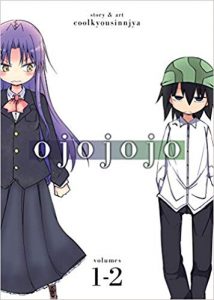
…OK, perhaps they don’t complement each other perfectly immediately. As you can see by the cover, where they stand as far apart as they can and still exist, there’s a bit of awkwardness. This is because Haru Jikogumeguri (you can tell she’s rich because the name is *six* syllables) is socially inept and therefore acts like an arrogant rich princess, and Tsurezure Kawayanagi (who seems to be of modest status, despite also having a “rich” last name) is sopcially inept and therefore doesn’t really interact at all, preferring to stare at nature. When she transfers into his class, they bond almost despite themselves, and the joy of this book is watching the two of them grow close and learn how to communicate honestly. They’re helped by Akane Tendou, Haru’s first female friend in class and the relatively “normal” one of the group, Haru’s acid-tongued butler, and Chris, an English transfer student who has a similarly arrogant introduction as Haru did, but gets away with it more (probably as he’s a guy.)

Haru is the sort of arrogant rich girl you can’t help but love, especially once you get her semi-tragic backstory and see her earnest yet awful attempts to change her ways. The first volume is fairly normal 4-koma stuff, as we learn about our heroes via various quick gags and the occasional sweet moment. (The author says he planned to end it with the first book.) In the second half, he starts to deepen things, particularly the relationship between Haru and Akane, which turns out to involve a lot of misplaced guilt on Akane’s end. (The last name is a bit unfortunate – be assured she is not crossing over from Ranma 1/2.) By the end of the 2nd volume our leads have progressed to holding hands (which, given their personalities, is a big jump), and Chris is beginning to get over his own arrogance. There is one more omnibus to go, though, and since we know next to nothing about Tsurezure (who is unrelated to the Children of the same name, speaking of which) I suspect the next book will go into his past in an effort to move things along further.

Add to this next to no fanservice (Akane is jealous of Haru’s large chest at one point, but it’s a normal large chest, not the massive bosoms we see in Dragon Maid and Mononoke Sharing) and you have a title that’s a perfect introduction to casual fans who want to read a nice romantic comedy and don’t mind the “gag comic” format. A nice pleasant surprise.

Baccano!: 1934 Alice in Jails: Streets

By Ryohgo Narita and Katsumi Enami. Released in Japan by ASCII Mediaworks. Released in North America by Yen On. Translated by Taylor Engel.

At the end of this volume Narita announces that they’re making an anime (which we have all already seen, of course), and also that after a Prison volume consisting mostly of old favorites, the Streets book mostly features either new cast members or relatively new ones, such as Christopher. That said, while they may have been new to the reader, I’m sure that the anime watcher is finally relieved to see Gustav St. Germain, his assistant/student Carol, and Graham Specter, who were cameo’d in the last book but show up in a major way here. Narita wrote Gustav and Carol into the anime as bookends commenting on the story in a metatextual way, which fits with what they do, and Graham showed up in one of the OAVs, whose events are described here but not shown. Well, at least I assume that folks are enjoying Gustav and Carol. Graham has a few people who just don’t like him, and I get it – like many, many other Narita characters, he won’t shut up.

Miria is in the foreground of the cover, but doesn’t show up till the end of the book. Same with Huey, whose ominous face takes up the background on the left side. Instead we see Renee, who is introduced to us as almost a parody of the “dojikko” type – busty and gorgeous, but always tripping and bumping into people, and constantly apologizing. Of course, just as we were introduced to Elmer C. Albatross as a smiling, likeable guy and then realized that this was not really correct, it turns out that Renee, like Huey, who she seems to have a connection to, is a bit of a horrible monster. Graham, Gustav and Carol are on the cover as well, in addition to Christopher Shaldred, last seen getting the crap kicked out of him on the side of a building in The Slash. Turns out that had a big effect on him, so in the meantime he’s playing bodyguard to the heir to the Russo family, Ricardo, who turns out to also have some big secrets. Not pictured is Lua Klein, Ladd’s girlfriend, who the Russos have locked up, presumably as leverage. Given Lua’s ultra-passive personality, you’d think they could just tell her to leave, but she does make an effort to escape when it presents itself.

That said, though, I think the most important part of the cast (also not pictured) is Rail, also one of the Lamia/Larva group we’ve come to know, and (as all of them are) one of Huey’s homunculus experiments. Huey’s view of everyone as an experiment tends to dehumanize them, and Renee clearly feels the same way. Add this to their not being “born” the way normal humans are, and the horrific tortures they’ve been forced to undergo, and it’s no surprise that most of Lamia are a bit eccentric. Rail is not sure about such basic things as humanity, and the events in this book really don’t help. That said, the majority of this book, as with a lot of Narita’s works, is a big series of fights and battles, combined with explosions (Rail loves to use bombs, although they are apparently not as good as another bomber we’ve seen in this series).

At the end of the book Miria and Jacuzzi’s gang are back in Chicago, trying to meet up with Isaac, who can only afford rail fare to there. So no doubt Peter Pan in Chains will bring the old and new cast together for a big finale. In the meantime, despite being filled with new characters you’re still learning about, this is a typically fun volume of Baccano!.

My Youth Romantic Comedy Is Wrong As I Expected, Vol. 6

By Wataru Watari and Ponkan 8. Released in Japan as “Yahari Ore no Seishun Rabukome wa Machigatte Iru” by Shogakukan. Released in North America by Yen On. Translated by Jennifer Ward.

This volume was pushed back a month or two, and when it finally did come out I didn’t have the time to read it except in short chunks. This is probably one of the reasons that I feel so exhausted after reading it, but the other is the subject matter. For a book that’s supposed to be a “romantic comedy”, which does have a generous helping of humor, it can be extremely depressing. It doesn’t help that this is exactly what the author is going for – after yet another problem is solved by Hachiman getting everyone to unite in hating him (and thus supporting the girl with the problem), his teacher reminds him that while Hachiman may not care about everyone’s bad feelings, there are others that worry about him. This includes her, as well as Yukino and Yui, but learning this lesson is, I think, going to take a few more volumes. Meaning that I may still be glum about this humorous series.

The subject of the book is the school’s Cultural Festival. Hachiman’s class is putting on a production of The Little Prince, which is not BL despite the best efforts of its adapter. Hachiman himself is on the festival committee, despite his best efforts, in the “Records and Miscellaneous” department, which rapidly becomes “defer everything we don’t want to do to here”. The supposed Festival Chairman is Sagami, a young woman with confidence issues who tries to get herself back in the “cool kids” group by taking this on, but in reality everything is being done by the vice-chairman, Yukino, almost to her physical and mental detriment, because since the chairman is flaking on things, everyone else decides to flake as well. And there’s also Yukino’s older sister lurking around the festival, making things worse in the way that only family can. Is this festival really going to be OK?

Well, yes, it pretty much is. There are no major festival disasters on this watch, mostly as Yukino is very good at organization (delegation, not so much). We are gradually seeing her warm up to a few people, particularly Yui, who remains the bright ball of sunshine in this series despite not having all that much to do in this book. The trouble, of course, is Hachiman, who once again narrates the book in a jaded, cynical and otaku-ish tone that serves to belie the fact that he really does care about these people and, when push comes to shove, wants to help them. But because of his self-image, he feels that it’s fine to solve a problem by throwing himself under the bus. Which is ironic, given how our three leads’ lives interacted at the start of the series. Despite being reminded that there are people who value him, the book ends with Yui taking a reluctant Yukino to the after party, while Hachiman resolutely doesn’t go.

I realize that once Hachiman learns from his past mistakes, we’re reaching the end of the series. And this is still very well written with interesting characters I want to see succeed. But man, it’s a slog, and right now I don’t really want either Yukino *or* Yui to end up with Hachiman. (There is a yuri fandom for it, right?) Definitely recommended for fans of the series, however.