Monthly Archives: December 2018

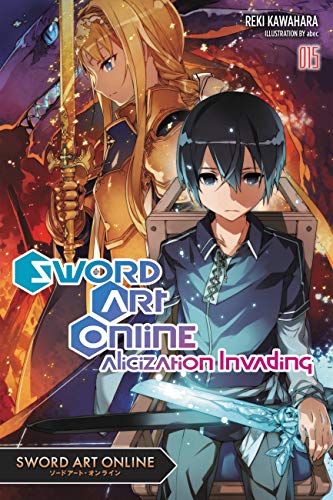
Sword Art Online, Vol. 15: Alicization Invading

By Reki Kawahara and abec. Released in Japan by ASCII Mediaworks. Released in North America by Yen On. Translated by Stephen Paul.

I was expecting that this volume would be a bit of a letdown after the highs of the previous work. Sadly, it’s even worse than I had anticipated: I actively don’t like this volume. Well, parts of this volume. We can divide the books events in half. Half of it involves Alice, having run away from the Integrity Knights at the end of the last book, living in the woods with Kirito, who is unresponsive and seemingly braindead. She’s struggling to find a purpose to fight, and various circumstances seem to give her that. This is not great writing, but it’s at least decent, and helps to set up the next couple of books. Alas, we then have the other half of the book. Even a Monkey Can Draw Manga discusses Shonen Power Creep, but there’s another aspect that Kawahara really suffers from, Shonen Villain Creep. Each villain has to be worse and more monstrous than the last one, doing even more evil things. So, ladies and gentlemen, meet Gabriel Miller.

Gabriel is introduced to us as a young corporate executive type, and we then flash back to his childhood, where he lived a comfortable life, met a nice sweet young girl to be his childhood friend, and then… well, Gabriel is a sociopath, like so many other of Kawahara’s villains, so you can probably guess. He’s part of a terrorist squad invading the ocean turtle, where Asuna and Kirito’s body are currently, in order to get the results of their experiments – Alice. He seems to regard humans and bugs exactly the same way, and is a thoroughly unpleasant individual. (He is assisted by another evil guy named Vassago, and I suspect that we may be familiar with him from previous volumes, though I will hold off till it’s confirmed.) Gabriel and Vassago are locked away from the Underworld, but they can still become “characters” in it. Which they proceed to do, as Gabriel is now the Demon Lord invading the human world.

The main problem with this book, and it’s teeth-grinding, is that half of it is from Gabriel’s POV. Given I already hate the way Kawahara writes villains, having to experience their thoughts for so long is unbearable. There’s also a couple of horribly violent deaths in the book, both women of course, there to make the reader feel sad and also make me wonder if the author had recently watched Se7en. (Speaking of which, Kawahara is rewriting his webnovel and editing it, and he changed events in Book 11 so that Ronie and Tiese are not, in fact, raped – however, dialogue towards the end of this book shows that he isn’t very good at cleaning up the mentions of it after the fact.) This may come as a surprise to the casual SAO fan, but I really miss Kirito’s POV here. Alice’s uncertainty and Gabriel’s loathsome villainy just make this book very hard to read. Oh yes, and Gabriel has also been in Gun Gale Online, and wants to do nasty things to Sinon as well. So that’s just great.

This was originally written when Kawahara was a much younger man, and it shows – it reads like the sort of thing an emo guy would write in order to be grim and gritty. The author, I think, realizes this – after the anime adaptation of Vol. 11, he publicly apologized for the rape scene, and said he wouldn’t write that sort of thing anymore. Unfortunately, it does mean we still have to plow through this book, which is filled with setup for cooler events to come, as well as appalling sadism. I won’t say to skip it, but you won’t enjoy it.

Dead Mount Death Play, Vol. 1

By Ryohgo Narita and Shinta Fujimoto. Released in Japan by Square Enix, serialization ongoing in the magazine Young Gangan. Released in North America by Yen Press. Translated by Christine Dashiell.

Sometimes you get so used to a specific author’s tropes and themes that you can tell from a cursory read that a work happens to be by that author. That said, it took a while for me to feel like this was written by Narita, the creator of Baccano! and Durarara!!. Starting in a fantasy world with a battle between a paladin and a skeleton lord is not really his deal, at least not in what we’ve seen over here. But once we move back to the modern world, and the “hero” starts describing people as toys? Once you see a sociopath who commits the most horrible crimes with a smile on her face? A ganster-like organization with a “family” feel and cops who are not afraid to use suspicious methods to get justice? Yeah, that’s Narita all right. Here he’s doing a “reverse isekai”, as the death lord from the prologue ends up inside the body of a young man in our world.

Polka is that boy, and his actual self seems to have been moved out of his own body so that the corpse lord can take it over. (It’s OK he ends up inside a plushie shark.) You worry Polka will start up his old ways, but it turns out he was a misunderstood corpse lord with friends who were killed because they associated with him, so it’s all good. Unfortunately, the real Polka has an assassin’s contract out for him, and the assassin, Misaki, is a smiling high school girl who is rather annoyed that the kid she stabbed through the throat sn’t dead. That said, she gets over it rather fast, especially once he kills and then revives her as a corpse – which, honestly, she’s much happier being. Along with a young man who doesn’t seem to leave his control room and communicates through drones, he’s here to figure out this magicless world, though he can still use plenty of magic.

Polka, in his “possessed” form, reminds me not a little of Huey Laforet, who also considers people his toys. That said, he’s not QUITE as morally nihilistic as Huey, and can tell right from wrong. Which is more than Misaki, who seems like what you’d get if you fused Anri from DRRR!! and Elmer from Baccano!, horrifying as that thought is. The rest of the cast are still unfolding, though the two police officers seem like they stepped off the pages of Gangsta. For the most part, this is a fun little action manga with a few mysteries, mostly content to coast along on mood. Be advised it’s a rated M title, though you get the sense that this is more the editors telling the creators “insert lesbian sex here” than any real plot relevance. It’s very Murcielago-ish in its lesbian sex scenes.

If you like DRRR!! and Baccano!, you’ll want to pick this up. Fans of reverse isekai and mindless sex and violence might also enjoy it.

Kagerou Daze VIII: Summer Time Reload

By Jin (Shinzen no Teki-P) and Sidu. Released in Japan by Enterbrain. Released in North America by Yen On. Translated by Kevin Gifford.

(This review gets even more spoilery than I normally do, FYI.)

I will admit, those who are only familiar with Kagerou Daze via the light novels themselves, rather than the franchise in general, may be a little dissatisfied with the ending. It’s not really that the villains win or even that most of the cast die, it’s that it all ends with a big old reset button. We tried a cool plan, it didn’t work, and so we’re going back to try something else – which, it turns out, they’ve been doing for a long, long time. Kagerou Daze is not a visual novel, but like Higurashi and Little Busters, it revolves around repeating a sequence of time to try and fix things. In the case of the light novel, things don’t get fixed. Oh, there are some survivors – the “side story” in this book deals with Seto and Marie after everything else has already happened, and Hibiya is still around as well – but no one really wins. Not even the villains.

That said, the novels are not all there is to Kagerou Daze. The books are based on a series of songs, and the final song in the “main” series, Summer Time Reload, is also the title of this book. It implies the majority of the cast survive, though they may forget about all this. There’s also the manga, which is just about to wrap up in Japan, and clearly tells a different version of events from the books and the songs. And there’s also the anime, Mekakucity Actors, which may annoy fans for various reasons, but also arguably provides the most closure. All the spinoffs are different kinds of flavoring to the main plot. Here, with prose, we get a lot of monologues showing off the emotional state of the cast – in fact, I would argue that Jin is better at this than he is at actual plotting.

There’s also an awful lot of shipping in this last volume, which surprised me. Kagerou Daze has a large shipping fandom – it’s got about 2.5K fics on Fanfiction.net – both het and otherwise. You don’t see much of the otherwise here, but other shippers should be pleased. Haruka clearly ships Shintaro and Ayano, and is visibly upset when their reunion in the Daze is less about “Sorry I forgot to say I love you before you killed yourself” and more “how do we stop the villains”. Hiyori, who I suspect the majority of readers may have forgotten about, pops in at the end too, and she’s just as tsundere as ever, though she does manage to spit out words very few tsunderes ever have. And the entire book is about Seto and Marry’s relationship, and how they’re family but also clearly want to have more, at least on his side. Sadly, his desire to protect is sort of destroying anything else they might have.

Jin’s afterword is very self-deprecatory, and I get that. These aren’t the best written books, especially in translation – there were several times when I could have used a “this character is now our narrator” slug at the top of the section. And Seto really did get the least focus of any character, coming off as a bit wet in the process. That said, in terms of emotion and character, Kagerou Daze was a fast favorite for me. The books make me want to listen to the songs, read the manga, and watch the anime all in a marathon. Which is all you can ask from a franchise spinoff.