Yearly Archives: 2018

Unmagical Girl, Vol. 1

By Ryouichi Yokoyama and Manmaru Uetsuki. Released in Japan as “”Hihou” Mahou Shoujo no Sonogo no Nichijou” by Ichijinsha, serialized in the magazine PoniMaga (Pony Canyon). Released in North America by Seven Seas. Translated by Beni Axia Conrad. Adapted by Gretchen Schrafft.

Expectations can be tricky. It’s almost impossible to go into reading something without an idea of what you’ll think of it. When I first saw that Seven Seas had licensed Unmagical Girl, my first thought was to dismiss it as another one of the endless series of “let’s kill of magical girls in a grimdark way” series that the companies have been licensing in an effort to have the next Madoka Magica. I was therefore pleased to see that that isn’t the case for this title. This is the sotry of what happens when a magical girl ends up in the real world, and the fallout from such. The cover depicts the titular magical girl walking through a shopping district, looking pensive. I was thus expecting some sweet yet melancholic soul searching. Wrong again. Now I’ve actually read the title, and it’s clear that we’re going after broad comedy. If you liked Aho Girl, you’ll like this.

Our heroine – or, more accurately, our straight man – is Mayuri, a plain glasses-wearing girl who “doesn’t have any friends” in the best protagonist of a manga tradition. Her father used to direct anime that was known for being “niche”, which is to say not very popular. He did have a title called “Pretty Angel Nirvana” which is now very popular… about five spinoffs later, and now no one really remembers or cares about the original. Oh, and he’s dead. Her mother sends Mayuri an old computer with some of his stuff on it, though, and after accidentally crying tears on the computer while wishing for a friend, Mayuri is startled to find the computer exploding, and out stepping NirBrave, the ditzy yet powerful heroine from the original series. She’s now in the real world, which poses endless problems, as she reacts to problems in a magical girl way, eats like a magical girl heroine (i.e. a ton), and is, in general, somewhat obnoxious.

How much you enjoy this very much depends on your love of loud, brash comedy. I compared it to Aho Girl earlier, and it’s pretty accurate – I had a lot of fun reading the manga, but it quickly began to pall as I realized that it seemed to be hitting a lot of the same notes. There are some amusing things here – NirBrave’s horror at reading a porn doujinshi of her series made me chuckle, and the landlady is an excellent caricature of the type of landlady you see in a lot of series like these, who has the ability to get money out of a stone. Later in the series we also get some more magical girls and magical villains, as apparently NirBrave’s arrival in the real world started a trend, and we see NirBrave facing off against her fellow magical girl NirWind. Unfortunately, its occasional attempts at depth and pathos fall pretty flat. It’s not for kids – there are a few blatant panty shots here and there, and a nude transformation sequence that seems to inflate NirBrave’s bust by a factor of three – and it’s not really for magical girl fans either. If you like broad, slap-on-the-black style humor, though, you may have fun with Unmagical Girl.

Kieli: The Dead Sleep in the Wilderness

By Yukako Kabei and Shunsuke Taue. Released in Japan by ASCII Mediaworks. Released in North America by Yen On. Translated by Alethea and Athena Nibley.

This is a digital re-release of a novel series that Yen originally published back in 2009, before the light novel boom. Which is good, as this really doesn’t feel like a light novel. Honestly, if it weren’t for the interstitial illustrations, which make Kieli look sort of cute and manga-ish, I wouldn’t even guess the author was Japanese. Instead, it feels like an odd fusion of children’s fantasy and Western, as if C.S. Lewis and Louis L’Amour had decided to collaborate. The main thrust of the story (clearly written as a one-shot, though there are eight other volumes after this) is to show the growth of its title character, a young girl living in a typical repressive pseudo-English boarding school that just happens to be in a post-apocalyptic world run by the Church. Fortunately, she’s got a perky roommate for company. Unfortunately, she also ahs a secret: she can see and interact with ghosts.

And yes, it has a new cover for the Western edition, which is meant to attract casual non-anime fan readers. If I recall correctly, Yen also did this with Spice & Wolf and Haruhi Suzumiya. At first I thought the cover image was a camera – it’s not till we get further into the book that you realize that it’s a radio, possessed by a ghost of an old soldier. The book gets started when Kieli and her roommate Becca meet a seemingly dead young man in the train station right before holidays. This is Herbie… pardon me, Harvey, who is an Undying, a former supersoldier used to end the war that was the cause of the apocalypse mentioned earlier. Like most inhuman yet sentient weapons created to fight a war, the Church has a very different view on him now. The thrust of the book involves Kieli accompanying him on a train journey, supposedly so she can get some history to write an essay for school, but in reality because these two are simply drawn to each other, and also because Kieli draws trouble to her wherever she walks.

The book is well-written and the characters are enjoyable, particularly Kieli, as she’s just the right combination of “intelligent and precocious girl” while still occasionally being a child. The first two-thirds of the book function as interlocking short stories, as we see Kieli and Harvey go to a new place and Kieli run into what she first thinks is a person but turns out to be a ghost – indeed, by the end of the book I was starting to wonder if anyone Kieli was going to run into was actually alive. Even the villain is an Undying like Harvey. It’s not clear how special her power to see ghosts is – Harvey doesn’t seem impressed, but that’s more a function of his personality, and the villain seems to want to torture her more than use her abi8lities. It’s a nice way to be able to show that the series can go on if enough people read it – and indeed, it did continue, with Vols. 2 and 3 due out later this month on Kindle, Nook, etc.

After a December filled with a more modern strand of light novel plots, I enjoyed reading the more subdued and thoughtful Kieli. Recommended for those who like teen fantasy but avoid the traditional Japanese light novel cliches.

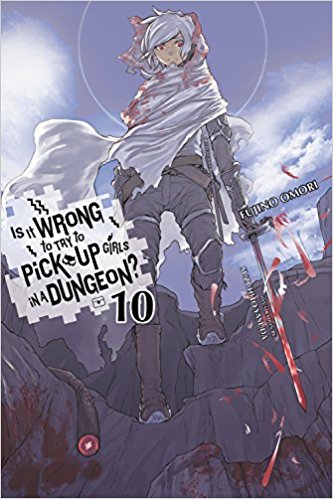
Is It Wrong to Try to Pick Up Girls in a Dungeon?, Vol. 10

By Fujino Omori and Suzuhito Yasuda. Released in Japan as “Dungeon ni Deai o Motomeru no wa Machigatte Iru Darou ka?” by Softbank Creative. Released in North America by Yen On. Translated by Andrew Gaippe.

Last time we asked what would change about monster hunting if we knew that not all monsters are evil and mindless. But if there are good and bad monsters, then there are also good and bad people. And the bad people who make up the Ikelos Familia are very bad indeed, so a good deal of this book is reversing any gains made by the last book. In fact, reversing may be a bit of an understatement – by the end of this book, Bell’s reputation is in shreds and everyone is furious with him. (Well, not his own Familia, thank God.) And while Ouranos’ experiment is still living on, it’s hanging by a thread. It’s hard not to sum up this volume of Danmachi as “Everything is terrible. The end.” That said, how we get there is important, and there are some excellent fights, good character moments, and… OK, yeah, no humor this time around. Not even any harem antics.

Much of this book continues to revolve around Wiene’s story, and unfortunately that’s a weak point in the novel, as she is absolutely a damsel in distress throughout it, whether it’s getting captured and sobbing in captivity, or being forced to mindlessly rampage aboveground. The trouble, of course, is that her plight is needed to advance Bell’s character, so she has to suffer as a result. The moral battle between Bell (pure, good, a bit headstrong) and Dix (twisted, evil, scheming) is a highlight, though I’m not sure Dix’s description of Bell as a hypocrite quite fits. Dix’s anger stems from a classic dilemma in stories like this – who do you choose to save if multiple sides are in peril? Do you save humans or monsters? Bell saves both, of course, and that’s why Dix rails on him for such impossible optimism. Dix himself is a thoroughly loathsome villain, though I wasn’t all that fond of the whole “descendants must carry on the insane plan” thing.

Aboveground, the rest of the cast gets relatively little to do – Lili and Hestia investigate a bit to try to find out where the middleman is in this conspiracy, but for the most part they’re sidelined. As for Team Loki, they get the bulk of the climax, trying to stop the rampaging monsters in the city and wondering why in God’s name Bell is chasing after one of them. (It is fairly notable that Bell’s “this is my kill!” excuse is rather lame, and while it is what kills his reputation I don’t think anyone who really knows him buys it for a minute – Eina certainly doesn’t.) I was wondering if Bell would have to fight anyone from Loki Familia, but we avoid that, mostly as he’d get the crap kicked out of him, I expect.

And so now we wonder where to go from here. Bell’s reputation is bad, but he’s not thrown out of the city or anything. And Hermes is already trying to find ways to fix things. I have a feeling that the next book will involve a lot of dungeon crawling. and I hope that it’s a bit more lighthearted. Still, if you’re looking for a dose of Danmachi at its most serious and grim, this is the volume for you.