Monthly Archives: May 2019

My Next Life As a Villainess! All Routes Lead to Doom!, Vol. 3

By Satoru Yamaguchi and Nami Hidaka. Released in Japan by Ichijinsha. Released in North America by J-Novel Club. Translated by Shirley Yeung.

The author admits in the afterword that the series was supposed to end with the second volume, which was pretty obvious (see my review of said volume), but presumably the series did well enough for more. As such, this is the “difficult second album” for Bakarina, with the first half of the book in particular spinning its wheels and showing us the same sort of thing that we’ve seen before. Katarina goes around the school festival with her classmates, eating lots of food, and coming across her friends one by one as they attempt to either flirt with her or cut off others flirting with her, which Katarina herself remains blithely oblivious. And, of course, we then get to read it again, because one of the conceits of the book (which I sometimes quite enjoy – see the second half of the volume) is that we see Katarina’s POV followed by other POVs of the same scene. It can be exhausting.

The best part of the first half of the book is the play, where one of the actresses falls ill and Katarina has to take on the role of the wicked stepsister. (I thought this was a ploy by Jeord, but apparently not.) Since she blanks on her lines, she just decides to act the part on instinct, and everyone is amazed at how well Katarina can play a villain! It’s metatextually delicious, frankly. The meat of the book, though, is in the second half, as Katarina is kidnapped as part of a plot to get Jeord to give up his claim to the throne. This is supposedly engineered by the second price’s fiancee Selena, but she’s more an easily led dupe. (Her idolization of Katarina also shows that our heroine is not the only one in the cast to completely misinterpret everything.) In reality, it is the smiling “butler” Rufus who is doing this, theoretically on behalf of the eldest son.

There are no real surprises in Bakarina, to be honest – even the secret identity of one of the characters was easily guessed once I saw their reaction to Katarina being Katarina (hysterical laughter – she’s clearly a reader stand-in). You read this series because you enjoy seeing Katarina being dense, and also because you enjoy seeing Katarina converting everyone around her with the sheer power of her niceness. This world, as it’s an otome game, runs on tropes, and this gives Katarina, who has memories from the real world, an advantage at times in dealing with people unable to understand why in God’s name she’d go this far for someone. That said, we may have finally hit a turning point regarding the main relationship, as after being scared out of his wits by Katarina’s kidnapping, and also seeing that Rufus (who now loves her, of course) bit her on the neck, responds by kissing her, and explicitly stating his love. Even Katarina can’t ignore this. Right?

There is some setup for future books here, as graduation is coming soon and we’;re clearly going to have Katarina working for the Ministry with Maria… and no doubt the rest of the cast. Still, this was an enjoyable book despite all its flaws, and got better as it went along. It’s definitely a book where you see the smoke pouring out of the author’s brain as they write, though.

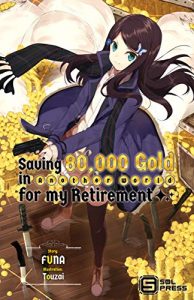
Saving 80,000 Gold in Another World for My Retirement, Vol. 1

By FUNA and Touzai. Released in Japan by Kodansha. Released in North America by Sol Press. Translated by Lukas Ruplys.

This is the third of FUNA’s series to be brought over to the West, but it was apparently the first one serialized (though they do say this and Potions debuted almost at the same time). Having now read all three, there’s no question why Make My Abilities Average! got the attention and the forthcoming anime adaptation: it’s the best of then. Potions gets by on Kaoru being somewhat terrifying rather than cute and plucky, and both it and MMAA have the heroines having to deal with situations where they’re dealing with permanently being in another world, even if they’re loaded up with ridiculous cheats. Mitsuha, though she appears to “die” and be reborn in a fantasy world, in fact has it the best of all of them. As a result, the danger level in this first book is fairly low, and it’s not as interesting as a result. That said, if you enjoy FUNA’s ridiculously OP heroines, there’s a lot to like here.

Mitsuha starts off the book pretty badly, to be honest. She’s not dead like Mile or Kaoru, but her parents and older brother are, leaving her alone and dealing with the fallout. One day at a lookout point, she’s attacked by some young creeps (she’s 18 but looks 12, in the best anime cliche tradition) and they accidentally push her off the edge onto the rocky cliffs below. She wakes up in a forest, and after walking herself to collapse finds herself in a rustic cabin… indeed, in a rustic world. Eventually she discovers that she can transport herself between this world and Japan, and, thanks to some friendly deus ex machinas who explain why she isn’t dead, she also can speak any language and has a healing factor. So what’s a young, recently orphaned young woman to do? Why, earn a pile of gold coins in the fantasy world, convert it over in Japan, and live a life of ease! Except she’s a FUNA heroine, so adventure and ridiculousness is bound to follow.

As with Mile, and especially Kaoru, there is a risk of Mitsuha coming off as uber-smug, especially when she’s doing things like bribing mercenaries to teach her how to use knives and guns, or showing off her general store with amazing inventions such as store-bought shampoo. (There’s also FAR more intrustive fourth-wall breaking in this book.) This being the case, I thought the best scene in the book is when she’s ingratiating herself with the local noble family, all of whom are taken in by her sob story (adapted for the fantasy world), and she gets carried away and calls the patriach “Father”… then starts to unconsciously cry. It’s a reminder that the author really does remember the character backstories, and this is a young woman who recently lost her entire family, who appeared to be pretty loving from what we hear (though the brother was a bit of an otaku). It’s a nice bit of grounding that helps you smile and nod when you see Mitsuha use dry ice and the power of FISH to wow everyone at a debutante ball.

This is my first Sol Press purchase. The translation was good, but the digital formatting was merely eh. They need to figure out how to make the interstitial pictures be one page on their own, rather than having text on the same page. That said, if you’re looking for silly heroines, and have run out of Make My Abilities Average!, this is a pretty good purchase.

Our Dreams at Dusk: Shimanami Tasogare, Vol. 1

By Yuhki Kamatani. Released in Japan by Shogakukan, serialization ongoing in the magazine Hibana. Released in North America by Seven Seas. Translated by Jocelyne Allen. Adapted by Ysabet MacFarlane.

I had heard a great deal of buzz about this title when it was licensed and before, but hadn’t really experienced it beyond people on Tumblr posting pictures of some of the stunning artistic concepts that form part of its story. Having now read the first volume, I remain deeply impressed with the art, but also drawn in by the story and characters. Our Dreams at Dusk gives us a look at LGBT people in Japan and their attempts to deal with these feelings that society – and their own family and peers – tell them is shameful. At its heard is a community founded by the very mysterious “Someone-san”, whose name we don’t know but who has brought together people who need to be able to confess their feelings to, well, someone. It can’t keep being bottled up and repressed. As we see in this first volume, some are more successful than others. And just because you “come out” doesn’t mean your problems are over.

Tasuku is our protagonist, who is high school kid who we fist meet when he’s debating whether he should leap to his death from a high wall. Flashbacks show that someone at high school grabbed his phone and found his browser history, and now are asking if he’s into “gay porn”. He denies it, using a slur he detests, but the truth is that he is gay, though he hasn’t – and feels he cannot – tell anyone or his life will be over. Just the thought of having to return to school the next day drives him to the brink. Before he can do anything, though, he sees a person leap out of a window much higher than where he is. Rushing to the building they were in, he doesn’t find the jumper, but his blurting out that “someone fell” leads him to Someone-san and the group there. Over the course of the book, he opens up to some of them, clashes with others, and continues to go to school, where his crush is on the volleyball team.

Of course, the ensemble cast is important as well. We meet an older man who seems to love Tchaikovsky, a tween-ish child who seems to dislike Tasuku on sight, the friendly and hard-working Utsumi, and Haruko and Saki, a lesbian couple who are still having some issues – Haruko has come out to her family and friends, and dealt with the fallout, while Saki still hasn’t said anything to her family. We also see that the group is not a perfect, all-loving conclave – Saki trying to drag Tasuku into her argument with Haruko shatters the mood a bit. And there is, as I noted, the art, which for the most part is elegant and expressive, but every once in a while shows us a two-page spread of artistic abandon trying to show the torment and desires in the main characters’ hearts. It’d be worth reading the series just for that – but we’re fortunate yo have much more to it.

There’s certainly more to this story, which recently ended in Japan at its fourth volume. I suspect the second one will deal with the kid who clearly does not like Tasuku at all. In the meantime, believe the hype – this is definitely worth your time and money.