Monthly Archives: November 2023

Rascal Does Not Dream of His Student

By Hajime Kamoshida and Keji Mizoguchi. Released in Japan as “Seishun Buta Yarou wa My Student no Yume wo Minai” by Dengeki Bunko. Released in North America by Yen On. Translated by Andrew Cunningham.

With the first two books in the “college” part of this series, I have struggled to see why it’s been ongoing at all beyond “this is now a franchise with ongoing multimedia, you will write more until we tell you to stop” coming from Dengeki Bunko. With this book, I think I’ve gotten a handle on where this is going, helped out by a much stronger “cover character” than the others, even if she’s far less likeable. The original Rascal books were, for the most part, “a traumatic event in someone’s past displays itself as external symptoms that are horrible”, with Sakuta attempting to fix things in the same way that Koyomi Araragi or Hachiman Hikigaya try to fix things, i.e. throw themselves at it with little regard to danger. But Sakuta has learned better by now, helped by Mai literally dying for him, and so self-sacrifice isn’t on the menu. More importantly, the external symptoms are now wonderful.

Sakuta is still doing his cram-school job while also attending college, working his part-time job, trying to figure out what’s up with the Santa girl only he can see, and also spending time with his girlfriend. This is a lot. The prophetic dream thing is still ongoing, and Sakuta has a dream that on Christmas Eve he’s on a train … not with his girlfriend, but with Sara Himeji, a new student in his cram school class who has had two cram school teachers apparently try to make a move on her and be fired. Sakuta is #3, and is determined to avoid that possibility, despite events conspiring against him at every turn. And there’s also the fact that Sakuta from the other world where he’s more competent has told our Sakuta that Mai is in danger because of Touko.

Sara may not be 100% likeable, but she’s one of the best characters we’ve seen in this series for a while. She’s basically not had to struggle her entire life, and people are naturally drawn to her. As a result, when something does not go the way she wants, it ends up devastating her in a way that’s pretty easy for Touko to exploit. The best part of the book is the solution to the problem, as Sakuta spends most of it doing detective work to try to find a way out of this dream future, and ends up going with “do what the dream says and see what happens. But then Mai invites herself along. Mai being part of the solution is something that works very specifically for Sara, who is poleaxed at seeing what a real couple really in love is like, and when Mai starts reeling off things she loves about Sakuta and informs her she can do this all day, it cracks the Adolescence Syndrome like an egg. You can see and hear Sara grow up.

There is an ominous cliffhanger to this book, which implies that once again the universe is out to kill Mai. That said, the title of the next book is Rascal Does Not Believe in Santa Claus, so presumably we’ll confront Touko at last.
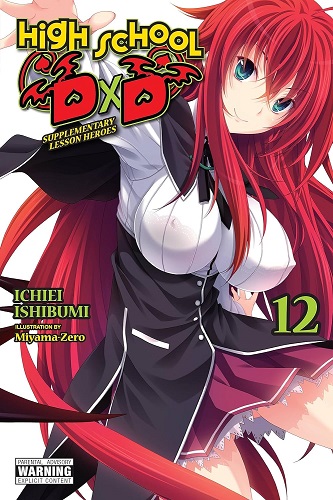
High School DxD: Supplementary Lesson Heroes

By Ichiei Ishibumi and Miyama-Zero. Released in Japan by Fujimi Fantasia Bunko. Released in North America by Yen On. Translated by Haydn Trowell.

I’ve talked before about how difficult I find it to review this series without just constantly saying the same things over and over again. There’s only so many times you can say “this is just combining shonen battle manga with ecchi harem manga” before the audience starts to nod off. And it’s the same with this book. Boy, those sure are some cool fights. They sure do bust out new special moves they got after training hard. And yeah, Issei really likes tits, news flash, film at 11. With this one I thought I’d have a bit more to work with, given the last volume ended with Issei being killed off. As I read it, I also realized that I could talk about how all the women were sidelined so that the male characters could get all the important fights. I could talk about that as well! Then the author, in the afterword, says “hey, did everyone notice the women were sidelined and the men got all the fights?”. So back to the first of those points, I guess.

As you might guess, the bulk of this volume is narrated by Kiba, given that Issei is dead. Kiba is devastated by this, of course, but he’s also the only one who is not romantically in love with Issei (possibly… more on that running gag later), so he’s the only one who can actually tell us what’s been happening and what’s going to happen next without having it just be silence or sobbing. Because the Gremory Family is shattered. Rias and Akeno won’t leave their rooms, Koneko, Ravel and Asia can’t stop crying. Fortunately, the rest of the family is off getting extra training/powerups after getting the crap beaten out of them, so they’re not there to be devastated by the news. That said, even from the end of last volume we suspected Issei would be back. After all, the dragon has not found a new person to give its power yet. And the Evil Pieces are still linked to Issei. Can he possibly return from the dead? In a way that doesn’t involve breasts?

Believe it or not, the answer to that last question is mostly yes, though there is a certain amount of “clap for Tinkerbell” involving chanting the Breast Dragon catchphrase involved. But yes, Issei comes back from the dead, and may arguably be more powerful by the end of the book. And he gets a date with Rias at the end as a reward. As for the rest of the heroines, I hope that they take a lesson from this and try to get a bit less dependent on Issei, but I’m not all that optimistic – they are young women in love, and it is a shonen series. The heroine who comes off best in this book is, of course Kiba – and yes, he is described in the afterword as a heroine. I’m not usually fond of the whole “make lots of jokes about men being attracted to Issei but have him no homo his way out of it” as a plot device, but for some reason with Kiba it just works. It helps that he has no concrete romantic interest in anyone female.

We’re told this is the end of an arc, and the next arc will be introducing magic users and also getting deeper into Gaspar’s nature. That said… there’s another short story volume next. Gotta be patient, I suppose.

Haibara’s Teenage New Game+, Vol. 5

By Kazuki Amamiya and Gin. Released in Japan as “Haibara-kun no Tsuyokute Seishun New Game” by HJ Bunko. Released in North America by J-Novel Club. Translated by Esther Sun.

In my review of the last book I mentioned that I was not entirely sure where the series would be going after this, since it seemed to end so decisively with the fourth volume: Natsuki has confessed to Hikari, rejected Uta as best he could, and also done a “God Knows” musical moment on the crowd. But of course, having a fulfilling high school life is the goal that he had when he went back in time, and romance is not the only thing in high school. That said… it is a pretty big thing. The Fellowship is still a bit broken after he made his confession, with Uta pouring everything into basketball and Tatsuya completely remaking his entire personality. And there’s the fact that he’s childhood friends and best friends with Miori… which makes everyone think they’re ALSO dating, and makes Hikari a little jealous (though she won’t say it out loud). That said, most of what we get in this volume is the other high school mainstay: sports!

No, it’s not a full blown sports festival (which is a shame, as I wanted to see some bread eating and scavenger hunt antics), but a ball game competition. The class divides into groups, each doing a different sport. For Natsuki’s class, the boys have basketball and the girls have soccer. That’s fine by Natsuki, who has all the training he got in his past life when he was trying desperately to be a cool athlete. But the actual cool athlete, Tatsuya, is still in an incredible funk over giving Uta up to Natsuki and then having Natsuki reject her anyway. As a result, he’s trying to BECOME Natsuki, pouring effort into studying to raise his grades. But does Uta even want someone who’s “just like Natsuki”? Also, is Miori finally going to snap, or will that wait till next book?

We’ve guessed that Miori has a hidden crush on Natsuki since the start of the series, but it’s now getting a lot less hidden. For one thing, she’s dealing with nasty rumors that she’s cheating on Reita with Natsuki, because they’re both on the Sports Committee and also clearly close. She’s also not dealing with with his new relationship with Hikari, trying to distance herself from him but failing, and pulling off a genuine “What if… I was in love with you all this time… ha ha just kidding… unless?”. Most importantly, Reita is well aware that she loves Natsuki, and is basically patiently waiting for her to either get past it, confront Natsuki, or break up with him. None of those things is happening. She and Natsuki are both much better at giving advice on love than dealing with it themselves, to be honest – Natsuki is flailing around trying to figure out how to behave when dating someone, and both he and Miori are fantastic when getting their cute nerd friends to confess to each other but less so otherwise.

So yeah, it turns out that returning to high school not only gets you a rainbow-colored youth but also typical high school drama. Still a fun series in the high school romcom genre.