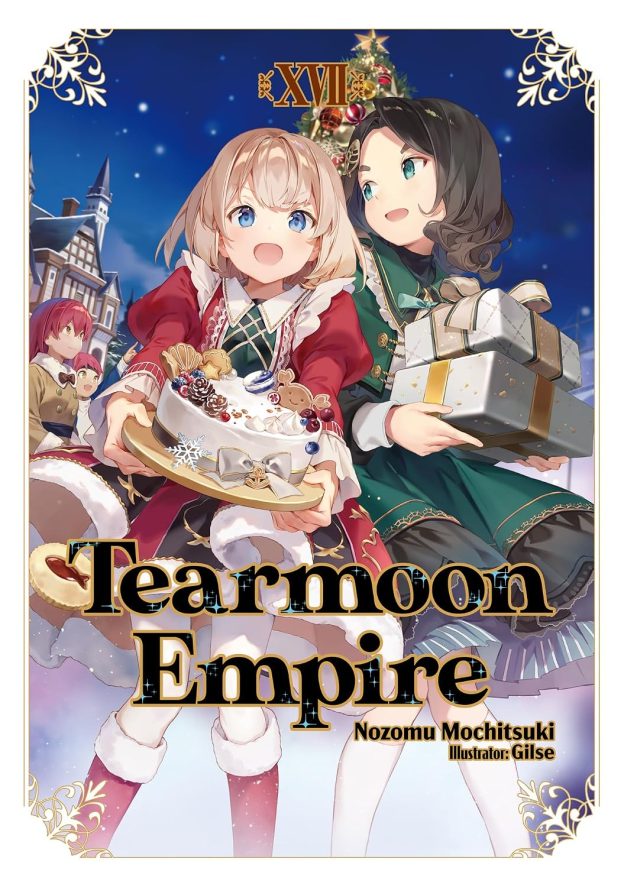
By Nozomu Mochitsuki and Gilse. Released in Japan as “Tearmoon Teikoku Monogatari” by TO Books. Released in North America by J-Novel Club. Translated by Madeleine Willette.
We’re now seventeen books into this series, short story collections aside, and Mia has gotten very good at actual princess things. Sure, she sometimes faces death from things like assassins (as in this book, where we get to see something rare in fictional works, armor actually doing its job in a realistic way), but for the most part, Mia is no longer in any danger of the world turning against her and getting guillotined. As such, Mia has to face an even more dangerous fate, and one that so far she has been very bad at stopping: people in the future thinking TOO highly of her. Mia wants to be a good Empress and avoid execution, she does not want to be worshiped as a God. And when the suggestion of a giant golden statue of her hits her ears, she naturally tries to do everything possible in this book to transfer praise and worthy deeds to others and avoid doing everything herself. Which… works somewhat, but it’s still a C+ overall.
We pick up where we left off last time, with Princess Orania accused of trying to assassinate her father, and then escaping. Now Mia is trying to do damage control, which involves talking with the King (doesn’t help much), getting an in with the merchants (works much better), and meeting with the nation’s Parliament, where she lays out a way that “stop treating your underclass like crap” can work for them (even better). Unfortunately, this does not stop the rest of the plot, which involves escaping, getting captured, cool sword battles, escaping again, getting captured again, and everything ending at a lighthouse, which Mia desperately wants to avoid as it’s where the future suggests her golden statue is put! Does Mia have enough allies and enough power of speechifying to save the day?
This can be a very idealistic series, but at its core is a very dark and bitter future, and even now that we’ve mostly escaped that future we still see where it came from. The actual conspirator behind everything turns out to be so indoctrinated by the serpents that talking to them isn’t going to work, and in the end, despite our getting the backstory behind Orania’s father, the “does not really care about his daughter” part is mostly present and correct – more to the point, he doesn’t care about anything except his past love. There’s no “I was doing tough love in order to save you”, which I was expecting. I do appreciate that Orania is able to get past this and use it to be stronger. Using Mia as a guide, as Mia again does very well here, narrator and gorging on sweets aside. (There’s some fat-shaming again, I fear I will never be entirely rid of that.) The idealism comes in Mia’s speech, where she rails against the pointlessness of revenge and inspires everyone to work harder for the future of their children. The narrator did not talk about people misinterpreting Mia at all in this volume – they interpret her just fine.
Presumably, then, the next volume will start a new arc. I’m not sure how long this series plans to run, but I’ll always happily read more.