Category Archives: reviews

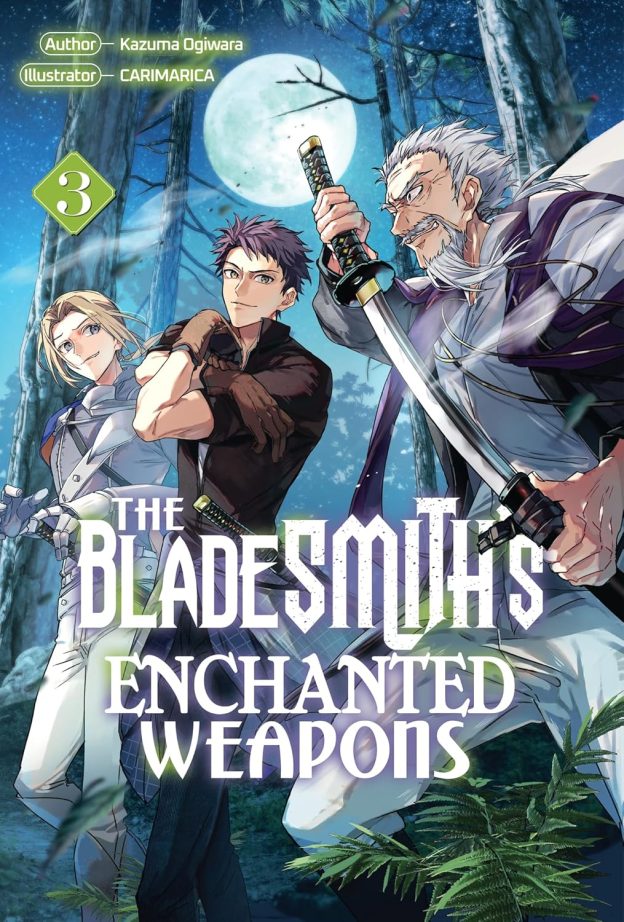
The Bladesmith’s Enchanted Weapons, Vol. 3

By Kazuma Ogiwara and CARIMARICA. Released in Japan as “Isekai Toushou no Maken Seisaku Gurashi” by Kadokawa Books. Released in North America by J-Novel Club. Translated by Ryan Burris.

We’re very used to seeing light novel titles where “the title is the plot” by now. They’ve become a joke now, usually involving a long title, a colon, and an even longer subtitle. The Bladesmith’s Enchanted Weapons does not have such a long title, but it falls under this category as well, as by now every volume’s plot has been set into motion by Lutz crafting a weapon, Gerhard enchanting it, and chaos accidentally springing from giving it to someone. The Japanese title translates a bit longer, but that also brings up something odd: it distinctly called Lutz an “isekai blacksmith”, but so far there’s nothing whatsoever indicating that’s true. Indeed, the third volume hammers home even more that Lutz’s father lived in this world and died in it. What seems to be the “isekai” part is simply that they’re making katanas, rather than the usual fantasy broadswords. The smithing technique is from another world… and it’s causing just as much of a mess as any potato-kun making mayonnaise does.
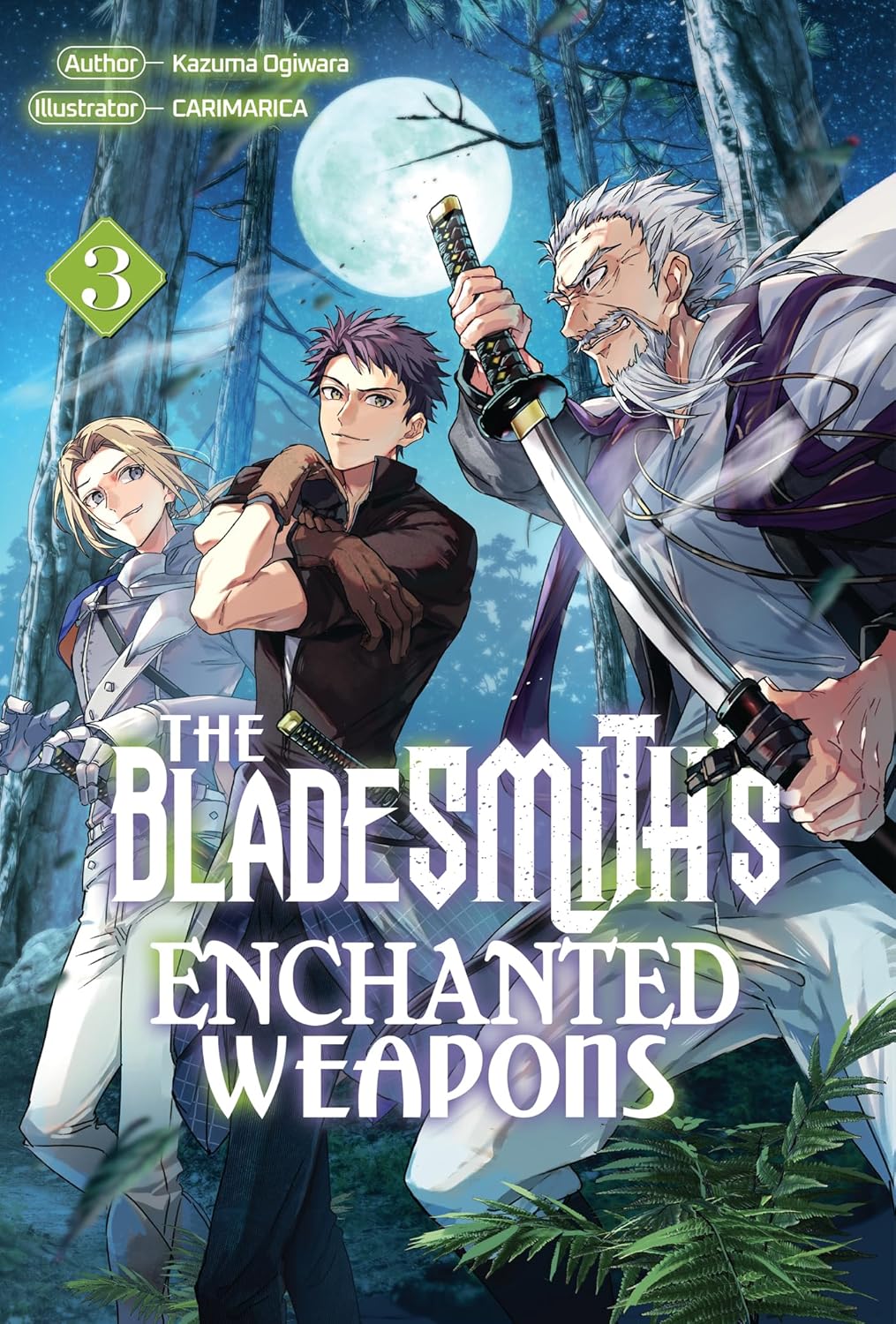
Last time I said I hope things would be a little better in the next book for Princess Listill, and I guessed I jinxed myself, as she really doesn’t have a good book. She’s on her way to visit Claudia, who she now regards as a big sister, when she’s kidnapped by bandits, who kill her guard knights and drive off the servants going with her. Given that she wouldn’t have been kidnapped if she weren’t going to visit Shander in the first place, the count sends an elite team to rescue her… and Lutz goes along as well, of course. She is rescued, and even manages to not get raped, because the bandits are ex-soldiers who were treated like murderers after the war ended, and are just trying to air their grievances before the king. Sadly, while their grievances are aired, the rumor mill is what it is, so everyone assumed the worst happened to the Princess, who is now “used goods”. And then things get worse.

In case you were wondering, rest assured Claudia is in this book a lot, and she and Lutz have a very active love life. She’s also good at strategy… though not as good as she thinks she is. I appreciated that the end of this volume showed that while Claudia is very clever, she still lacks experience and can be, as she disparagingly says, only good for her big, stupid butt. (Which is mentioned more than once – this author knows their audience). It’s not only her fault, though – Lutzx has got to start making katanas that turn everyone who gets them a bit crazy, because it’s starting to actually influence the politics of the region. And I didn’t even mention the secondary plot, a horror story where the dungeon in their domain has been seeing a lot of missing adventurers and a lot of mysterious jewels… or things that look like jewels.

This continues to be a series that you mostly read if you like watching guys acting cool. There’s a lot of that here. I quite like it.
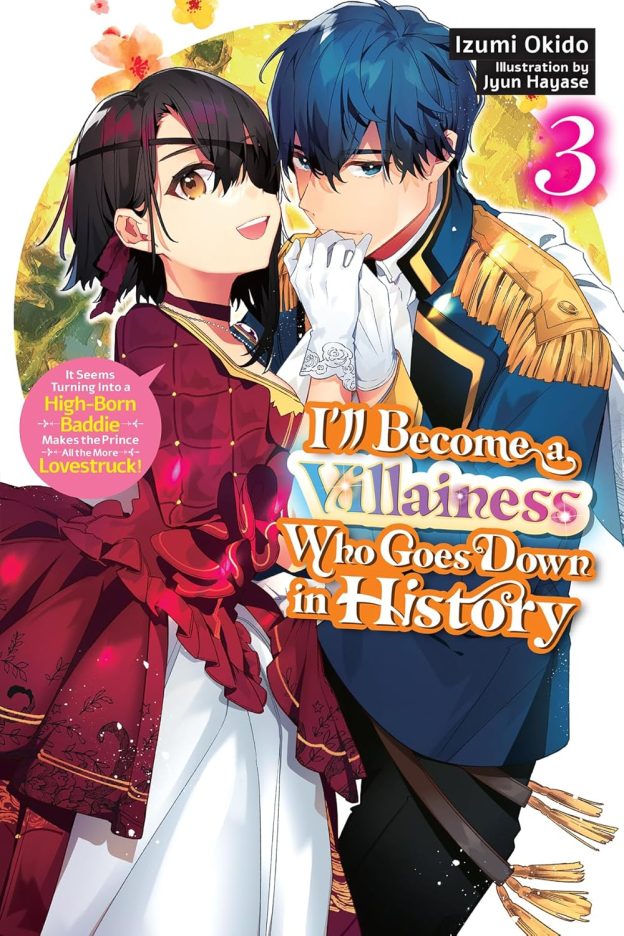
I’ll Become a Villainess Who Goes Down in History: It Seems Turning into a High-Born Baddie Makes the Prince All the More Lovestruck, Vol. 3

By Izumi Okido and Jyun Hayase. Released in Japan as “Rekishi ni Nokoru Akujo ni Naru zo: Akuyaku Reijō ni Naru hodo Ōji no Dekiai wa Kasoku suru yō desu!” by B’s-LOG Bunko. Released in North America by Yen On. Translated by Sarah Moon.

She’s not in this volume much, but I will admit I have started to wonder what this series is going to do with Liz. For the most part, these sorts of “the good villainess is balanced by a bad heroine” style books tend to overbalance the heroine into being genuinely evil, or incredibly incompetent, etc. It’s easy to see what’s going to happen to them. Liz is not quite like those in that she’s charming people into loving her, but not deliberately, and it’s basically causing folks to affirm her own misplaced idealism. Unfortunately for her, the rest of the cast really hate her, and I’m fairly sure that exile is probably going to be her best outcome here, and genuinely snapping may still be on the menu. Sometimes you’re just the wrong archetype in a book that’s about someone else. Speaking of what someone else, let’s check in on Alicia.

Alicia wants to investigate Laval, but she can’t simply take a field trip into another country, especially when their own country is chock full of magic users and Laval doesn’t have any of them. So she’s going to have to figure something out. Fortunately for her, Duke suddenly loses all his memories of her, and everyone around says that she’s the one who did it – something which she leans into almost on impulse, because she literally cannot resist trying to be a drama queen. Hey, presto, she’s exiled to Laval so quickly that you’d almost think that it was a deliberately ploy on the part of Duke. She arrives disguising herself as a boy and quickly ends up part of the knights who work for the second prince, who is trying to find an achievement that will let him take the throne. An achievement that may need… magic.

It is sometimes interesting seeing the narrative through the eyes of Alicia, who is living it as if she’s the protagonist of a light novel and to whom dramatic events constantly happen, and the rest of the cast, who are actually part of reality and are forced to deal with the darker bits that Alicia touches upon but rarely stays long. The reunion of the king and his brother is agonizingly awkward, especially when you consider that a lot of the cause of their strife is, well, still around. Alicia may be delighted to be exiled, but for Gill it’s a nightmare, and to make matters worse he’s at Duke’s side through most of the book, so he can’t even pine properly for the girl he loves because the much better love interest is next to him. As for Alicia herself, we’re rapidly finding out that she may want to be a villainess, and has been told to play a villainess, but she has a much more important hidden role. Which, well, Liz is not gonna like.

This isn’t top tier villainess, but it’s solid, and fans of the genre should be quite pleased.

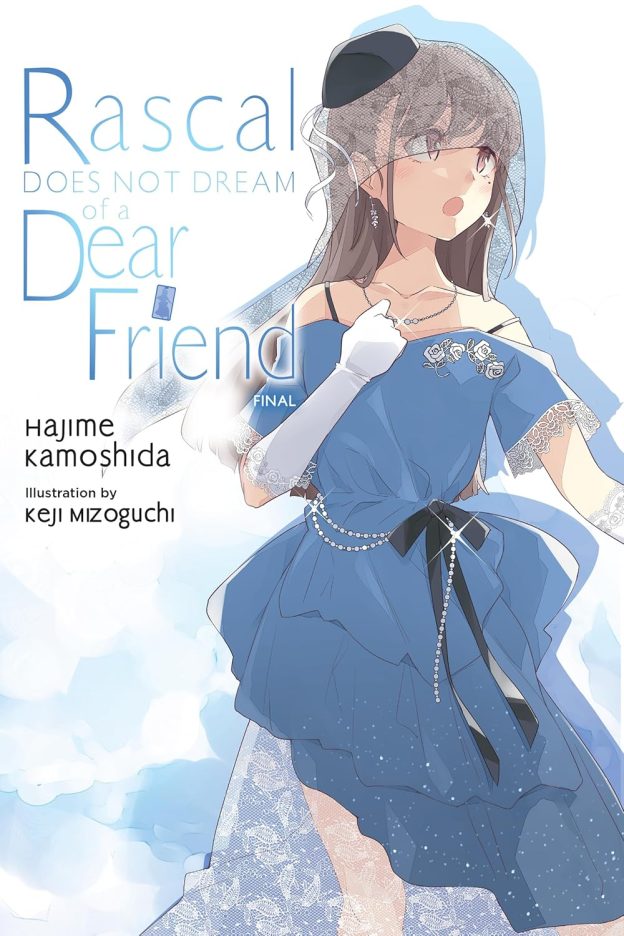
Rascal Does Not Dream of a Dear Friend

By Hajime Kamoshida and Keji Mizoguchi. Released in Japan as “Seishun Buta Yarou wa Dear Friend no Yume wo Minai” by Dengeki Bunko. Released in North America by Yen On. Translated by Andrew Cunningham.

And so the Rascal books come to an end (leaving aside any short story or side story collections) with a volume just as short as the previous one. The main conflict from the last few books gets solved fairly quickly and easily, so much so that we realize that it was a fakeout, and we’re right, as the real conflict is with Sakuta himself. Well, that and maybe the publishers. I’ve talked before about how the series has always felt a little artificially extended after the 9th book, and that Sakuta in college but still dealing with all the Adolescent Syndrome stuff felt tacked on. Turns out Sakuta agrees with me – no, not the Sakuta we’re familiar with, but his alternate-world “perfect” Sakuta, who has come by to let him know that there are many and infinite alternate realities around them, and they all think Sakuta sucks, because he’s managing to break all of them.

When we last saw Sakuta, everything was terrible as Mai announced to the world that she was Touko. Now he has to make things right, which involves getting deep into the heart of Miori’s relationship with Touko and why her repressed feelings are actually making things worse. This is resolved, and thanks to Mai doing a quick “this was all an April Fool” bit, no one believes that she’s Touko anymore (including Mai herself). Unfortunately for Sakuta, all the OTHER reality-altered dreams are still present and correct – there are two Kaedes, Yuuma is dating Rio, etc. As it turns out, Miori is more than just the last in a string of women Sakuta has to help, she’s a dimensional nexus point of sorts. While everyone else has alternate versions of themselves (which we’ve seen with the alt-Sakuta), there is only one Miori. That said, most of this has little to do with Sakuta’s actual problem – how does he fix everything?

Despite the fact that this seems like the 15th book in a row where Sakuta takes a lot of public transportation lovingly described until a solution occurs,. there are things I really enjoyed here. Touko’s final song being a palindrome made it very life affirming, and I wish Miori luck in finding a Touko who isn’t dead. I also liked Sakuta’s discussion with the alt-Kaede, and her own simple solution to his “problem”. His problem is phrased as “grow up”, and the solution is pretty neat, and ties into something we’ve known about Sakuta from the very start – I appreciate how this fixes everything. The biggest issue with the book, and possibly why the last two were so short (well, that and artist illness) is that it’s padded out. Sakuta goes round in circles a lot here, and at one point takes us on a tour of iconic Rascal Does Not Dream locations. Like his alternate self, I wanted Sakuta to get with it and solve everything, not mope around.

The book ends with an epilogue set two years later, with stuff I really liked as well as a few things I’m eeeeh on (why do people love student/teacher relationships? Who are not students?). Sakuta and Mai are still exactly the same as before only with all their issues resolved – sorry, no engagement, marriage, or honeymoon scenes. Basically, everyone has grown up. Rascal went on too long, just like its hero, but I liked it a lot.