Category Archives: reviews

Dahlia in Bloom: Crafting a Fresh Start with Magical Tools, Vol. 3

By Hisaya Amagishi and Kei. Released in Japan as “Madougushi Dahliya wa Utsumukanai” by MF Books. Released in North America by J-Novel Heart. Translated by Nikolas Stirling.

I mentioned this in my review of the second volume, but it bears repeating: These two are a wonderful couple who absolutely should not get together at this point. Even the rest of the cast agrees with me. No one dares bring it up with Dahlia, who is still being treated with kid gloves, frankly (then again, it has only been a month since she was dumped by her fiance the day before her wedding), but everyone is planning for her business to be SO successful that she gets made a baroness, which would solve most of the issues with her marrying Volf. Not that she really has clued in to her own feelings yet. Volf has clued in to his own feelings, but his solution to the problem of class differences is terrible, as is fortunately pointed out to him by his older brother. Really, for the moment, they’re best as they are seen here: inventing new things, creating hilariously bad and terrifying magical swords, and eating and drinking a lot. A whole lot.
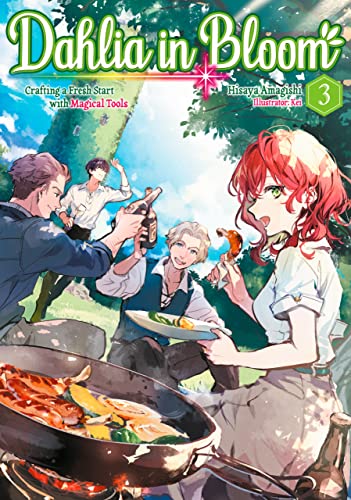
Much of this volume is spent with Dahlia trying to find a way to make the portable stove even smaller, so that it can be easily carried by knights when they go on their missions. We get into the nitty gritty of materials needed, cost, and how much to change – this book does not skimp on the business insights. That said, Dahlia is still showing off some painful naivete in this book. She’s trying to deal with the gossip about her and Volf, but it’s not something that you can just smile and hope it goes away. More concerning is the fact that she has so little self-worth that she gives away valuable creations at the drop of a hat, not realizing that she needs to convey a better idea of what she is as a proprietor rather than as a friend. As for Volf, well, his biggest concern is a monster that creates an illusion of a loved one – something Volf has never really had to deal with until now.

We already pretty much knew that Dahlia was having trouble dealing with the death of her father, and here we see that she’s also still having trouble dealing with her previous life in Japan, where she had a still living mother when she overworked herself to death. Honestly, she may have a similar fate here unless events conspire to get her and Volf together, as we see her lose track of the entire day working on another invention. She also says she plans to never get married, which is fine right now given that she and Volf are already acting like – and are mistaken for – a married couple. You can absolutely see where the rumors come from. The scene where they buy the matching glasses and amphora in order to have even better alcohol is really great, and shows that when they do manage to get past their own personal demons, they will be an amazing power couple.

But that’s for future Dahlia volumes. For now there is outside barbecue, a strong cider, and Dahlia’s vague feeling that she wants Volf to be by her side forever. Huh. Wonder what that’s about?
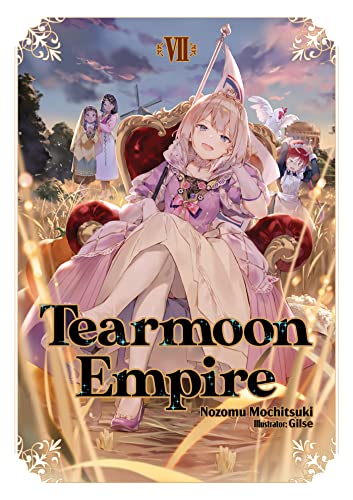
Tearmoon Empire, Vol. 7

By Nozomu Mochitsuki and Gilse. Released in Japan as “Tearmoon Teikoku Monogatari” by TO Books. Released in North America digitally by J-Novel Club. Translated by David Teng.

The narrative voice is one of the most well-known parts of this series, but we do occasionally see inside Mia’s own thoughts as well, and when we do we can sort of get what the narrator is talking about. There are several points in this book where Mia is essentially being a petty, selfish and gluttonous princess – we see how she thinks. In those cases, yes, the fact that everyone misinterprets her can be ridiculous. That said, we also see many times in this volume Mia’s sharp instincts to avoid the guillotine, and those are top-tier. When Mia doesn’t think but simply reacts, be it to a death flag or when she sees one of her friends is unhappy, she shines. And heck, even her selfish pettiness doesn’t last long – her desire to see a money-grubbing merchant suffer is thrown out the window when she sees him legitimately suffering the aftereffects of a heart attack. In this book we really do see that if she does become Empress, she might just do OK.

The first fifth of the book wraps up the third “arc” we’ve been reading, with Mia returning home for the weeklong festival to celebrate her birthday, as we are reminded that her father is, not to put too fine a point on it, a freak. That said, it’s the colors Mia wears to her party that make the impression. After this we move into a new arc which features Mia, having set up an excellent program to combat famine, trying hard to keep it from collapsing. Chaos Serpents are still trying to sow discord, but we also have to deal with those who realize that a famine can be a great way to make a pile of cash if you’re the one delivering the food. Now Mia and Ludwig have to face off against an antagonist who Mia remembers from her past life… when things ended in disaster. Can she turn things around with the help of a commoner studying medicine and the power of wheat?

This is usually the point of every review where I get annoyed at the narrator for harping on Mia being chubby, and yeah, it’s here as well. That said, we also see Mia chiding herself for a different kind of flab. A couple of times in this book she makes the mistake of being complacent, and that’s when disaster pricks at her intuition. Given that there is a secret society whose goal is to destroy her and her kingdom, Mia simply can’t stop and just relax. I think, in time, this will become second nature to her – she just needs to have her thoughts map to her instincts more. She also has help. Ludwig is hilarious here, taking on the brunt of “misunderstand Mia in a positive way” and realizing that if you truly want to change everything about the Empire, might as well also let people like him be Chancellor. As for Shalloak, the “evil” merchant, his story actually ends up being heartwarming and tragic at the same time – the benefits of people dreaming of their past lives in another world.

Add to this one of the best side stories in the entire series, where a search for cake will make you cry, and you have a fantastic volume. Each one of these is a treasure.

Strike the Blood, Vol. 20

By Gakuto Mikumo and Manyako. Released in Japan by Dengeki Bunko. Released in North America by Yen On. Translated by Jeremiah Bourque.

I’d like to welcome you all and thank you for coming to another one of my attempts to review the latest volume of Strike the Blood. If you’re reading this, I assume that either you are a hardcore fan of the series (and have therefore, no doubt, seen the anime that has already adapted this volume) or you just enjoy reading about me trying and failing to get 500 words out of a series whose main plot is “cool action sequences for 279 pages”. It’s always felt like a novelization more than a novel, but here in English, where we’re reading the novels after the equivalent anime, it’s even more apparent. This is, essentially, the final arc, Part 2 of 4. It will therefore not surprise you that it ends with a bit of a downer, though honestly not as much as previous books. That said, fans will feel relieved to hear that Kojou says “my fight” and Yukina corrects him with “No, senpai, this is OUR fight”, so all is present and correct.

As noted, for the most part this is the second part of what we saw last time, so there’s still a lot of Itogami Island being divided into factions that are fighting for supremacy. We do, however, get the reason that this is happening: Avrora is alive again, and that means Kojou does NOT have all 12 beast vassals… meaning he’s essentially about to spiral out of control. There’s two main ways to solve this: kill everyone on the island by removing their memories and reason (bad), or kill Avrora (kind of what they’ve been trying not to do for the last several books). This therefore sets up most of the book, which is a lot of plotting, counterplotting, and friends turning against each other for the greater good and then feeling like absolute crap about it afterwards. That said, Kojou’s actual solution SEEMED like a good idea at the time, but…

The end of the book, i.e. Kojou’s fate, is honestly something I thought we’d have gotten about a dozen novels before now, so I’m relieved to see it here right before everyone gathers for the big finale. It’s still a powerful moment, mostly because it’s so quiet, just him and Yukina sitting watching the horizon after completely failing to stop the end of the world. Also a surprising scene, and showing that the author is perhaps getting a handle on light-hearted stuff at last, is Kojou in the shower, struggling against his vampiric instincts, and then Kanon, Shizuri AND Yukina all offering him their bodies. Separately. Which means it briefly turns into a British farce. That’s not the surprising thing, the surprising thing is that Kojou doesn’t get beaten up for it. Perhaps we have graduated from the Rumiko Takahashi school of slapstick.

Presumably next time we will be headed to the big island in the sky to have yet more exciting battles that are very hard to review. Till then, please enjoy another Strike the Blood. It is what it is.