Category Archives: reviews

A Tale of the Secret Saint, Vol. 2

By Touya and chibi. Released in Japan as “Tensei Sita Daiseijyo ha, Seijyo Dearuko Towohitakakusu” by Earth Star Novels. Released in North America by Airship. Translated by Kevin Ishizaka. Adapted by Matthew Birkenhauer.

At least I can respect its consistency, as the 2nd volume of Secret Saint has exactly the same flaws as the first volume did. It can be a lot of silly fun, especially when Fia is forced to be the straight ma in the group despite the fact that she is an airhead 100% of the time. This even holds true, mostly, for the fighting scenes when our heroes are battling the most deadly monsters they’ve ever seen before and Fia reacts the same way you would if you spotted a blue tit in your bird book. On the other hand, it does mean that when we get to the more serious stuff involving the pasts of both Fia and Zavilia, it feels out of place. It’s written well, don’t get me wrong, but out of place. Also not helping things is that this book is technically only 130 pages – the other 80 or so are side stories, interludes and bonus stories, meaning we don’t get much of the main plot.

After the events of the first book, it’s clear that Quentin, at least, has figured out who Fia’s tamed familiar really is. Unfortunately, that makes him into goofy airhead #2, as when he’s talking about powerful monsters he gets obsessive and over the top. The knights are going to set out on a mission to try to drive out the black dragon that is presumed to be in the forest and send it back to its lair, thus solving the “why are so many monsters hovering around here lately?” problem. There are two issues with this plan: 1) the reason the powerful monsters are coming around is they’re drawn to Fia; and b) the powerful black dragon is in fact the familiar that she’s putting bows on to make it look cuter. Still, I’m sure nothing will go wrong, even if it means forcing all the soldiers to deny everything they just saw.

While they feel awkwardly out of place, I will admit that the more serious parts of the story are also the most memorable. Zavilia’s past is the Ugly Duckling gone horribly wrong, and its moral is basically “people are assholes even if they’re dragons”. Far more impactful is Zackary, the most sensible of the captains, trying to get Fia to confess who she really is. She almost does, and feels like she can trust him, but when she starts to do so she has a complete panic attack. This is quite well handled, and Zackary does a good job of helping her recover and backing off, but it’s clear that the trauma of her past life is not remotely something she has gotten over, and therefore allies are going to need to either rely on good faith or assume that the world has turned weird.

I’d argue that if you’re looking for fun overpowered dimwitted swordswomen, Reborn to Master the Blade is probably a better choice. This is still pretty good, thogh, I do hope volume 3 gives us a bit less “let’s pad out the book with other people’s POV”.
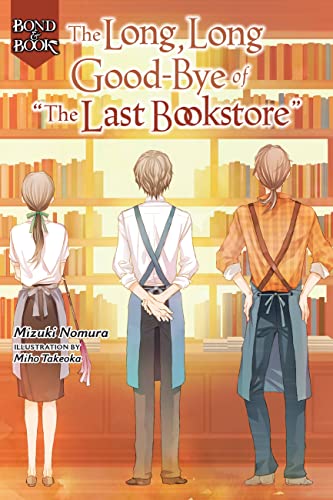
Bond & Book: The Long, Long Good-Bye of “The Last Bookstore”

By Mizuki Nomura and Miho Takeoka. Released in Japan as “Musubu to Hon: “Saigo no Honyasan” no Nagainagai Owari” by Famitsu Bunko. Released in North America by Yen On. Translated by Nicole Wilder.

If you are reading and enjoying Bond & Book, as well as the author’s prior series Book Girl, then I am going to assume that you are a fan of books. Not just “Oh hey, I like reading” or “I always get the new release of Index when it comes out”, but someone whose entire life is tied up in reading and the titles that have impacted them. Certainly this series is both about and for those people, and while it takes the time to explain the books that it focuses on, there’s a greater depth if you’ve already read the stories in question. Not that I expect too many light novel readers will rush out to buy The Field Guide to Extinct Animals, but certainly The Seagull and The Scarlet Letter are very important to this volume, and being familiar with both stories lends them an added emotional impact. Which is surprising, as the author already knows how to pack quite an emotional punch without the references.

After introducing us to what seemed like our main cast in the previous book, this volume sees Musubu on his own. the reason for that is that he’s gone to a distant town where the bookstores have been shutting down one by one. Only one is left now, and its owner just died in what was seemingly a tragic accident. Now it too is going to close, and Musubu is there to make sure that the books are cared for in their final days there. This irritates Minami, the bookstore’s longest-serving part-timer, who not only felt a close kinship with the former owner but is creeped out by this teen who says that he can talk to books – and they talk back. As the days pass and the closing of the bookstore becomes a major event in the town, will we find out about the owner’s past history and secrets?

Unlike the first volume in the series, this one is more of a novel than a short story collection – in fact, the afterword makes me think the author wrote this one first. It overflows with the love that you can get from reading a beloved book, and how that love can also lead to different things. A couple who loved each other from afar when they were teens reunite years later thanks to The Tomb of the Wild Chrysanthemum. A boy who has become terrified of earthquakes is given a fun series about aliens to read that will calm his mind. And, in the main plotline, an actress and a writer both have ties to this bookstore and its owner, and they’re more than just the Chekhov and Hawthorne stories that wrap around their lives. The ending of the book is incredible, wringing emotions out of you, and making you think that, years from now, maybe Bond and Book will be the series that lodges itself in your heart.

There’s two more volumes out in Japan, and this delights me. I just want to read more from this author, whatever it is. And I want to go back and re-read The Seagull. (Not The Scarlet Letter, though. Sorry, Nomura-san, your work can only take me so far.)

Chitose Is in the Ramune Bottle, Vol. 1

By Hiromu and raemz. Released in Japan as “Chitose-kun wa Ramune Bin no Naka” by Gagaga Bunko. Released in North America by Yen On. Translated by Evie Lund.

Manga and light novel trends tend to feel into each other, with parodies, homages, and deconstructions of the hot new thing happening three years later and becoming the next hot new thing. Nowhere is this more apparent than the halls of Gagaga Bunko, home to the cover art where every series looks exactly the same. Gagaga, I’m sure, must also have fantasy and isekai titles… but those aren’t licensed here. Instead we started with My Youth Romantic Comedy Is Wrong As I Expected, where a cynical so-called loner psychoanalyses the nature of high school cliques. Then we saw Bottom-Tier Character Tomozaki, easily the most popular of the subgenre of “the popular kids can even turn you, a loser, into one of their own”. And now we get Chitose Is in the Ramune Bottle, where the main character IS the popular kid, and you will be surprised and shocked that he too has something to say on the nature of popular kids and high school cliques. Everyone’s riffing on someone else.

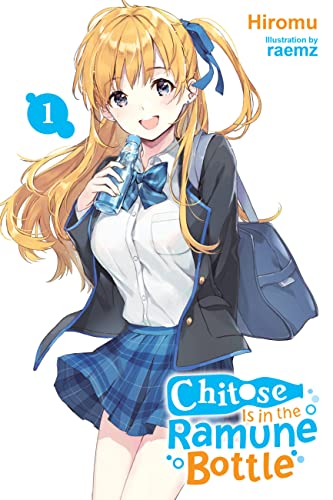
No, that’s not Chitose on the cover – Chitose Saku is our hero, a handsome cool high school kid who enjoys school and hanging out with his equally popular friends. He has several girls who are interested in him. He’s almost immediately made class president. He’s living the good life. And now he has a job to do, as the teacher has asked him to try to get Kenta, an otaku nerd type, to come back to school – he’s stopped going after getting shut down by a girl he confessed to. Chitose goes along with this, managing to get Kenta out of his room with a nice combination of encouragement, hot girl and good old fashioned violence. But Kenta, who whines about how Chitose gets everything handed to him and an easy life as a popular kid, decides to show Kenta how to actually make an effort.

As you can see, this synopsis bears more than a little resemblance to Tomozaki (Kenta is even named Yamazaki), and we do indeed get the “let’s shop for clothes that are not otaku schlub” and “here is how to actually converse with another person” scenes. At the same time, it also mocks that trend of “self-help” books as unrealistic, showing how difficult it can be to try to change your image and personality and not immediately get attacked. There’s a whole lot of jerks in this book, and the way Chitose and his friends handle them is a good look at “don’t punch down”. As for Chitose himself, he’s a protagonist who cries out for more than one book, so it’s a good thing this won an award and got a series. There’s hints of his past as well as his need to live up to his reputation that might get darker in later books. But overall, he and his friends are very likeable, fun people. If you’re reading this as you heard it was “romcom starring the popular kids”, you won’t be disappointed.

I will note that Chitose can come across – deliberately, he’s clearly doing it on purpose – as smug much of the time, and this may grate on readers who are more used to cynical sad sack narrators. That said, I am very curious to see how this handles being an ongoing series and how much we can peel back Chitose’s hero complex.