Category Archives: reviews

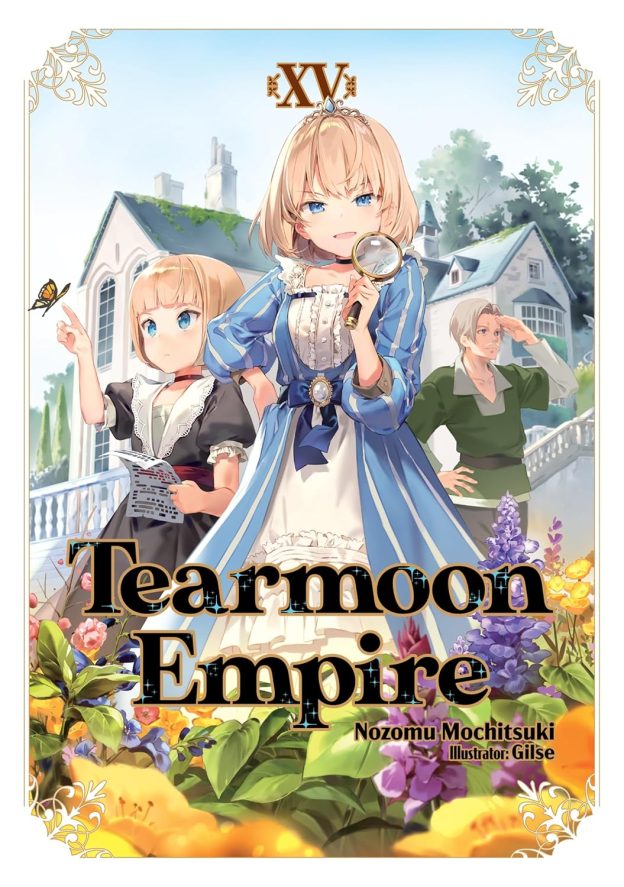
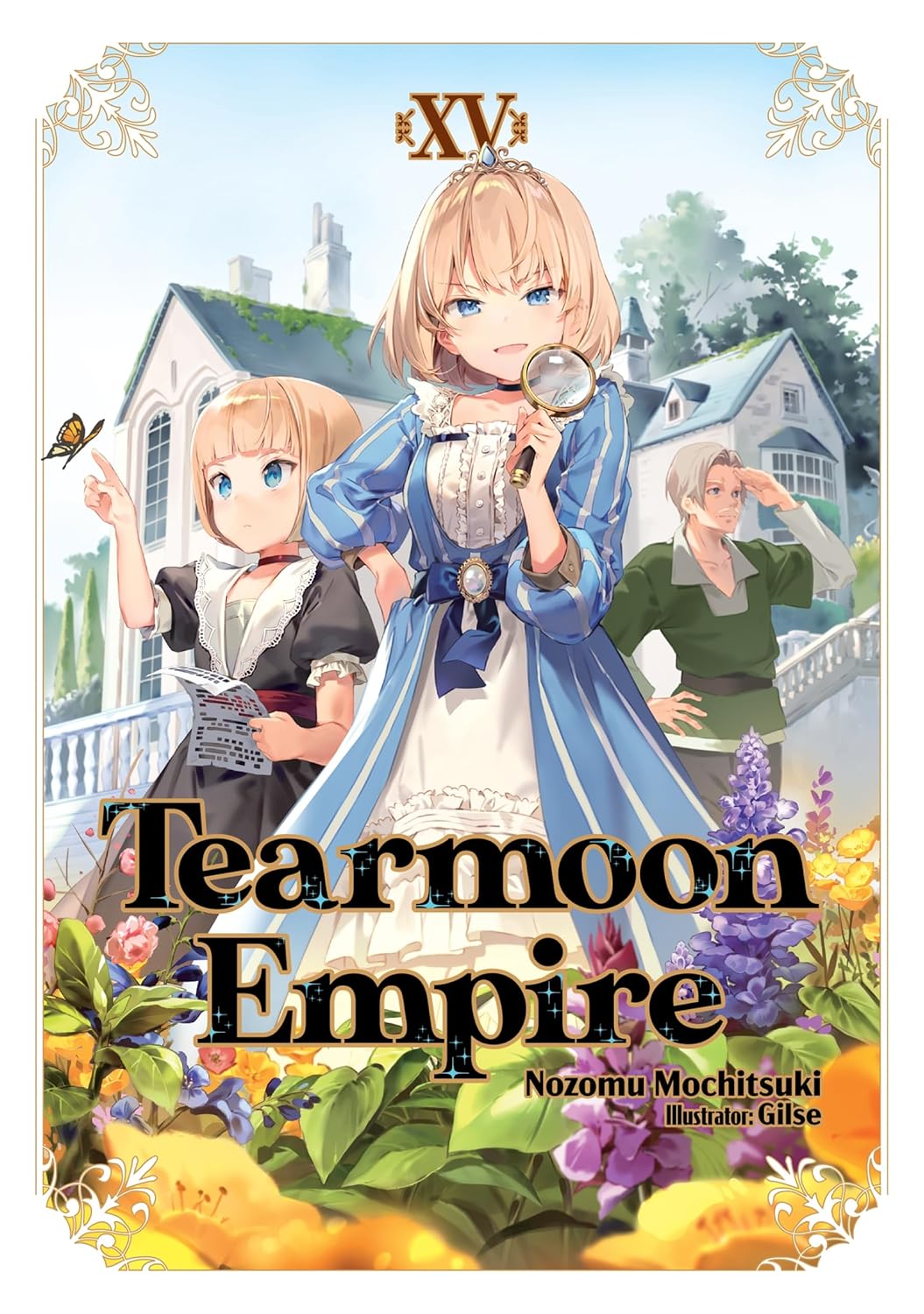
Tearmoon Empire, Vol. 15

By Nozomu Mochitsuki and Gilse. Released in Japan as “Tearmoon Teikoku Monogatari” by TO Books. Released in North America by J-Novel Club. Translated by Madeleine Willette.

Generally speaking, unless God is literally involved in the plot, the “how and why” of these time loop stories is rarely examined. We know why – so they can redo their life and get it right this time. And for a lot of Tearmoon Empire, that’s been the case. Even with vanishing diaries and conflicting timelines, the premise has been “Mia fixes things so she’s not executed”. But with Bel and Patty, things aren’t quite so clear cut. We can guess that Patty might have been sent back to screw up Mia’s timeline fixes, but if so that’s going pretty badly. As for Bel… is it really just to help her mature and keep Citrina happy? Or is there some deeper purpose to her presence? Is there a guiding hand in this that is not Saint Mia and her sarcastic narrator? Unfortunately, this is Bel’s problem to solve, as Mia has a whole host of new things to deal with. Which, mostly, she handles very well.
This is a “set up the next arc” volume, so there’s a bit less drama and a lot more talking. What drama there is comes from Patty, who is on the verge of a nervous breakdown, and Mia realizes that she may have left it a bit too long before she needs to tell her the truth. We also get more details about Patty’s brother, who was supposedly very ill, and also supposedly assassinated by Citrina’s family… though we discover most of those “assassinations” were “ship them overseas on a boat” instead. Once Mia returns to home base, she must deal with her clingiest friends being out of sorts about not spending time with her, and also has to win over a new princess in order to further her own plans. Unfortunately, this princess is following daddy’s orders, and while she’s savvy she’s not really that clever… except when it comes to fish.

After last volume reminded us that Sapphias exists, this volume does the same for Esmeralda, who has mostly been absent from the story since the shipwreck arc. She’s very aware of that, in fact, and has been hearing about Mia having all of these adventures – some of them dangerous, but that doesn’t matter – without her. As for Esmeralda herself… look, with Mia, we have her genuine character growth constantly undercut by the narrator, so we have to pick it out in between the snark. The narrator, however, mostly shuts up when Mia or her immediate offspring aren’t involved, though, and it allows us to see that Esmeralda has changed as much as Mia.This also means that she not only spots regrets in others – such as one of Mia’s ex-maids who is now at the Mia academy – but also in herself, as she finally gives Arshia a richly deserved apology… which, to Arshia’s credit, she doesn’t accept. More needs to be done before the bridges can be repaired. It’s also a good example of the timeline changing as we read. as the start of her arc in this book has Esmeralda an obscure, mostly forgotten figure who worked behind the scenes, while at the end she’s a famous diplomat.

I was annoyed that the fat jokes seem to have returned here, but other than that this was an excellent volume, showing Mia actually thinking things through and making clever decisions, though it’s her empathy, as always, that wins the day.
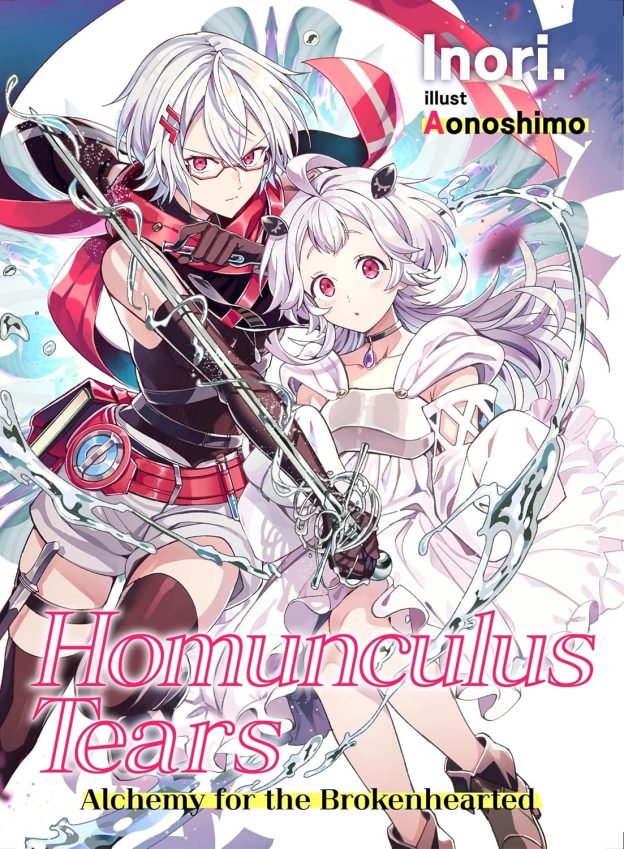
Homunculus Tears: Alchemy for the Brokenhearted

By Inori and Aonoshimo. Released simultaneously in Japanese, English, Spanish and German by the author. Translated by Kevin Ishizaka.

(I try not to spoil too much about this book, but I do spoil the final resolution of it. Reader beware.)

This is a spring/summer that will have two works by I’m in Love with the Villainess author Inori coming out. The second, The Girl Who Wants to Be a Hero and the Girl Who Ought to Be a Hero, came out the traditional way in Japan via Dengeki Bunko, and is coming out the traditional way here via Yen Press. But this is a self-published work, releasing digitally on the same day in four languages, and translated by the same translator as ILTV. As such, thoughts like “experiment” and “risk” come to mind. Which may be true, but in the end, I think the most important thing is that it’s a good book with a lot to say about why we exist and what to do when someone feels they no longer want to. It’s also got a good couple at the center of it, who can be boiled down to “the grumpy one and the sunshine one”, but also contain greater depths. Best of all, I love the narrator, whose deal is my favorite part of the book.

In a dystopian world where humans are at war with the demons (and the men appear to have all been killed off – this is a yuri genre, after all), Maha is a grim but excellent soldier, who uses alchemy to wipe out the demons, though the cost of the alchemy she does is that she deliberately destroys past ties to herself, such as her memory of those who died, or of the taste of good food, in order to give equivalent exchange to power her spells. One day, her researcher mother (who has spent most of her life ignoring her daughter) reveals they have created a homunculus, who hopefully will be able to fight against the demons so that humans no longer has to. Maha has many feelings about this, most of them angry, but unfortunately, the homunculus herself, Ruri, is adorable, innocent, and really likes Maha a lot. And Maha’s grumpy, closed-off heart gradually starts to open up again.

There were a couple of minor things that made me a bit annoyed during the book – I’m not fond of the “loli that’s really x00 years old” archetype, and the relationship between Maha and Ruri starts off with “we’re like older and younger sister!”, which I’ll be honest had me saying “oh no, not again” after ILTV. But for the most part, this was a very rewarding read. The narrator is not Maha, as you’d expect, but instead… well, I don’t want to spoil too much, but someone who is both a guide for Maha and also a filthy shipper who really wants Maha to fall in love with another woman. The narrator is also deeply tied to the past of this book, which reminded me a lot of the 5th ILTV book, and I’m wondering if the author first thought of this concept while writing that. I also appreciated the fact that it managed to not only argue for the value of living, but did so without (I’ve got to spoil this) a tragic sacrifice, while I was expecting from about Page 20, and had steeled myself for. Instead everyone goes for a swim. I smiled.

The author says there may be more self-published works in this vein. Honestly, I’d like to see a different story done the same way, as I feel this wraps up very neatly in a volume and doesn’t need a sequel. Fans of the author should enjoy this a great deal.

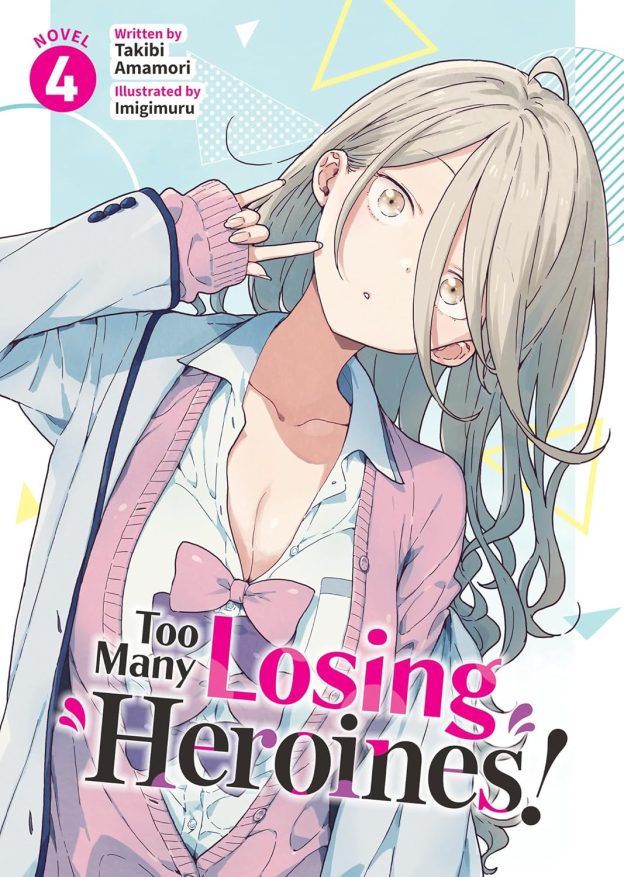
Too Many Losing Heroines!, Vol. 4

By Takibi Amamori and Imigimuru. Released in Japan as “Make Heroine ga Ōsugiru!” by Gagaga Bunko. Released in North America by Airship. Translated by Matthew Jackson. Adapted by Acro.

I feel that as this series has gone on it has very much decided to be a normal romcom with an oblivious protagonist rather than a satire/deconstruction of same, and I like it better this way. Sure, I still want to strangle Nukumizu, but that’s the point, and everyone else in the story agrees with me. Unfortunately, because this is a romcom, all the women in the series who are not otherwise seeing someone seem to be falling in love with him. Including new candidates this volume, because unlike previous ones, the plot forces him to stay involved the entire time and not try to blow everyone off. What it shows is that when he tries, he can be observant, caring, and genuinely nice… provided he’s not thinking about it. Once he does, and he gets into that “no, I’m overthinking this, there’s no way she could be interested in me that way” mode, that’s when he makes girls want to punch him.

This is one of those series where each volume has the heroine of that particular book, so as you may have guessed, this volume focuses on Shikiya, student council secretary and vaguely emotionless weirdo. That said, the book starts with Tiara Basori, the uptight vice-president of the student council, confiscating Tsukinoki’s later BL novel, which features… erm… a genderswapped student council president and Nukumizu in RPF. Naturally, she threatens to submit it to the faculty, which will definitely lead to Tsukinoki getting suspended at least, the dissolution of the literature club, and possibly Nukumizu, who’s in the book, also getting suspended. As such, there’s a new goal for Nukumizu to achieve… find a way to blackmail Tiara and get that book back! Of course, this is not an issue, because, as Shikiya says, “Tiara is easy.”

Note that easy means a romantic pushover, and not easy in the western way. She falls for Nukumizu almost immediately, it’s honestly one of the better jokes in the book at how comically fast it is. That said, she’s also the duller, more standard part of the book. The more interesting bit is with Shikiya and Tsukinoki’s fractured relationship, and how no one really wants to talk about it. Shikiya has been amusing but an enigma in the first three books, and in this one we see that her emotional difficulties are actually a major issue for her, and that she regards other people smiling – even if it turns out to be just a faked smile – as something that she can’t really do. As with every other girl in this series, if she and Nukumizu became a couple, they’d be a good one. Also like every other girl in this series, that would require Nukumizu to be self-aware, which he painfully isn’t. Right now he has a better chance of scoring with his “still walking the incest line but not going over it” younger sister.

Still, if you like romcoms with a greater emphasis on “com”, and don’t mind the fact that everyone in the cast is a failure pile in a sadness bowl, this is perfect for you.