Ranma 1/2, Vols. 23-24

By Rumiko Takahashi. Released in Japan by Shogakukan, serialized in the magazine Shonen Sunday. Released in North America by Viz.

Ranma fandom these days is a different beast from where it was in the halcyon days of 1996-1997. Then it was striding the anime world like a colossus, at least in North America, and not even Sailor Moon seemed to have quite as many people discussing or writing fanfics about it. Nowadays it’s a small fish in a big pond, somewhat forgotten but retaining a nostalgic glow. This has, however, allowed some newer aspects of fandom to infiltrate, notably the BL fandom. Back in the day there was BL, but it seemed to get drowned out by all the male fans arguing about which girl Ranma should end up with. The idea that the best man for Ranma might be Ryouga is something that is dealt with in this volume, albeit not in a serious way.
ranma23-24

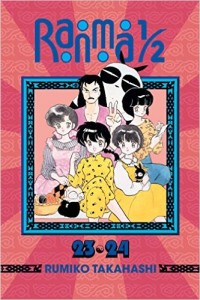
Ryouga comes across yet another magical item that will help him to win Akane, this time a fishing rod whose mark on a body leaves it with ever-increasing feelings of love. To be fair to Ryouga, he does seem to have moral qualms about using such a device to win Akane over. To be unfair to Ryouga, he tries it regardless. And when it hits Ranma, Ranma starts feeling very friendly indeed towards Ryouga. It starts off as washing his clothes and cooking for him, But as the mark expands, things get more serious, to the point where Takahashi feels obliges to urn Ranma female for the rest of the story. Akane, of course, becomes convinced that Ryouga is using the rod on Ranma because he can’t confess to him. Not exactly progressive, but honestly, this is exactly the sort of plot hook that many a BL story could work with. It’s also the best story of the first half of the book, which otherwise deals with annoyances such as Pantyhose Taro’s return (boring), Akane’s cooking (very boring), and Gosunkugi winning an enchanted suit of armor (really super boring and bad).

Luckily, the second half of the volume, is fantastic, and consists of one long story – indeed, there’s a cliffhanger, so it will carry over to the next volume. Herb is a villain who gives Ranma a challenge that he hasn’t really had to face in a long time, and his goofy yet deadly sidekicks Lime and Mint are just as dangerous – Ryouga is even brought to the point of death, though thankfully is able to triumph due to his super-depression. It allows Ranma to be clever and analytic again, one of my favorite sides of him, as he’s unable to see how Herb’s martial arts works – and how it’s actually LESS powerful than expected – without knowing the secret – like Ranma, Herb changes to female in cold water. This is the first time we’ve seen someone with the same exact curse as Ranma, and it helps to showcase their different styles – Herb has modesty, for one, something Ranma does not care about a bit. We also briefly see Ryouga and Mousse work together with Ranma, even if they have murderous motivation at the start. They make a good team.

Ranma sometimes seems a bit hoary and sexist (and homophobic as well) compared to some of the more popular works today, but Takahashi’s creativity usually shines through, and fans of the series will find most of this omnibus highly rewarding.

Honey So Sweet, Vol. 1

By Amu Meguro. Released in Japan as “Honey” by Shueisha, serialized in the magazine Bessatsu Margaret. Released in North America by Viz.

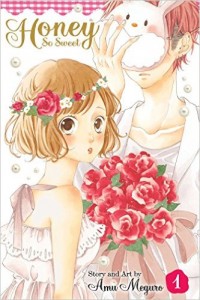
In general I try to avoid reading back cover copy when I get a book, as it frequently tends to spoil the entire volume, particularly with manga titles. That said, I wouldn’t have to worry about that with Honey So Sweet, which wastes absolutely no time telling us what our premise is. Bad boy delinquent is secretly a big sweetie pie. We’ve seen this before, and not just in shoujo, and if that’s all there was to this title I’d likely be saving it fro a Brief review and moving on. But it also has the heroine, Nao, who is shy in all the worst ways – life has left her with an intense desire to avoid conflict, and so when Taiga confesses to her the initial reaction is “if I say no, he’ll kill me’.

sweet1

I’ve talked before about how difficult it can be to keep readers from abandoning a series when you write someone with major character flaws. To be fair, it is easier to do so when your heroine is of the wallflower variety than if she’s a selfish ball of temper. But Nao is the early parts of this volume is someone that is seemingly making all the wrong choices in an effort to just slide by in life – and she knows it, as she keeps repeating it to herself. Her parents have passed away at an early age, and much of her narrative monologue is done as communication with their souls in heaven. Her She’s living with her mother’s younger sister, who she has a massive complex for since he took her in and has sacrificed quite a bit for her. And she (not surprisingly) always seems depressed.

So it’s great seeing Taiga slowly manage to get Nao to have fun, and show actual effort, and elicit feelings from her that aren’t “go along with him because SCARED!”. We learn less about him in this volume, except that he tries a bit too hard to help out everyone, particularly Nao, but that’s the point – he’s the nice guy at heart, and you have to look past his face. By the end of the volume, Nao’s uncle is remarking on the fact that she’s smiling a lot more these days, and it’s a great thing to see, as now we can see her moving forward in life and doing things she’s good at.

In many ways this is very typical shoujo romance – we’ve seen Taiga’s sort in hundreds of other titles. We have two others who form a core group with our hero and heroine, and one is the tsundere hothead guy who speaks before he thinks, which again we’ve seen before. The other is Kayo, who’s grumpy, stoic, and seemingly written as a gift to me – I really want to see more from her in future volumes. Together they don’t make this title unmissable, but they make it enjoyable, and by the end Nao has developed enough so that you’re rooting for her as well.

David Bowie

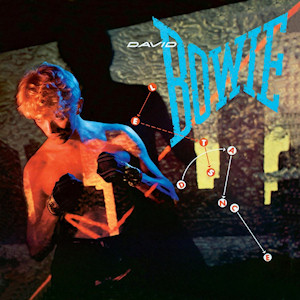
Yesterday I said that instead of a review today I would write a post about David Bowie. This then left me with the same problem as countless other people had yesterday: what on earth can you possibly say? He’s been around my entire life – I was born the week Aladdin Sane came out. I wasn’t old enough to really get the impact that he made on music from 1972-1978, but certainly in the 1980s I was listening to him, even though until college I was never really obsessed with music. You’d hear his singles on the radio – Ashes to Ashes, Let’s Dance, Modern Love – WELI, my local AM radio station, would play Modern Love incessantly, possibly due to its ‘retro’ nature.

letsdance

When I got to college, I began to obsess about music to a ridiculous degree, and of course that meant Bowie as well. My first mixtape that I ever made had a Bowie song on it – Suffragette City, still one of my top 5 Bowie songs. Like many, I gravitated more towards the glam Bowie – I still do, and my first choice of albums to listen to yesterday were Hunky Dory and Ziggy Stardust. But I knew that the musicians that I liked, those whose CDs I bought, and whose interviews I read in the NME, they all talked about a different period that I had trouble getting into – not quite as immediately rewarding, but with greater depth. This would, of course, be the Berlin Trilogy, which was Bowie’s equivalent of The Velvet Underground and Nico, i.e. everyone who listened to the albums formed a band. Except they sold a lot more than TVUAN ever did.

Bowie also touched some of my other musical obsessions. First of all it was nice to have a singer who was in my vocal range – Under Pressure was doable if I didn’t have to sing Freddie’s part! J.G. Thirlwell posted a lovely tribute to Bowie yesterday, talking about how his music influenced his work as Foetus (and likely his current instrumental scoring for The Venture Brothers). Frank Zappa disliked Bowie – stealing Frank’s lead guitar player mid-tour certainly didn’t help – but used Bowie’s then stunning music video iconography in one of his best 80s satirical songs, Be In My Video. There were punk rockers who cited Bowie as an influence, less for the musical style and more for the attitude and exaggeration. And of course as a Doctor Who fan I had to like Bowie – it was a well-known fact that Bowie was secretly a Time Lord, and would never die but merely regenerate.

But sadly that hasn’t happened, and we once again are left with little to say except perhaps “fuck cancer”. I feel bad that I never listened to more of his later period – when I was in college, finally listening to his early 70s period, Black Tie White Noise and Tin Machine II were coming out to critical shrugs. It seemed for a time that every new Bowie album was the comeback… then the next one would be the new comeback, and you’d realized the critics had written off the prior. But that’s music criticism for you, and by the time those reviews came out he’d likely moved on to something else anyway. In the end, I suppose all I’m left with is what everyone else has been saying. David Bowie’s music spoke to outsiders, kooks, weirdos, and those who felt distanced from everyone else. I hope that each new generation who feels the same way can find inspiration and solace in his work, and use it to create their own ethereal, otherworldly beauty. Even if they may find it hard to sing “let all the children boogie” with a straight face.