Haganai: I Don’t Have Many Friends, Vol. 10

By Yomi Hirasaka and Itachi. Released in Japan as “Boku wa Tomodachi ga Sukunai” by Media Factory, serialization ongoing in the magazine Comic Alive. Released in North America by Seven Seas.

There is always a certain level of frustration in a harem comedy, which its audience tends to want resolved immediately and its parent company tends to want to have it go on indefinitely. The author is usually caught in the middle somewhere. Harem fans love the romance to a point, but after around 6 or 7 volumes the voices start creeping in, wondering why the hero doesn’t understand that all these girls are all over him, why isn’t he going after (girl who is not the lead girl), why isn’t he manning up and showing all these girls who’s boss? (I will get into the inherent sexism of much of the harem manga fans at a later date.) Haganai has always been a bit meta about such things, and here the face of that fan becomes Rika, as she has finally had enough of Kodaka’s act.

haganai10

There’s actually a nice buildup to this the entire volume. Sena’s attraction to Kodaka has been obvious, as has her frustration, but Kodaka has been very good about hiding his desires for anything to go further with anyone. Now we see that he’s starting to become more obvious – ending up shopping with Sena on what is clearly a date, at least until she presses the issue of whether he wants a girlfriend or not. Later on, when Kate and Maria (look, if I say ‘Zoro’ and ‘Ryouga’ I’m allowed to say ‘Kate’ as well) show up at his house, and we get the inevitable full frontal nudity fanservice that seems to be this titles way of driving away any readers I might lead to it, Kate observes that she’s like to go after him, but it’s no real use – after all, he has Sena. His ‘huh?’ is used as the cliffhanger here, but when it’s followed in the next chapter by ‘I knew what she was trying to say’ we know that he’s started to stop lying to himself, at least.

The Friends Club is, to a degree, inhabited by people who are socially inept and have difficulty communicating in ways that society considers ‘normal’. This manifests itself on Kodaka’s end both by his desire to have the club stay together no matter what, but also his denial that he has any friends, the purpose of the club. Staying in a comfortable place where you can quietly hate yourself and hang out with friends without risking anything. If you admit you’re friends, then why have a club? If you admit you’re falling for Sena, then won’t everything fall apart? And is this club more important to someone like Yozora than it is anyone else?

This culminates in the maid cafe scene, where the girls all do their best to show why a maid cafe is a disastrous idea. For Rika this involves acting like a stereotypical ‘tsundere’ maid, but in reality it’s a way to work off some stress about Kodaka’s dumb act. Earlier in the volume, we heard her say out loud that no one can be that oblivious, and his response was, naturally, “What’s that?’. Readers of this series should know that’s almost a catchphrase by now, and it’s not because he’s hard of hearing. So when Rika ‘serves’ Kodaka as a maid, her service turns into 15 minutes of abuse and torture, which the others observe is a way to get her frustration out of her system. Kodaka admits to himself he knows what she was trying to do. But he still doesn’t say anything.

Can a harem comedy, especially these days, go on forever without making a choice? If Kodaka admits his feelings for Sena, will the readers abandon ship the way Yozora might? It’s a high-wire act that’s really hard to achieve, but a little meta makes it enjoyable.


Assassination Classroom, Vol. 2

By Yusei Matsui. Released in Japan by Shueisha, serialization ongoing in the magazine Weekly Shonen Jump. Released in North America by Viz.

In this second volume, there’s a bit less focus on the actual assassination attempts as Matsui starts to try to expand the cast and show us more of the horrible world they live in. We meet the principal of the school, who exudes pure cynicism and hatred from every pore, and it’s quite apparent that he will not allow Class 3-E to succeed. Scapegoats who learn to better themselves have no value to him, and so he changes the rules to ensure that they are hated and despised. What it’s doing to the kids themselves doesn’t seem to matter to him – I think if they all killed themselves the day after graduation he wouldn’t spare it a second thought – but in my mind, it’s the values he’s placing in the A-D classes that’s far more chilling.

ac2

Of course, this is meant to contrast with Koro-sensei, who may be an alien out to kill us all but is also determined to give these kids self-confidence to be the best they can be, and takes it personally when all his hard work goes wasted during the midterms. This is nicely contrasted with all the moments where Koro-sensei is simply an eccentric idiot – the reasn that we don’t get to bored or irritated with him is that he has so many flaws and bad habits in among his invulnerability – flaws that are dutifully being written down by our narrative voice Nagisa (calling him the protagonist of this series seems oddly wrong), and flaws that are abused, seemingly, by the new teacher and assassin introduced here, Irina Jelavich.

A brief aside. For those who hoped that with the forced addition of ‘Koro-sensei’ we’d see honorifics in this series, sorry, Jump editorial practice will only allow it if it leads to an untranslatable pun. Thus ‘Bitch-neesan’ becoming ‘Bitch-sensei’ is not going to happen, and instead we see ‘Ms. Bitch’ becoming ‘Ms. Vitch’, which also neatly allows Viz to soften things up a bit. Bitch or Vitch, though, Irina certainly makes a horrible first impression, on both the cast and the readers. She’s an omniglot and talented assassin, but it’s clear that she only knows how to assassinate through seduction, and when it comes to actually keeping her cover as a teacher she’s useless. That said, she does seem to be easing up a bit, particularly when she sees how Class 3-E are treated by the rest of the school. I could have done without the tentacle rape joke, though given what Koro-sensei looks like I suppose it was inevitable.

We see the students here as well, but so far they seem to be more of a cast herd rather than having deeply drawn personalities. Nagisa is the strongest, being the keen observer (though he’s weak for busty women, like most teens – and indeed like Koro-sensei). Kaede hasn’t really said much at all (though I did love the ‘my brain is up here’ sign she held up, a wonderful translation choice, as I think the original just had her complaining about Irina’s large breasts). And Karma may be the smartest in the class, but he made far less of an impression here. The end of the volume promises that may change soon, though, and I’m hoping that this is the sort f series where everyone gets some attention paid to them. Though ‘a lot of them are only bit players so I try not to make them too unique’ doesn’t bode well.

Overall, this is still an addictive series, even if I feel it has some issues with character. Irina is an amusing addition to the cast, and I hope we will eventually get jokes about her that don’t involve her being a femme fatale who’s really just a ditz. More to the point, the stakes are raised with the introduction of the principal, as now we really see what Koro-sensei and the class are up against. Go get this.

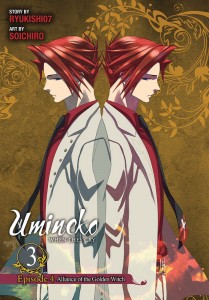
Umineko: When They Cry, Vol. 9

Story by Ryukishi07; Art by Soichiro. Released in Japan in two separate volumes as “Umineko no Naku Koro ni: Alliance of the Golden Witch” by Square Enix, serialized in the magazine Gangan Online. Released in North America by Yen Press.

With this volume we are halfway through Umineko proper, at least in terms of arcs. Most of the major issues involved have become fairly clear to the reader. Battler’s incompetence as a detective is not because he’s stupid per se, but because he can’t see past the who and how to figure out the why. I think he finally manages to grasp this by the end of the book, but by then it’s a bit too late for Beatrice, who is a character whose ‘who’ and ‘why’ define her, to the extent that her dying wish to Battler is to uncover who she is. As for Ange, she figures out what’s going on, and learns how magic works, but her lack of empathy for Beatrice means that she fails here as well, and gets a highly grotesque death. The only real winners in this arc are Bern and Lambda.

umineko9

There’s also the small matter of what’s happening on the “game board”, of course, in which the rest of the cast bar Battler are quickly polished off in an almost perfunctory way. You know things are ridiculous where Krauss fights a goat butler and wins. Actually, I’d argue that the manga didn’t go far enough here – the VN framed this as a long scene, showing off the goat butler’s ‘motivation’ and framing it as a video game with cliches piling up one on top of another. It was highly amusing, yes, but more to the point it shows off how overegged this pudding is. When first Jessica and then Kyrie take pains to tell Battler “you must believe in the witch god we were so wrong being all logical and stuff”, you’re meant to raise an eyebrow. Of course, with all the special effects death, magic is hard to deny. Assuming you can trust what you see.

The most important scene in the volume, which I also think the manga gives some short shrift to, is game-Beatrice asking game-Battler to remember his sin, and her complete devastation when he doesn’t. For Battler, 6 years ago is when he walked out on Rudolf, and all his theorizing about why that was wrong has to do with his place in the Ushiromiya family. Beatrice is clearly looking for something very different and more personal, and the fact that it meant so little to Battler that he’s forgotten it is what breaks Beatrice, both in the game and in meta. It’s telling that, since the whole Ushiromiya family thing is what he remembered, she takes that away from him by removing that identity. (This is where Battler truly is stupid – he knows his dad is a philandering ass, he should never have been taken in by her word games.)

So where are we now, with half the series gone? Beatrice is seemingly killed off. Battler can’t really escape the game. Everyone on the island is still dead. And even Ange is stated to have “died in 1998”, which is quite interesting given that the last we saw of her she was having the Seven Stakes of Purgatory brutally slaughter Kasumi and her yakuza goons. (Speaking of Ange, she starts to understand Eva a little better, though I worry she goes a bit too far. It’s a very hard line to walk between explaining and excusing child abuse, and I think Umineko sometimes walks across that line a bit too much.) And to no one’s surprise, Lambda and Bern turn out to be working together, or at least having mutually useful goals.

So Battler is an awful detective. Ange tried her best, but was too caught up in revenge and suicidal tendencies. Is there not a Great Detective who could possibly tell us what happened in Rokkenjima? Is there someone for whom this level of reasoning is possible? And can they actually be unbiased? Well, now I may be asking too much. In any case, May will bring us ‘End of the Golden Witch’, in which Beatrice’s tragedy reaches its inevitable conclusion. (No, it’s not the last arc.)