Rascal Does Not Dream of a Nightingale

By Hajime Kamoshida and Keji Mizoguchi. Released in Japan as “Seishun Buta Yarou wa Nightingale no Yume wo Minai” by Dengeki Bunko. Released in North America by Yen On. Translated by Andrew Cunningham.

When I first saw the title, I wondered why we were getting two “singer” books in a row, and wondered if we’d be hitting all of Sweet Bullet. But no, this is not “Nightingale” as in “sang in Berkeley Square”, it’s “Nightingale” as in “Florence Nightingale”. I’m not sure if the author is TRYING to hit every single fetish, but it’s certainly true that, after commenting on the miniskirt Santa he met last time, he has to deal with several nursing school students this time around. Including, unfortunately, his old nemesis Saki. Fortunately, both of them have grown up to the point where they can actually tolerate each other in short bursts. As for the actual person who stars in this volume, we’ve seen her before as well. She was briefly in Sakuta’s high school in the “other universe” in Book 9, and he briefly saw her at college last book. And, as it turns out, she’s heavily connected to his past.
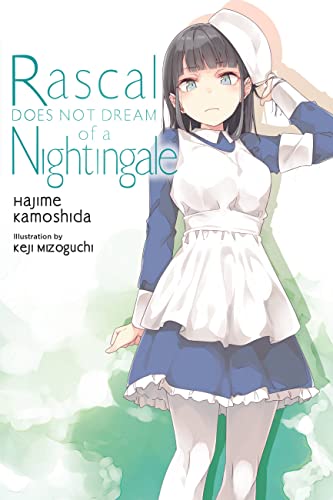
After briefly meeting up with Yuuma and Rio for a day outing, and confirming that Yuuma is quite happy being written out of the series, Sakuta goes back to trying to solve the problem of Touko Kirishima and the resurgence of Adolescence Syndrome. Of course, this being Sakuta, “trying” is perhaps too strong a word. What he ends up finding is that Ikumi Akagi, his old classmate from junior high, has been going around doing good deeds. Horrifying, right? It turns out that these good deeds are connected to a social media tag where people confess prophetic dreams, and Ikumi has been using that to try to stop the bad prochecies from coming true. This bothers Sakuta, who has first hand experience about why doing that can be a terrible idea. That said, what’s more bothersome is the fact that she’s making him remember what happened back in junior high, i.e. the events that led to the main plotline of this series.

This isn’t a harem series. Really. Sakuta has remained faithful to Mai the entire time, and the two have several lovey-dovey scenes together. It’s just that Sakuta has that combination of a bad-boy personality combined with good-boy actions that leads everyone to be drawn to him. Ikumi is no exception, and I actually want to be circumspect here, because I thought a lot of the aspects of her syndrome, as well as the cause and resolution, were very clever in a series that’s already pretty clever, so I don’t want to give it away. At heart, this is about how hard to can be to live up to your own expectations. Ikumi feels she failed Sakuta in junior high, and has never been able to get over it. Sakuta always feels like he’s doing the wrong thing, especially after going to the other world and finding a Sakuta who seemingly did everything right. We are our own worst critics.

Good stuff, even if it still feels like a series that ended at Book 9 and the publisher is locking the author in a room until they write more because it’s got movies coming out.
Chitose Is in the Ramune Bottle, Vol. 4

By Hiromu and raemz. Released in Japan as “Chitose-kun wa Ramune Bin no Naka” by Gagaga Bunko. Released in North America by Yen On. Translated by Evie Lund.

It was once said, a couple decades ago, that no one would ever license a sports manga because it wouldn’t sell. Nowadays, given the enormous number of people who obsess over series like Haikyu!, that seems a bit ridiculous, but it was true. I’m not entirely sure if there are a large number of unlicensed light novels that follow baseball or basketball teams the way that manga does, but I’m inclined to say probably not. And we certainly don’t have them licensed over here. You’re allowed to dungeon crawl, or try to break off your engagement so you don’t die, but please don’t mention the K word. And by K I mean Koshien. That said, Chitose Is in the Ramune Bottle is notable for having a LOT of jocks in its cast, by the nature of its premise. And it’s this fourth volume that drills right down to the heart of the jock, showing us what it means to dream big, and also balancing the harem again with its shortest member.

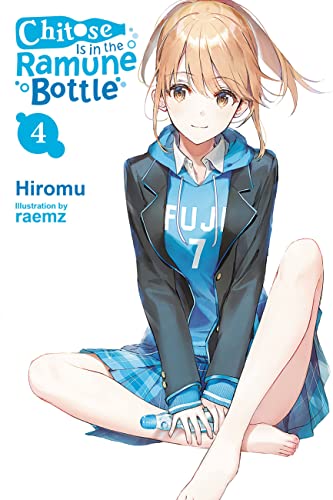
We’ve known since the start of the series that Chitose used to play baseball but quit. Now the team is back, begging him to come back as their star is injured, and won’t be ready in time for the first knockout game. Chitose, needless to say, is rather pissed off about this, as he had reasons for leaving the team – which, you’ll be grateful to hear, we finally hear about. He’s also dealing with the girls’ basketball team, which has a new captain, Haru, who’s a taskmaster and is pushing the others past their limits – which they hate. It’s needed in order to make them a better team, but it also makes Haru a very convenient target. Will Chitose manage to help Haru to reconcile things with her basketball team, and can he do that by giving in and playing his last ever baseball game? Even if it means breaking himself to do it.

The series’ best feature remains its ability to convince you, in each new volume, that the girl being focused on is definitely the one who should “win” the Chitose romantic partner sweepstakes. Last volume I said that Asuka was written out in the third book as she was so far ahead of the others. (As it turns out, she’s still around, though Chitose is mooning over her less.) In this volume, it feels like he and Haru also really belong together – they’re birds of a feather, basically, and a reminder that “opposites attract” is not always true. The book is also very good at showing the frustrations of the high school athlete. Haru is a fantastic basketball player. But she’s 4’9″, and there’s simply no way to make up that difference in height in a sport like that. As for Chitose, well, he’s cool. The best scene may have been when he’s wavering back and forth on what to do, and when he tries to do an uncool option Haru chimes in “I don’t like this Chitose.” It was adorable.

So yes, the light novel for normies remains excellent. We’ll see what the next volume brings – Yuuko is on the cover, will she be the lead girl?

So I’m a Spider, So What?, Vol. 16

By Okina Baba and Tsukasa Kiryu. Released in Japan as “Kumo Desu ga, Nani ka?” by Kadokawa Books. Released in North America by Yen On. Translated by Jenny McKeon.

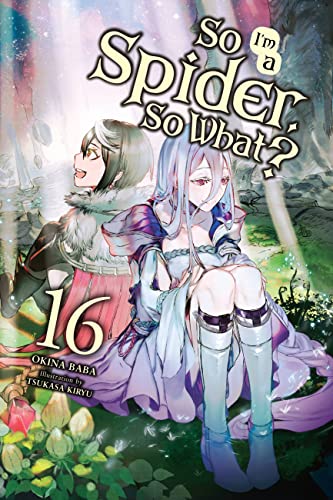
I had heard rumors that the Spider So What fanbase (yes, there is one, though perhaps not as much now) was unhappy with the webnovel ending and hoped it might be changed a bit for the light novel. Sad to say, I don’t think it is. Also sad to say, I get their point. Even if I haven’t liked her at times, or felt that she was being too much of an evil villain, the spider is the star of the show. White is the reason everyone is reading the book. I may enjoy following the adventures of the human cast more than the rest of the fans of this series, but that doesn’t mean that I want the book to star them instead. The book’s gimmick is its spider doing really cool things while chattering endlessly in her head. As such… why the author decided to have her appear only at the start and end of this book is beyond me.

We pick up right where we left off, with White battling Black for the future of this world. One side wants to kill half the population to save the goddess who’s being tortured to keep everything going, the other half wants to kill the goddess to save the population. There is a lot of angsting, hand-holding and self-doubt among the various cast members about this… at least until about halfway through the book, when everyone realizes what the reader pretty much knew: there are no sides, we are all in this against D, who simply wants to have bad things happen for the lulz. Everyone (except Black and White, still fighting) teleports to where D is, and some are shocked to discover that she’s the real Wakaba. They’re even more shocked to discover that she’ll give them what they want… if they defeat her.

This book ends up being a string of anticlimaxes. Chief among them I’ve already mentioned, which is White being absent from most of the book. Second among them would probably be White’s actual fate in the final pages, which I suppose is meant to be punishment for her hubris but reads like thumbing a nose at the reader. The rest of the book alternates viewpoints among the rest of this ludicrously large cast,. and the only ones who remotely get closure and a happy ending are the adventurer couple, who survive and live happily ever after mostly as she clonks him on the head and runs away from the final battle. The epilogue reads like the author lost the last hundred pages of the book so decided to submit bullet points instead. Shun’s romantic resolution is absolutely a “fuck you” to me personally. I could go on.

I made it through this whole series, and it started off great. But it began to flag a few volumes back, and the climax has been a painful experience. White deserved better than this.