The Executioner and Her Way of Life: A Casket of Salt

By Mato Sato and nilitsu. Released in Japan as “Shokei Shoujo no Virgin Road” by GA Bunko. Released in North America by Yen On. Translated by Jenny McKeon.

You will pardon me if I am just a bit exhausted after reading this volume of the series. It consists entirely of payoff, which makes the plot more interesting, but also means that we don’t really get to relax and take in anything. And, frankly, we’re still inhibited by the actual writing. The anime was quite successful when it was released, and I think it showed off that the ideas and concepts in this series work best when they’re taken away from the author’s control. This book is a slog, no mistaking it, and while I realize some of that is simply because the events in it are unrelentingly grim that’s not the only reason. It doesn’t help that I get the feeling this series was supposed to end with this book (and Flare’s plan), but the upcoming anime had the publisher tell the author “we need to extend the series, can you make everything worse instead?”.

This book is about the battle between Menou/Akari and Flare, and it does not need supporting characters getting in the way, so Ashuna quickly departs (after confirming what we all knew already, that it’s Momo she’s really into). As for Momo herself, she falls for a fairly obvious trap and spends most of the book in a literal cage. This is not to say that Menou and Akari are getting all the cool and awesome things to do, though Menou does pretty well. Unfortunately, the new character from last volume has shown up, and she is absolutely the new antagonist and wants to let you know it by removing Akari from the board. The one thing that Menou has been trying to avoid this entire time has now happened, and what’s worse, she’s not a wanted traitor. Can she possibly find a way to set things right?

It’s hard to talk about this book without spoiling everything (as you can see by that awkward paragraph above), but I do want to say that a lot of the ideas and themes here are really good. We finally get revelations about Menou’s past, as well as Akari’s past, and they fit thematically. Everything about the Pandaemonium subplot was fantastic, and almost made me have an emotion. That’s probably the part of the series I look forward to seeing most in the next book. There’s generational stuff here, as we see the relationship back in the day between Flare and one of her isekai’d victims was similar to Menou and Akari’s. An anime of this would probably kill. It’s just… it all feels so flat on the page. I kept checking to see how long it had to go. The author’s writing has no style, no pep, no verve.

There’s enough here for me to grudgingly continue, if only to see if Ashuna can actually do something next time. But for the average reader wanting to see what comes next, I recommend waiting for a Season 2 of the anime.

Rascal Does Not Dream of a Lost Singer

By Hajime Kamoshida and Keji Mizoguchi. Released in Japan as “Seishun Buta Yarou wa Mayoeru Singer no Yume wo Minai” by Dengeki Bunko. Released in North America by Yen On. Translated by Andrew Cunningham.

As we hit double digit volumes for this series, and we start what is basically “Rascal: The College Years”, it’s probably a good time to ask ourselves what we really want out of the series. Let’s face it, I’d be perfectly happy just watching Sakuta interact with the rest of the cast, no plot or dangerous supernatural phenomenon needed. Add in 40-50 pages of descriptions of subway stations, which is about the average with this series, and you could say that we don’t NEED the main premise of the series anymore. The main cast, for the most part, has accepted their past and trauma, and made a good effort at moving on. Sakuta and Mai are adults in college, and even Kaede will probably be graduating soon. There’s no NEED for what has been termed “Adolescence Syndrome”. And so, until the last page of the book, I assumed that this was the point of this volume. That the problems Uzuki had were totally normal.

You can sum up the plot of this volume as follows: “What measure is a non-airhead?”. Sakuta and Mai are now at college, and living the blissful couple life (well, except they barely see each other due to her job). He’s also tutoring two students from his old high school at a cram school, and hasn’t had to worry about any supernatural phenomenon in a year and a half. Uzuki and Nodoka, from Sweet Bullet, are also there, and Uzuki is in a lot of Sakuta’s classes, as they share a major. Uzuki is, of course, her usual lovable ditz self, and seems to get along with everyone in the class. “Seems” being the operative word. Because one day, Uzuki shows up at class, and something is… off. She’s making efforts to fit in more. She’s picking up social cues. What the hell is going on? This is so unlike her!

There’s actually a whole new mini-cast introduced here, which no doubt will get more of a look-in in future volumes. We meet Miori, who honestly seems to be Rule 63 Sakuta a lot of the time, and her obvious attempts to insert herself into his life. Ikumi, who we briefly saw in the last book, is briefly seen again, and Sakuta is still vaguely uncomfortable around her. There’s the cram school kids. I feel the author is apologizing for a lot of the old cast only making token appearances, but such is life. As for Uzuki and her issues, I thought it was very well handled and sometimes very sad, and the climax of the book was excellent. The actual resolution, though, feels not QUITE as happy as I’d have liked… especially given the OTHER new character we see at the end, who implies that this really WAS supernatural, not just Uzuki suddenly maturing. Enter Touko Kirishima.

No, it’s Touko, not Touka, this is not becoming a Tokyo Ghoul crossover. Exactly what it’s becoming is still undecided. But I will admit feeling unsatisfied that the catalyst for Uzuki’s issues was actually a third party. I will have to content myself with the fact that the conflict and resolution of it was all Uzuki, and she did very well.

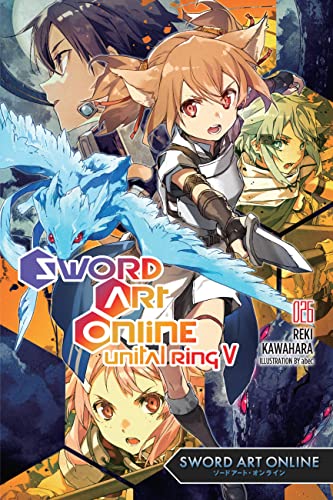
Sword Art Online, Vol. 26: Unital Ring V

By Reki Kawahara and abec. Released in Japan by Dengeki Bunko. Released in North America by Yen On. Translated by Stephen Paul.

It’s not clear how much ;longer this arc of Sword Art Online is going to go, or if it really is the final arc in the story. I don’t think even the author knows, especially given that his afterword talks about how he gets distracted by side stories and diversions all the time and can’t advance the plot. But I think he’s thinking about it, and we get a little of that with Silica here, who gets to have most of the narration that isn’t Kirito’s when he’s in the Underworld. She’s been one of the original SAO gang for so long it’s sometimes hard to remember that she’s three years younger than most of the others, and she’s noticing that Asuna and Lisbeth aren’t playing games quite as much as they used to. It’s not framed in a “put away childish things” sort of way – indeed, Silica notes one of her friends think she’s the weird one for continuing to game so much after SAO – but hey, adulting is necessary. The real world beckons.

The plot here is neatly divided in half. On the Underworld side, Kirito, Asuna and Alice finally get to see Alice’s sister frozen in time, awaiting her return… along with two other surprise guests! Unfortunately, unfreezing them will involve Kirito and Eolyne becoming astronauts, going to one of the satellites where Kirito, pre-memory wipe, hid the information. But, of course, while there they find bad guys doing terrible things. On the Unital Ring side, the rest of the main cast need to find more ore in order to keep up with the other gamers, and doing so will involve facing off against a giant wasp nest! Can they use a dangerous flower that the SAO players know very well to try and swing the battle a little more their way? can can we really get to see a scene with Silica sitting on top of a giant bear fighting a wasp? Because that sounds pretty awesome, frankly.

This book not only thinks about the future a little bit, but also manages to recall the past. We get more “what measure is an NPC?” philosophy, but this also involves Asuna clearly thinking of Kizmel, and almost having a little breakdown. Those reading the Progressive books will know that Kizmel is hugely popular and I think the author is dragging things out a bit to use her more, but it’s also plainly obvious that she’s not going to stick around till the 75th floor, so we can guess what likely happened. And of course, we get more Underworld stuff, though of all the minor characters from that arc to make an emotional reappearance, the elevator operator was not the first one I would have guessed. It works well, though, and also allows our heroines to have a nice long bath, satisfying both Asuna’s love of bathing and also abec’s love of drawing fanservice.

So yes, the plot progression was minimal here, but this was a solid, fun read. SAO fans should be happy.