Tearmoon Empire, Vol. 9

By Nozomu Mochitsuki and Gilse. Released in Japan as “Tearmoon Teikoku Monogatari” by TO Books. Released in North America by J-Novel Club. Translated by David Teng.

I’m not sure how long Tearmoon Empire is supposed to be, or even if the author has an ending in mind. Certainly Vol. 12 is due out in Japan soon, so we’re not anywhere close to the end at the moment. And yet it feels that we have at least started to hit the back half of the series, if only because we’re getting flash forwards that aren’t always depressing nightmares. The last couple of volumes of Tearmoon Empire have shown us glimpses of the main cast in the original world after Mia is executed, and this volume has one as well. It’s meant to show us all the good that Mia has done her second time around, even when she doesn’t always realize it. But here we also start to see flashforwards that seem to be the ACTUAL happy future, showing us an older Mia still happily running rings around everyone even if the narrator insists that she’s being a selfish coward. I really enjoyed reading them.

We pick up right where we left off at the end of the previous book, with Mia and company trying to stop Prince Sion from being poisoned by his younger brother. They succeed at this… accidentally, but the actual poisoning that happens is much worse, and requires everyone (but particularly Tiona and Citrina) being incredibly quick-witted. After the fallout from this, there’s still a massive party with nobles to attend to, so Sion and Abel decide to fight for Mia’s hand once and for all in a sword duel. Which comes as a big surprise to Mia, who as usual in matters of the heart seems to act like a girl her age. That said, when Sion actually confesses to her, she knows that this isn’t something she can actually brush off or deflect, and gives him an honest, sincere answer. Even the narrator is (mostly) silent here.

Tiona spent most of the start of this series either absent or barely appearing, which was a surprise given the role that she had in Mia’s original timeline. But gradually she’s grown in importance as a character, and here we see what Mia’s actions have wrought, which is that she and Sion have now had enough character development that they can genuinely confide in each other. While Tearmoon Empire isn’t quite a “villainess” book per se, and is not derived from an otome game, Tiona absolutely fulfills the “heroine of an otome game” archetype, including being able to see past noble bullshit and get to the heart of the matter. As for Mia, she’s getting smarter by the book. I especially loved when Citrina praised her for her foresight in finding the antidote mushroom, and Mia briefly debated taking credit for it, but decided to tell Citrina that it really was just pure coincidence. I’m hoping that in future books we can see her be even more honest with others about her real motives, though the basic premise of the book tells me I won’t see it too often.

This was an absolute banger of a book, wrapping up this arc in fine fashion, and with several real dramatic moments. Next time we’ll be going to The Valley of Horses, but hopefully not in a Jean M. Auel way, and presumably we will slowly set up the next arc but not pay it off. These books are long, as are the arcs.

Adachi and Shimamura, Vol. 10

By Hitoma Iruma and raemz. Released in Japan by Dengeki Bunko. Released in North America by Seven Seas. Translated by Molly Lee.

Finally, after two volumes with illustrations ranging from minimal to none, we have a new artist. I had speculated last time that Non, the old artist, had left the title as they were ill, but I’ve since found out that it’s more “they are shifting their career goals”, i.e. they’re only drawing BL now. Which is fine. Replacing them is raemz, who is best known over here for the gorgeous illustrations for Chitose Is in the Ramune Bottle. So things are back to normal with this series… for the most part. This volume, following up on the 8th book, spends far more time in the future with Adachi and Shimamura moving in with each other after graduating and getting jobs. Iruma has never really been all that fond of linear storytelling, so I’m not too surprised, but it does also remind you that the series is winding down. Indeed, the author states in the afterword that the 8th book was the “final” one, and the four to follow are afterwords. And Dengeki confirmed 12 will be the last.

As noted, the book is divided into ‘present’ and ‘future’ sections, with the former narrated by Shimamura and the latter mostly by Adachi. In the present, now that Adachi and Shimamura are dating, and given that the author is not really going to do anything with Hino and Nagafuji here after they got a major spotlight last time, there’s really only one plot thread to wrap up. Or rather, to cut. Tarumi is still around, still has a major unstated crush on Shimamura, and still wants to hang out with her. And credit to Shimamura, here we see what all this interaction with Adachi and Yashiro has wrought, as she decides to deal with the issue head on telling Tarumi that she’s dating Adachi now. The scene is meant to be heartbreaking, but sadly, most of Shimamura’s narration still puts a layer of gauze over everything, so I think it’s merely bittersweet.

There’s quite a bit of Yashiro in this book, as she spends most of it dressed up in onesies of various kinds of animals. I’ve joked before about how I’m the only fan of the series who likes Yashiro, but I do think that her role in the story is very important. First of all, she deserves just as much credit as Adachi for getting Shimamura out of her passive daze and forcing her to take a good long look at herself. Adachi does this directly by being a vibrating ball of gay, but Yashiro always does it indirectly, so it’s harder to spot. She also gives Adachi and Shimamura a gravitas that they would not otherwise have. The idea from prior books that there are many alternate universes, and that all of them have Adachi finding Shimamura in them, is a nice one that distracts you from the fact that these books can be very, very dull if you let them. Future Shimamura also seems to realize that even after they’ve moved to a different city, Yashiro is gonna show up anyway. She’s the spice.

Adachi and Shimamura 11 just came out in Japan last month, so it will no doubt be a while before we see it here. Till then, enjoy the present, as Shimamura cuts ties with an old friend, and the future, as Adachi and Shimamura move in together and share a bed but are quite asexual about it all.

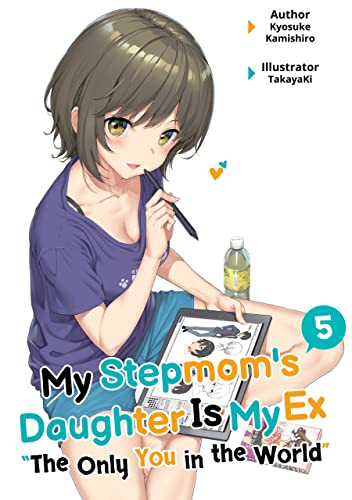
My Stepmom’s Daughter Is My Ex: “The Only You in the World”

By Kyosuke Kamishiro and TakayaKi. Released in Japan as “Mamahaha no Tsurego ga Motokano datta” by Kadokawa Sneaker Bunko. Released in North America by J-Novel Club. Translated by Gierrlon Dunn.

This series is definitely one which enjoys being for otaku nerds, and expects its readers to keep up. Fortunately, it also has Yume, who is not an otaku nerd, and who sometimes needs things explained. (There’s a Haruhi Suzumiya joke here, and it’s remarked on how old that series is.) It also leans heavily on the sort of stereotypes such fans enjoy. And Isana Higashira leans heavily into those stereotypes. She’s the weird one. She talks like she’s from the 19th century. She’s got a really big chest. The whole nine yards. She’s also a hoot to read. I was quoting this book on Twitter while I read it, and everything I was quoting was one of her lines. That said, there’s a reason why, despite her plotline supposedly wrapping up in the second volume, the author came back to look at her in more depth. It’s because real life is not like light novels, and people don’t really get over being rejected by their first love that easily.

Mizuto and Yume return from their trip worse off than before, thanks mostly to Yume’s inability to spit her feelings out and Mizuto’s talent for rationalizing anything as “not in love with me”. They’re back home, though, which means that Isana can come over. A lot. And hang out with Mizuto, and get in compromising situations with Mizuto, and go out on a date with Mizuto (and Yume, who invites herself along), and introduce Mizuto to her mother. It should not really come as a surprise that, when school finally goes back into session, the rumor among the class is that Mizuto and Isana are dating. And Yume, trapped by her own inability to get her own feelings across, can’t say anything. Unfortunately, suddenly being the center of attention, and having the reason for that be a lie that everyone believes, makes Isana very unhappy.

The subtitle of this volume comes from Isana’s awesome mom, who sounds like she starred in a light novel series of her own as a teen. Isana suffers from an inability to read social cues, and when she asks things that to her are not obvious, she binds that everyone gets upset and she’s isolated. Mizuto is the first person her own age she’s met who not only does not get upset by her but is able to interact with her as a friend. This is why she fell for him so hard, and it’s also why, despite everything she’s told him, she can’t get past being rejected quite yet. The author mentions in the afterword that he originally ended the volume with Mizuto being more cool and dramatic, but that Isana was telling him that something wasn’t working there, so he went back and wrote the ending we have now, which feels more in character.

Yume will still eventually get together with Mizuto, of course, whenever this series ends. That said, I can understand why the author says Yume “feels like she’s losing” after this book. Isana, if nothing else, deserves her own spinoff.