When Supernatural Battles Became Commonplace, Vol. 3

By Kota Nozomi and 029. Released in Japan as “Inou Battle wa Nichijoukei no Nakade” by GA Bunko. Released in North America by J-Novel Club. Translated by Tristan K. Hill.

Imagine that you are an Olympic sprinter. It’s the final race. All eyes of the world are on you. You’re feeling great. Your fiancee is cheering from the stands. The starter pistol goes off, and you take off, quickly putting all the other runners in the shade. It’s smooth sailing till the end of the race. You smile, confident and proud. Then you trip on absolutely nothing and fall flat on your face. All the other runners trample over you as they fly towards victory. You have humiliated yourself and your country. The medics don’t even want to treat you. Your fiancee leaves you, sobbing. The team bus leaves without you, as does the team plane. And so there you are, broke and starving, wondering where it all went wrong. If it wasn’t for that one horrid misstep right at the finish! If you can imagine that, then you can pretty much imagine how I felt on getting to the climax of the third volume of When Supernatural Battles Become Commonplace.

As has become the norm with this series, the first half is basically a bunch of fooling around, goofy gags, and Andou being incredibly irritating. The club plays tennis, and has a cosplay roulette tournament, which gets everyone into embarrassing outfits. That said, as you may have guessed by the cover art, Chifuyu is the featured girl of this volume. She seems to be having difficulty at school, which Andou drops her off at one morning, and trouble dealing with her best friend Madoka Kuki, aka “Cookie”. Well, best friend is probably the wrong word. Partly because Chifuyu is so helpless at doing anything that Kuki ends up acting more like a mom than anything else. And partly as, well, Chifuyu has the club, and talks about the club all the time. Which, naturally, makes Kuki mad.

For the most part, this was a lot of fun. Andou has become tolerable for the most part, especially when we contrast him with his loathsome “friend” Sagami. He and Tomoyo go on what is, to all intents and purposes, a date midway through this book, and it’s cute as hell. There’s some ominous foreshadowing of a character from Andou’s past (who might be trans?), but that’s for a future book. And Chifuyu’s problem thankfully has nothing whatsoever to do with the superpowers or the other evil organization – it’s just typical elementary school stuff, and reminds you that she really is ten years old. Which makes Andou’s “solution” to the problem really head-slappingly terrible. Even Hachiman would not quite be this self-sacrificing. It’s creepy. And it also reminds you that Chifuyu probably *is* a love interest for Andou despite being ten, because the whole club is – that’s the point of the book, ti’s a harem series. Which, whatever. But there’s no need to underline it with all this lolicon stuff.

So, 85% of a good book. Just stop before the final chapter and assume there was a sensible solution. …right, this is When Supernatural Battles Become Commonplace, there is nothing sensible here. Never mind. Carry on.

Reincarnated As the Last of My Kind, Vol. 4

By Kiri Komori and Yamigo. Released in Japan as “Tensei Shitara Zetsumetsu Sunzen no Kishou Shuzokudeshita” on the Shōsetsuka ni Narō website. Released in North America by Cross Infinite World. Translated by Roman Lempert.

It’s two years after the previous book, and there’s a lot of bad, heavy things going on. Tina is now living at the captured fort, being flown around to various dangerous places to purify monsters. She’s referred to as “the holy woman” by basically everyone, and has almost come to accept it. She’s also coming to accept the fact that she’s in love with Renge, and debates confessing to him, though world events kind of put a kibosh on that. But the Sugula keeps coming closer and closer to them, and it needs to be destroyed soon. We’re getting into “this is the passing of an era” style fantasy, where one mentor close dying and another mentor actually dying off screen (how rude!). And, of course, there’s still the occasional enemy attack, and those are getting more and more dangerous. What on earth can Tina do to help things? If your answer was “have a fashion show”, then congratulations, you too may be able to write web novels.

To be fair, the fashion show *is* a side story, where Tina tries to solve the problem of newly freed slaves who still have tons of issues working them out by bullying each other. There’s also two side stories, which focus on the non-Tina romances in this book, and show off that just because a character SEEMS dense and oblivious it doesn’t necessarily mean they actually are. Unfortunately, the two side stories and the extra story run to just over half the book, leaving only the first half left for the actual plot to bubble up. This is also a problem with web novels, which are rarely written with the author thinking “now, I’m at about Page 220 if this were a Kadokawa book, time to have a cliffhanger”. But it can be very frustrating if you’re invested in how the world is going to be saved.

Tina doesn’t really have a fun book. We don’t even SEE the inn that she and her father used to tend here, and she’s pretty much resigned herself to being the savior of many (though her sister and others also yearn for a day when she can just lie around and make incredible healing potions, something she doesn’t have time to do anymore). She gets more information on her parents’ background, but this comes at the cost of losing a new found family member just when she realized she was a family member. And of course there’s the revelation that falling in love with Renge may actually produce a stone that could lead to a war that lasts centuries – again. As plot macguffins to stop a confession go, it’s certainly a strong one. That said, I think that the 5th book is the last? So we may not have more to go before an actual confession.

This is the second book in a row that felt like it was just marking time, and as always YMMV on the romance between a 15-year-old with the mind of a 30-year-old inside her and an immortal who rescued her as a baby. Still, I’ll soldier on. This was OK.

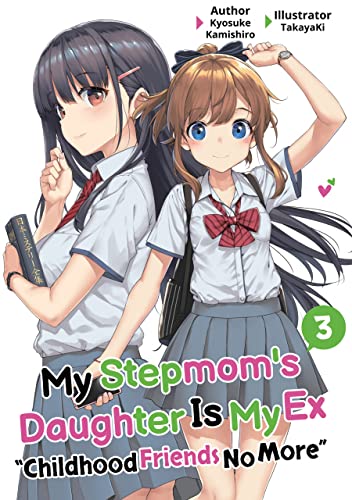
My Stepmom’s Daughter Is My Ex: “Childhood Friends No More”

By Kyosuke Kamishiro and TakayaKi. Released in Japan as “Mamahaha no Tsurego ga Motokano datta” by Kadokawa Sneaker Bunko. Released in North America by J-Novel Club. Translated by Gierrlon Dunn.

Given that I’ve said how much I don’t care for Akatsuki, and how I prefer it when the series focuses on its main couple, this third volume was always going to be a hard sell for me, as it gets into the nitty gritty backstory of her relationship with Kawanami, how it changed, and her own personal issues, with Mizuto and Yume once again being pushed to the background. That said, it does a decent job, showing me that Akatsuki is aware of her dangerous personality issues and is doing her best to change them, even if she thinks of it as “wearing a mask”. And frankly Kawanami has just as many issues, some of which were brought on my his tortured past relationship but most of which are his own damn fault, and he seems to be as obsessed with his friendship with Mizuto as Akatsuki is about her friendship with Yume. They have a lot more baggage than our two leads, and I’m not sure they need to get back together.

The first half of the book focuses heavily on Isana Hagashira, who has now been rejected by Mizuto but oddly takes that as an invitation to be even more blatant around him, since she knows he’s not interested in her romantically. Essentially, she still has some difficulties working out how normal girls react around normal boys. And she’s probably not getting any help from the people around her – for one thing, Kawanami takes an instant dislike to her as she says she’s Mizuto’s best friend – that’s his job! The second half of the book gets into the backstory of Akatsuki and Kawanami when the group all go on a “study camp” sponsored by the school, and we discover, as Hagashira points out, that the “childhood friend” trope is something best reserved for fiction.

Explaining the backstory of those two is pretty easy, actually: they’re both latchkey kids who lived next to each other, and Kawanami was naturally extroverted anyway, so they simply grew together. Unfortunately, Akatsuki’s lack of boundaries proved to be crippling – we saw a lot of that in the first volume, and it creeped me out. Here we see Akatsuki acknowledge she was backsliding, and she really is trying not to get so obsessed with those around her (Yume as well) but the sheer loneliness that settles in when she does this is crushing. The intervention towards the end of the book that led the two of them to break down in front of each other is good for catharsis, but I’m not sure it will lead them to grow closer again just yet. As for Hagashira, she’s pretty hilarious, but I do think her shtick only works, as she knows, because of Mizuto’s lack of interest. As for Mizuto and Yume themselves… the biggest romcom thing that happened to them takes place entirely offscreen.

The anime of this has started, and the verdict so far seems to be “OK but flatly animated”. We’ll see how it goes. Till then, this remains a decent romcom but I wish we would return to our main couple.