My Daughter Left the Nest and Returned an S-Rank Adventurer, Vol. 4

By MOJIKAKIYA and toi8. Released in Japan as “Boukensha ni Naritai to Miyako ni Deteitta Musume ga S-Rank ni Natteta” by Earth Star Novels. Released in North America digitally by J-Novel Club. Translated by Roy Nukia.

Easily the best in the series to date, despite the fact that we’re now at the second round of “I have gotten everything planned out to see my dad again but something comes along to screw it up at the last minute”. Angeline is still a big-time Daddy’s Girl, but she’s put into a situation where that’s mostly irrelevant, and when it is relevant she actually manages to use it as a force for good. Belgrieve is finally forced to admit to himself that he may actually be as good at fighting as Angeline says he is, after going toe-to-toe with a top-ranked adventurer and … not winning, but lasting far longer than a 40-year-old with one leg should really be lasting. And the overall plot is finally coming into focus, giving us more ongoing bad guys, as well as an idea of what they’re going to do. Which I suspect is “kill Belgrieve and then watch Angeline destroy the world”. Best to stop that.
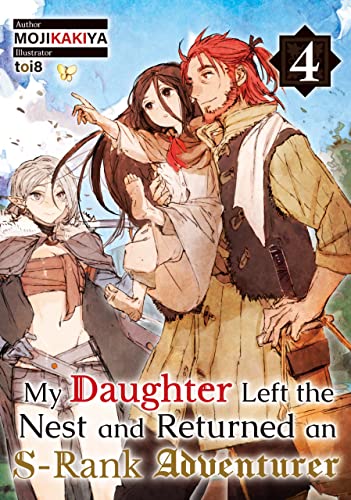
Angeline and company are ready to take Charlotte and Byaku back to her hometown. Unfortunately, the nobles have finally gotten around to noticing her, and have called her to the capital to come get an award… which means she’ll get back too late to make the trip before winter sets in. She is… unhappy. Meanwhile, Belgrieve has settled in with his new mini-family back in Turnera, but some of them are leaving as well, mostly as they have the adventure lust in their blood. It’s also reminding him of his past, which we get brief glimpses of here, and we see how even as a younger man he was cautious and careful. As for Angeline, when she arrives at the capital she not only finds a pile of nobles but also a mysterious guy in a dungeon… who may be more connected to her than she thinks.

This is not really a big fighting volume. Belgrieve gets into a couple of spars, but that’s not the same thing. As for Angeline, as I noted above, the best part of the book is the fight she doesn’t get into, especially as it’s supposed to be used as the excuse for a coup. It’s actually the second time she avoids this, the first being in the middle of her awards ceremony, where a noble attempts to taunt her into fighting and she responds by pointing out exactly what battling monsters and demons should be for, and it’s not “to show off my strength against some noble jackasses”. That said, they aren’t all bad here, and I really liked the young spunky noble girl, who I hope we see again. Plus Angeline gets her reward at the end – her dad came to see her rather than the other way around, and he’ll be there all winter.

Despite once again keeping its two leads separated most of the book, this time it did it in exactly the right way. This is a solid fantasy series.

The Apothecary Diaries, Vol. 5

y Natsu Hyuuga and Touko Shino. Released in Japan as “Kusuriya no Hitorigoto” by Hero Bunko. Released in North America by J-Novel Club. Translated by Kevin Steinbach.

For the most part, this is something of a transitional volume of The Apothecary Diaries, at least until the end. While Maomao is no longer at the palace, she’s still very much involved in everyday life, and now she has a little boy to look after (who proves to be quite an artist). There are several interlinking plots, one of which is likely to stick around – there’s a potential famine on the way, which was figured out by the fact that there are more grasshoppers than locusts around, something I absolutely did not know, so kudos there. Maomao even finds time to attend the theater, where we see a magic act that looks pretty impressive, but which is fairly easily explained by a combination of tricks and drugging the audience. The second half of the book, though, is more interesting, as Maomao is taken by Jinshi to a banquet in the western part of the country, and all hell breaks loose, both figuratively and literally.

Let’s leave Maomao and Jinshi for later and talk about the other parts of this book. I really enjoyed seeing Maomao back in her hometown and fitting in very well… she even takes on an apprentice, who has a very good memory, something required in an apothecary. The apprentice will no doubt be necessary soon, as there’s no way Maomao stays here long. Indeed, the second half of the book is a big field trip, first where she goes to the quack doctor’s hometown and meets his family (who she refuses to name, continuing this book’s longest running gag). I must admit Maomao challenging a bunch of assholes to a drinking contest may be the best part of the book, especially when she worries she’ll lose not by getting too drunk but by having to pee. I also really liked her relationship with Lishu, who is a trembling bird of a woman who turns out to be bullied at home and at the palace. That said, maybe she’s found a guy… which is more than can be said for Maomao.

The final scene should technically be romantic, but is instead deeply uncomfortable to me. I have never seen someone so blatantly determined not to fall in love as Maomao is in this series. The Emperor is pushing Jinshi to get married, and things are not going well, mostly as Jinshi only wants Maomao. For once there isn’t really a class or status problem here – *if* Maomao were to admit to her birth parentage, which she really really does not want to do. She desperately wants Jinshi to marry anyone else mostly to try to get rid of the undeniable tension between them. The final scene features Jinshi, in a bit of a rage at Maomao’s attempts to brush him off, literally almost choke her to death, and it’s horrifying. As is Maomao’s response to this, which amounts to “gotta do this, I guess”. It’s a good thing that this series is a large number of volumes, as if Jinshi and Maomao got together now as they both are, bad things would happen.

This remains one of the best light novel series out there, an absolutely riveting read. If you’re reading it for the romance, though, I’m so sorry. Also, I forgot to mention the lion. There is a lion.

The Genius Prince’s Guide to Raising a Nation Out of Debt (Hey, How About Treason?), Vol. 9

By Toru Taba and Falmaro. Released in Japan as “Tensai Ouji no Akaji Kokka Saisei Jutsu ~Sou da, Baikoku Shiyou~” by GA Bunko. Released in North America by Yen On. Translated by Jessica Lange.

As we’ve now gone through about nine volumes of this series, it’s good to remember that the initial premise was that Wein was trying various ways to abdicate his responsibilities, and failing for the most part because a) he’s too good at his job, and b) he won’t do it if it means the people of Natra suffer. For the last few books, that’s mostly been forgotten, to the point where the title almost seems archaic. But this book reminds us that yes, Wein really does not want to be running his country, and he is still trying to take steps to avoid being the ruler. Fortunately for Wein, he has an adorable little sister with even more charisma than he has who sucks up knowledge like a sponge. The most interesting scenes in the book are when he asks Falanya is he really is “good” to the Flahm, and if so, how? Getting her to stop hero-worshipping him is a good first step.

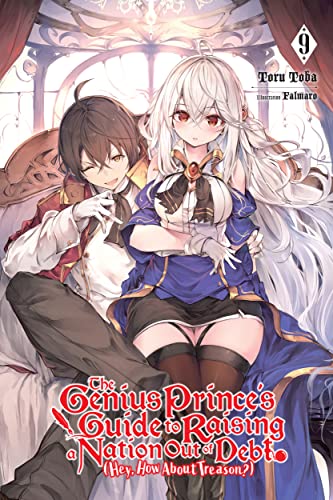
Wein and Ninym are on their way to Ulbeth, a nation divided into four regions: Muldu, Altie, Roynock, and Facrita. In theory they all are distinct areas with their own distinct rulers but united as an alliance. In practice, they all hate each other. Wein has been invited by Muldu’s representative, Agata, a Holy Elite who wants Wein’s help to undermine the other nations. Of course, Wein is not about to do this out of the goodness of its heart, but (as with most books in the series) complications suddenly turn up. Who’s going to win this mini-throne war? Can everything be solved by simply marrying as many couples as possible? And, most importantly, if something happens to Ninym, has Wein matured enough as a person not to simply kill every single person in the nation?

Slavery, as a concept, is so prevalent in light novels that it has become one of the worst cliches, and Genius Prince has been no exception. The Flahm have been presented in the story to date as an oppressed and hated group, and even in Natra, which supports them to an extent, Wein and Ninym have to merely be content to be ruler and aide and nothing more. The backstory of the Flahm has been teased in previous books, but here we get (secondhand) most of the story. I’ll be honest, it’s handled a bit better than other stories of its ilk, but still makes me a bit uncomfortable. On the up side, spoiling the previous paragraph a bit, we’re now seeing Wein be big enough to have someone kidnap Ninym and NOT destroy them completely. Alas, poor Ninym for once is the damsel in distress – her pulling a Wein and bewailing it at the end is hilarious.

I have a sneaking suspicion this series will end with Falanya on the throne and Wein and Ninym running off somewhere together, but we’re not there yet. Till then, this is a solid volume.