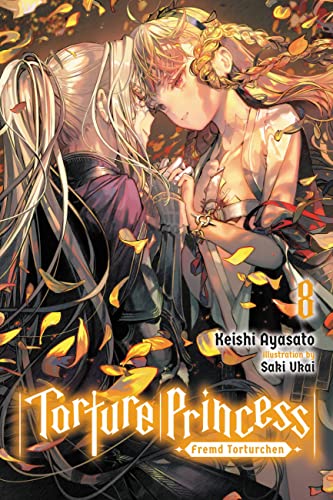
Torture Princess: Fremd Torturchen, Vol. 8

By Keishi Ayasato and Saki Ukai. Released in Japan as “Isekai Goumon Hime” by MF Bunko J. Released in North America Yen On. Translated by Nathaniel Hiroshi Thrasher.

As you might expect, there’s a lot of serious stuff going on in this volume of Torture Princess. We’re going to war, and one side does not really have a goal that is not “kill everyone in the most appalling way imaginable”. We get to see this world’s equivalent of last resort weapons, only for the enemy to respond with their own. Characters that we have seen since Book 1, who have died before but always seem to come back, finally die. And, of course, the entire book is asking the question: why are we even bothering to save a world like THIS? As a result, you might guess that the humor we’ve seen in previous volumes is pretty much absent, and you’re right – mostly. There is one scene near the end, though, which also begins in death, which ends up being the funniest scene not only in this book but possibly in the entire series. I don’t want to spoil it, but it features Jeanne and Izabella. It’s magical.
The mixed-race people, with Lewis and Alice behind them, are continuing to wage revenge against the humans and beastmen, with the help of some demi-humans. There are a few suggestions to stop the war. One is offered by the enemy, which is to give them Elisabeth, Kaito and Hina. But that would pretty much make the previous seven books pointless, so that’s off the table – at least privately. No, let’s face it, there’s really only one solution left, and it’s to go to war. On one side we have the humans and beastmen, aided by two Torture Princesses and some near gods. On the other side we have Alice, Lewis, and a dead giant sandworm which proves to be far more useful than anyone else might have imagined. Can one side win? What is “winning” in a battle that’s just about revenge? And is this world simply doomed regardless?

Kaito and Hina get a bit more to do in this book, despite spending almost all of it trapped in the big ol’ crystal. Their dreamscape not only shows off what’s happening in the world as a game of brutal chess, but also has a few uninvited guests. That said, for the most part we’re still putting focus squarely on Elisabeth. She’s trying to do her best here, but as everyone is fond of pointing out to her, she’s changed a bit TOO much fro being around Kaito, and actually, y’know, likes and cares about people now. That, plus the fact that she’s trying to save Kaito and the world he himself saved, means she’s less effective in many ways. Thankfully, she has daddy dearest, Vlad, on her side. The battle between Vlad and Lewis is probably the second best scene in the book. Also not without humor, it has a far darker finish.

The afterword notes that the next volume will be the final one in the series. Which is good, as frankly we’re running out of population. Will we go full end-of-world? Can our heroes manage to pull a happy ending out of a hat? Does a happy ending even fit this series? We’ll find out soon. Till then, this was an excellent volume.
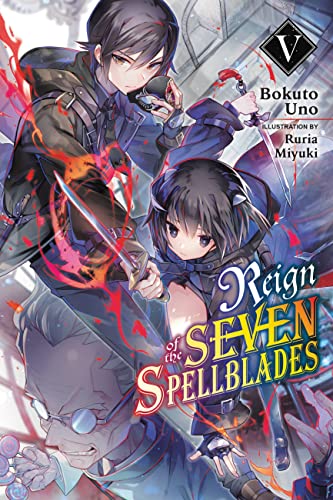

Reign of the Seven Spellblades, Vol. 5

By Bokuto Uno and Miyuki Ruria. Released in Japan as “Nanatsu no Maken ga Shihai suru” by Dengeki Bunko. Released in North America by Yen On. Translated by Andrew Cunningham.

It’s been several books since we’ve had to deal with the revelation that we got at the end of Book One, which is to say it’s been a while since Oliver and his allies have tried to murder a teacher. Good news! We get that here, as the academy’s resident mad scientist is next on the chopping block. More good news is that we also get a lot more explanations and backstory for exactly what is going on. Being Seven Spellblades, of course, it’s complex, and its discussion of Gnostics and Gnostic Hunters is very reminiscent of the battle for the “true face” of Christianity around the time of the Apostle Paul. There’s more suggestions that by the time this series is over Oliver will be dead or evil, but honestly, that’s not really a surprise anymore. Revenge is sometimes more important than… well, everything else. That said, boy, this revenge was costly. If the body count goes up with each dead teacher, the academy may be empty by the final book.

The book opens to a flashback showing us Chloe Two-Blade, the legendary Gnostic Hunter, and her fight against the Lovecraftian wyrms that have devastated her comrades. Hold that thought, because we then move back to the present, as our heroes try to tame griffins the hard way, learn about astronomy (which honestly seems more like history than anything else), and worry about Nanao, who has unfortunately Been Noticed – not only by Chela’s father but also by the headmistress of the academy, and you really don’t want to get noticed by her. Also, Professor Forggieri takes Pete on a tour of his mad scientist lab, with Oliver and Nanao tagging along. Still, there’s a sense of unease and tension throughout the book… which lets out in the second half, which is one big battle to kill said mad scientist.

Our main cast are probably safe, at least until the second to last book where one of them will tragically sacrifice themselves (my money’s on Chela), but the book is here to remind you that anyone else can die, as we’re introduced to more students who seem fun, powerful, and who are in the end sacrifices to help Oliver get his revenge. Even aside from Oliver, Guy and Katie meet a student who cheerfully says he’ll die soon due to experimentation, and try not to be like him. this is a super dangerous place, and even after graduation there’s no guarantee you won’t die fighting monsters from beyond our ken… or end up being brutally tortured and murdered by your allies. I really enjoy the religious subtext at the back of this series, and how it’s trying to show you that kindness is not a virtue here – something that may prove Oliver’s undoing, as little hints here and there suggest that we’re building up to a final battle between him and Nanao.

Fans of this series should be quite happy, as long as they don’t get too attached to anyone, and are familiar with 2nd-century religious persecution.

Rascal Does Not Dream of His First Love

By Hajime Kamoshida and Keji Mizoguchi. Released in Japan as “Seishun Buta Yarou wa Hatsukoi Shoujo no Yume wo Minai” by Dengeki Bunko. Released in North America by Yen On. Translated by Andrew Cunningham.

One of the things I like best about this series, which sets it apart from many of its contemporaries, is its use of short, quick sentences. The book reads fast, with dense paragraphs kept to a bare minimum and most of its page count being dialogue or inner monologue of some sort. However, this does not mean that it sacrifices any emotional impact – in fact, in many ways it’s heightened. The start of this book was always going to be a killer, and the prose makes it even more so. The sheer despair that Sakuta is feeling, the grief and rage that Mai’s mother and Nodoka have as they blame him for her death and cry out as to why it happened, it’s absolutely visceral and raw. Even knowing that this is not going to be permanent, that Mai will not remain dead (a series does not kill off its main draw), this is still a painful read. It gets better. But at some cost.

When we last left our heroes, Mai had just been hit by a truck. Sadly, she is not reincarnated in a fantasy world, but is simply dead. This shatters Sakuta, and things are not helped by the fact that a superstar actress died in order to save the life of her ordinary boyfriend – most of Japanese media is out to get him. refusing to accept Mai’s death, he returns once more to the beachfront we’ve seen in most other books in this series, and finds the older Shouko there once more. She reminds him of what almost everyone has experienced so far – Adolescence Syndrome – and that this might actually be a future we don’t want to see, rather than the present. But can Sakuta return to his “present” even though he’s already there? Will anyone notice him? And even if he can stop Mai from getting killed, who’s to stop HIM from dying?

I do wonder if there’s a fanfic out there showing what happened in that bad future if Sakuta couldn’t fix it, because the implication is there is no way the media would allow him to survive. Sakuta’s grief infuses over half of this volume, making it by far the least funny of the books to date, but that’s fine, you don’t want laughs here. When they come later, they’re as much a relief for Sakuta as they are for the reader. It’s also nice to see Mai reminding us that she is quite a sweet and loving partner, to the point where Sakuta has to actually find ways to upset her in order to have her be cool and menacing towards him (his professed fetish). And then there’s Shouko, whose life and death also rides on this book. The ending may be a bit sappy and unrealistic, but given the nature of the series, realism is not what I want. That said, it’s VERY abrupt – you’re waiting for another epilogue.

It’ll be interesting to see where we go from here, with the main backstory plotlines pretty much resolved. The next volume promises a return to Kaede’s attempts to go to school. Till then, please enjoy this cry of grief from the heart, and be thankful it all ended well.