In the Land of Leadale, Vol. 6

By Ceez and Tenmaso. Released in Japan as “Leadale no Daichi nite” by Famitsu Bunko. Released in North America by Yen On. Translated by Jessica Lange.

Last time I wondered whether Opus’ introduction would lead to him explaining the plot a bit more, or just to him being a dick. As it turns out, it’s both. Indeed, the explanations come fast and furious, which is a bit of a surprise. We’ve occasionally thought back to Keina lying in her hospital bed, and how Leadale was created essentially for her. But this volume shows that goes MUCH deeper than we’d expected , and that Cayna is tied to Leadale in a far more significant way than I think she’d really like to be. I don’t want to get too much into spoilers, but suffice to say that Opus’ real-life identity was the least surprising part of it. That said, the real world is not an option for Cayna anymore, so best make the most of it and do what she does best – be a terrifyingly powerful mage who you never, ever want to see get angry. Sadlty, in this volume, Opus is at her side most of the time, so no luck there.
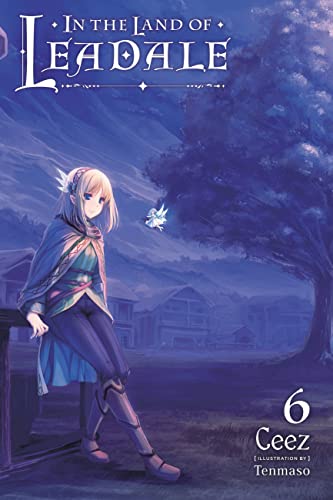
After recovering from her MP-draining rage attack on Opus from the last volume, Opus actually deigns to answers a lot of her questions about the true nature of this world. From there, she goes back to the village she’s now calling home, trailed by Opus and his Maid/Bodyguard/Tsukkomi Siren, who has definite opinions on what servants should be like but also is well aware of how much of an asshole her boss is. She then returns to the capital, where her granddaughter asks her to deal with a loose end… the player/bandit leader she put a punishment collar on several books ago, who has basically learned his lesson. As for Opus, he’s just starting to walk around and get back into the swing of things, but he certainly enjoys putting the fear of God into anyone he interacts with. This won’t change.

There’s a prologue where we see Keina at the hospital, interacting with her family and the programmer who’s there to tell her about Leadale, and it helps to hammer home how mentally exhausted she was in there, and also how truly immature she still is. I’d mentioned the reaction against her violence last time, and I think that’s because we’re told (as everyone else thinks) to see her as a 200-year-old all-powerful grandma rather than a teenage girl who get really, really excited simply by the fact that she can run around. As for her and Opus, leaving aside the various reveals, I am pleased to see that they have exactly zero romantic chemistry together… though admittedly that’s not what the rest of the cast thinks. It’s OK, sometimes you can just have a relationship be two antagonistic friends who have the power to destroy a continent. Cayna yells, Opus smugs, punches ensue, rinse and repeat. It’s fun.

Leadale is not for everyone, and if you didn’t like the anime I don’t think this adds enough value to recommend, but for those already invested, there’s a lot of payoff here you weren’t expecting.
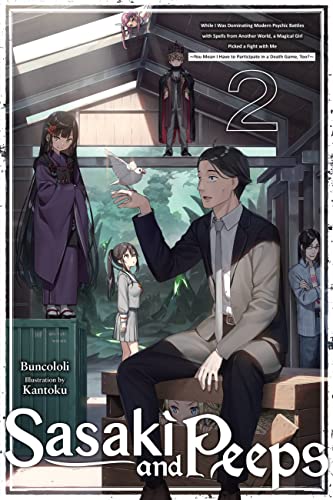
Sasaki and Peeps: While I Was Dominating Modern Psychic Battles with Spells from Another World, a Magical Girl Picked a Fight with Me: ~You Mean I Have to Participate in a Death Game, Too?~

By Buncololi and Kantoku. Released in Japan as “Sasaki to Pi-chan” by Media Factory. Released in North America by Yen On. Translated by Alice Prowse.

Content warning before we start: near the end of this volume there is an attempted rape scene of a middle schooler, and it is 100% played completely seriously. It helps to show off the strengths and weaknesses of this series in general. The author clearly wants to take several distinct genres and slam them all against each other. We’ve got isekai fantasy, esper battles, magical girls (and, because it’s the 2020s, they’re dark killer magical girls), and now we’re adding a battle between angels and demons using humans as proxy. This works pretty well when things are ridiculous, with our stoic salaryman Sasaki, his relatively stoic bird, and the amusing Futarishizuka. But it’s also trying to tell the story of an abused, suicidal middle school girl who is also deeply twisted, and it’s telling it with all the gravity it requires. Which… y’know, better than the alternative, but it GRATES against everything else.

As with the first volume of this series, things are slightly more interesting on the Japan side of the equation. This is not to say that the fantasy world doesn’t have a lot of danger, but it’s fantasy isekai danger, which means you have a lot of domineering nobles and sneering merchants. All Sasaki is trying to do is sell off all the modern things he’s bringing from Japan, but now he’s involved in a proxy war between two counts, two princes, and two companies. That said… he’s an experienced Japanese salaryman. This is what he’s GOOD at. He fares far less well when being tasked with his high school girl co-worker to try to recruit a new psychic who has fire powers. This goes disastrously wrong in ways I 100% was not expecting. That said, the most interesting part of the book was when the little princess from the fantasy world stows away when Sasaki returns to Japan… not the last time these two worlds intersect, I hope.

As for “the neighbor”, whose name, we find, is Kurosu, we get a little peek into her horrible, horrible daily life. She has to steal food from school to not starve to death, and it’s middle school, so she also has to avoid the class hottie helping her lest she be in trouble with the other girls. Her mother is sleeping with a guy who tries to rape her. Oh yes, and then there’s the corpse that drops in front of her as she’s walking home. Kurosu’s story has still not really intersected with the main one yet, but I expect that to change in the next book – the “death game” mentioned in the ludicrous subtitle of the volume is hers, not Sasaki’s. We also get a bit more about the magical girl… and it’s not really great news. She’s already killer her comedy animal mascot, she alleges that Sasaki’s employers killed her entire family and friends, and she now doesn’t know whether to trust him or not. So, y’know, just another day at the office.

If you enjoy A Certain Magical Index you might get a big kick out of this, because the chaos is the point. That said, unlike Index, there’s sometimes a realistic and very dark undertone to this series. I’ll read more, but YMMV.

The Apothecary Diaries, Vol. 6

By Natsu Hyuuga and Touko Shino. Released in Japan as “Kusuriya no Hitorigoto” by Hero Bunko. Released in North America by J-Novel Club. Translated by Kevin Steinbach.

It’s time for another volume of everyone’s favorite mystery series, Murder, She Grumped. We pick up where we left off, with Maomao and Jinshi at the Western Capital (and with Maomao decidedly avoiding an extremely horny Jinshi, who is so horny he’s willing to try it on with his bodyguard), but we soon get a suicide that is not what it seems. After this they finally go home (separately, Jinshi still has to wrap up investigations) and Maomao is tricked/lured by Lahan into dealing with “family business”, something that makes her very unhappy, even as we learn about how glorious potatoes can be. That said, I think the main draw of this book is not going to be Maomao but Lishu, a girl who is trapped in a series whose base qualities are set up to destroy her, and when she gets tangled up in the ongoing plot, she is very nearly destroyed. For once, I found the non-Maomao segments in the book very interesting indeed.

A chunk of this book revolves around the cultural disconnect between East and West, as one of the plot points is that the “love letter” that Lishu had been writing, which gets her in big trouble, is actually her transcribing a translated version of Romeo and Juliet, which has taken the rear palace by storm. The funniest part of the book may be when both Maomao and Jinshi find the plot of the play incredibly annoying, pointing out how miscommunication is not tragic, just frustrating, and all the sobbing young women who say they just don’t get it. Maomao is her usual excellent self here, pretending to have an uncaring, logical mind while constantly helping everyone around her. She’s still not back at the palace yet… but honestly, Jinshi visits her constantly, so that’s fine.

And poor Lishu. The concept of the “weak” Consort being bullied by everyone around her, including her own servants, is not unique to this series, but that doesn’t mean that the emotional impact is lessened. Lishu goes through a lot in this book and the previous one, from almost getting killed by a lion, to being accused of infidelity to the Emperor and locked in a tower, to (perhaps worst of all, and the lead-up even gets an illustration) having Maomao need to “verify” for the official record that she’s still a virgin. She’s not a candidate for the Emperor’s bed, and honestly, I don’t think she’s the sort to eventually win over those around her by being sweet and kind… she’s simply too ineffectual even to achieve that. Her ending here is probably the best one we can possibly expect, and I hope that she has a far better life going forward than she’s had to date.

That said, we do now have a vacant Consort position. While I briefly considered the idea of it going to Maomao, and howled with laughter (till I realized she would probably castrate me if she heard me), I suspect it will be part of the plot of future books. The part that is not about Maomao investigating crimes like the most sullen Angela Lansbury ever.