Reign of the Seven Spellblades, Vol. 4

By Bokuto Uno and Miyuki Ruria. Released in Japan as “Nanatsu no Maken ga Shihai suru” by Dengeki Bunko. Released in North America by Yen On. Translated by Andrew Cunningham.

First of all, the big news regarding this 4th volume in the series is that it actually manages to come to a logical conclusion that feels like the end of a volume, as opposed to the last two volumes, where the ending was just “finish the page you’re writing now and we’ll send a courier to pick it up”. That said, the events of the first three books are not forgotten, and have great impact on the 4th, as our heroes start their second year at Kimberly. Everyone is also growing up; our second years are sixteen, and there is a lot of discussion of sex here, why and how it should happen, and who to watch out for. It’s considered as a rite of passage rather than a shameful act. That said, events from the previous book also leave Oliver a bit… pent-up, shall we say. Fortunately, one of his friends notices this and helps him out in a scene that is actually really well written and well characterized. Further, deponent sayeth not.
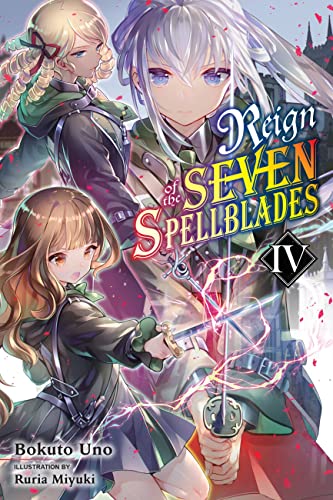
Aside from talk of sex and relief from sex-based spells, there’s a lot of magical academy stuff going on here as well. We get new teachers, including one with the improbable name of Ted Williams, who stuns the entire cast by being a reasonable, normal instructor. Nanao excels in her broom-riding sport, so much so that she’s promoted to the upper-year senior league… where she finds, for once, someone she can’t blow her way past with natural talent. The kids all go out to the local town, something that takes up the back half of the book, where they get into fights with rival schools, experience the terror of British food, and deal with a mysterious man who keeps assaulting magicians. With all this going on, will Oliver finally find time to get around to why he’s actually there?

On Twitter I posted a poll asking how everyone thought the books would end: with the main cast in a polycule, or with the main cast all dead? Unsurprisingly, the poll was almost dead even, because really both options seem likely. Leaving aside Oliver and Nanao’s deep chemistry, and Nanao’s desire to want to fight him to the death (I’m hoping for redefining death in a future book), it’s pretty clear that Chela also likes Oliver a lot. Pete, of course, is also falling for Oliver. Guy and Katie have that vague R*n and H*rmoine vibe, but honestly that feels like one of the least likely, at least until Guy gets his act together. As for the death part, well, come on, look at the school. If nothing else, I’m fairly certain Oliver’s plan is not going to go swimmingly all the way to the end. Especially since his next target has taken a special interest in Pete…

I haven’t even mentioned half the things going on here – these books are very dense, and there’s a lot going on. If you enjoy magical academy stories and don’t mind them being darker and more adult than the typical light novel fare, this is still a must read.


The Angel Next Door Spoils Me Rotten, Vol. 3

By Saekisan and Hanekoto. Released in Japan as “Otonari no Tenshi-sama ni Itsu no Ma ni ka Dame Ningen ni Sareteita Ken” by GA Bunko. Released in North America by Yen On. Translated by Nicole Wilder.

Tempting as it is to simply cut and paste my review of the 2nd volume here and call it a day, I will try to find new things to discuss. This series runs on sweet but slow burn, and there are very few surprises. On the downside, that makes it somewhat boring. On the good side, you know exactly what you’re getting and you get a lot of it. The main difference in the third volume is that Mahiru tries to come on to Amane a lot stronger to get past his impenetrable shell of self-hatred. She fails, but it’s the effort that counts. She is starting to get a bit sick of his attitude, though – as is the rest of the cast, including his new friend Yuuta, the “class prince”, who sees a kindred spirit in Amane and is rather startled that the feeling isn’t mutual. By the end of the book, everyone is dragging him constantly to feel better about himself. Will it help? Possibly?

Usually the 2nd paragraph of my reviews is where I summarize the plot, but the plot can essentially be summarized in three words: Mahiru Tries Harder. As such we get a lap pillow, and more spontaneous touching. We get Amane seeing another guy ask Mahiru out, and see just how difficult it can be for her to reject them, especially when they refuse to accept it. We see Mahiru managing to actually join Amane for lunch and get away with it. Most importantly we get Golden Week, where Mahiru asks Amane on a date. Of course, it’s not a romantic date to him – not at all, after all, how on earth would she ever have feelings for him? It’s just going out to a cat cafe, a mall (where much trying on of clothes is done) and an arcade (where there is winning of stuffed animals) but as Just Friends. That said, a return to school shows some folks spotted her on the date, so something may break next time.

The author knows Amane’s big flaw can be annoying to the reader, but instead of trying to disguise this it is shoved in our faces – and his. We do finally get his own tragic backstory here, which amounts to “I grew up rich and naive and then met typical middle-school two-faced jerks”, but it’s left him bitter, mistrusting and thinking he’s the absolute worst. This even plays into the title, as he regards everything Mahiru is trying to do in order to get her feelings across to him as “spoiling him”, so he automatically pushes back. Multiple times in this book she, Itsuki and Yuuta all tell Amane to man up, have confidence, and actually try to show Mahiru how he feels about her. The end of the book implies we may see this in the next volume, but for now, this is painful.

Still, the sweet and cute romance outweighs wanting to strangle the lead man, so I’m still invested in it. Imagine how sweet it will get once these two actually confess. Like eating Pixy Stix.

Arifureta Zero, Vol. 5

By Ryo Shirakome and Takaya-ki. Released in Japan as “Arifureta Shokugyou de Sekai Saikyou Rei” by Overlap Bunko. Released in North America digitally by J-Novel Club. Translated by Ningen.

It’s been a good sixteen months since I last read Arifureta Zero… and come to think of it, eleven months since the last Arifureta in the main series. This is the danger of catching up with the Japanese release, and I knew this meant that a lot of my time was going to be spent trying to remember who everyone apart from the main characters were. Little did I realize that that was going to be ALL of my time. This is the 2nd to last book in the series, and as such it has to gather everyone in the cast together for the big battle in the finale. And I do mean everyone – every single ally we’ve seen in the books to date pops up again, along with new characters we haven’t seen before, and they’re all written as if we remember who they are and are nostalgic to see them again. It’s exhausting. Fortunately, there’s BIT more going on than just setup.

A month after the end of the previous book, Miledi is still in a coma, which has everyone stressed out, especially Oscar, whose fighting abilities are actually being affected by his worry. Fortunately, she wakes up soon after the book begins. Unfortunately, she’s… a bit different. Yes, it’s We Want Our Jerk Back, the light novel. The largest chunk of the book is spent getting Laus, their newest ally, to the rest of them, as he’s being hunted by the entire church… including two of his own sons. (This is framed as a big reveal, but it’s telegraphed so badly I feel no remorse revealing it here.) Once he’s arrived, and Miledi puts everyone through RIGOROUS TRAINING, it’s discovered that three of their allies are going to be put to death publicly by the Church. So Miledi decides now is the time. the Big Battle. (In Book 6.)

The author apologizes for this book being so long, and he should. It’s too long, and a lot of this wasn’t needed. The “checking in with everyone who the Liberators ever met in prior books” section is a lifeless slog. Better were the scenes with Miledi waking from her coma, but she’s missing her annoying. Without it, she’s a cute adorable teenage girl in love with Oscar and not ashamed to say it. This is mined for much comedy, and for once it actually works quite well, especially her reaction once she returns to normal. Speaking of love, Miledi and Oscar don’t confess here, but that’s because they want to wait till after the battle – their feelings are known to each other. Oh yes, and there’s an incredibly annoying bunny girl in this as well, who seems to combine all the worst parts of Shea and none of the good points. The author loves to write “incredibly annoying but secretly goodhearted and awesome” people – indeed, the lesson of this book is that all of the Liberators are eccentrics – but sometimes I feel they overdue it.

So next up is the finale, and it’s not a spoiler to say that Everybody Dies – this is a prequel, after all. But it’s not the journey, it’s the destination, and so we’ll see how it all happens and how many times our heart can be broken. If you like Arifureta, you should read this, but be aware – it’s long and has boring bits.