Combatants Will Be Dispatched!, Vol. 5

By Natsume Akimoto and Kakao Lanthanum. Released in Japan as “Sentouin, Hakenshimasu!” by Kadokawa Sneaker Bunko. Released in North America by Yen On. Translated by Noboru Akimoto.

For some time now, the “evil” in this series’ evil organization has been somewhat questionable. At first it looked like it was just Six, who clearly was content with being a creepy asshole but drew the like at, know, actual evil things like rape and murder. As we’ve gone on, and found that the evil organization is in fact trying to save the planet Earth, more motives have been questioned. And now we find that the organization actually has a real HR policy – we’re told that the Combat agents can sexually harass to their heart’s content (it gets them evil points, after all) but that actual sexual assault is a punishable offense. You get the sense the author realized that they were going a bit too far. KonoSuba, by the same author, will also try to walk this very thin line. In the meantime, the organization is going to have to deal with the biggest threat it’s ever seen to date. The demon lord is dead and his daughter has taken over… and she’s a total sweetie pie.
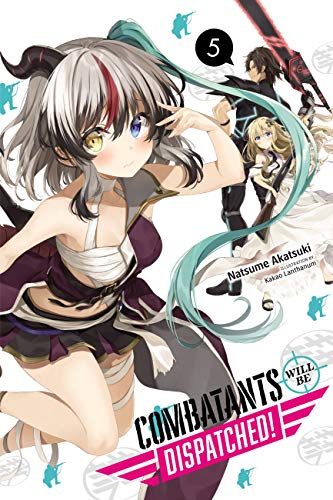
Rose gets the cover, and is the “heroine of this volume”, but actually gets very little to do besides eat. The Demon Lord’s Domain wants to negotiate, so the group heads over there, and as noted above, finds they accidentally killed the demon lord in their last attack, leaving his daughter Viper in charge. The demon lord was a stubborn middle aged cuss. Viper is kind, gentle, and very apologetic. As such, the demons are actually surrendering – and asking for Six and company to find them a new place to live, as their territory is basically uninhabitable. There’s just one problem with this – the Kingdom of Grace is not content to let the demons simply go “our bad, sorry” and then move in next door. They want reparations. Can Alice negotiate their way to a settlement? Can Heine come to terms with her new job as a magical boiler room? And can six and Viper team up to take out those pesky Puzzle x Dragon games once and for all?

So yes, Viper’s presence in the cast really shakes things up, mostly as, unlike Princess Tillis, Grimm, Snow, or the other characters whose suffering is hilarious (and in Grimm and Snow’s case, brought upon themselves), being mean to Viper is like kicking a puppy. Indeed, the main worry is that she’s too naive and willing to do whatever anyone else wants – hence the mention of the HR guidelines. Honestly, she’s probably the first major character in this that I can’t think of an equivalent to in KonoSuba, the way that you can see Snow as Aqua + Darkness or Grimm as Wiz + Yunyun. Her friendship with Six is actually, dare I say it, rather sweet. Of course, this does not mean the author has suddenly forgotten that this is the Japanese equivalent of It’s Always Sunny in Philadelphia. There is lots of terrible stuff here. But when said stuff hits too close to Viper, it just sort of drifts to a halt.

We’ve almost caught up with Japan, and the anime based on the series is out next month. So it’s a good time to read a new volume of the worst evil organization, and see how they deal with good.

How a Realist Hero Rebuilt the Kingdom, Vol. 13

By Dojyomaru and Fuyuyuki. Released in Japan by Overlap Bunko. Released in North America digitally by J-Novel Club. Translated by Sean McCann.

Anyone who has consumed any amount of Japanese anime/manga/light novel material will be familiar with the concept of the “bland hero”. He is there to be the reader, essentially. He is nice. He is usually smart, at least in these sorts of books. He is sensible. He tends to get flustered easily, usually. Sometimes this can even be done well. Realist Hero’s Souma is a fairly good example of the type without having most of the negative points that people complain about. Unfortunately, this can become a problem when the situation requires the character to have a reaction that is NOT “bland hero”. Near the start of this book, Souma takes offense to the rather wet (no pun intended) island princess comparing her situation to his wife Roroa’s, and gets mad. Which is fine, except I do not for one minute buy his anger at all. I had thought it was a calculated move, like virtually everything else he does. But no, it was meant to be rage. And wow, nope. Fortunately, the book improves greatly after that.

We pick up where we left off last time, with Princess Shabon and her bodyguard Kishun begging Souma to stop the upcoming war with the Nine-Headed Dragon Archipelago Union. This proves to be quite a wrench in the works, not only because Shabon’s desperation and poor self-image leads her to piss Souma off, but also as, well, he’s already got a plan in place, no worries. That said, there’s a bigger issue here, as the reason that all this seems to be happening is a giant monster that is prowling the seas and taking away all the fish – and sometimes the fishermen. Souma has to find a way to not go to war, avoid having the Empire called in, and deal with what is, let’s face it, Gamera. Fortunately, he has a lot of tricks up his sleeve, including a Navy that is powerful and does things other navies can’t, a monster expert who’s still a kid (I mean, when I say it’s Gamera I’m not making things up) and also find time to deal with the fact that another of his wives is pregnant.

The action parts of this book are quite well done, as is the “clever plan”, especially when we realize who Souma’s contact inside the Archipelago Union is. As noted above, this is very deliberately an homage to old kaiju movies (Souma uses the word to refer to the creature), and like most of those movies, you feel sad when it is finally brought down. There’s also some good politicking for those who read the series for that. I’m especially interested in what’s going on 3with Empress Marie, who pretty blatantly says here that she’s fine with simply letting Souma rule over everything. (I’m still betting she’ll be a final wife.) In terms of the ongoing plot, however, it’s still simmering, with Souma and Fuuga knowing they’re going to have to fight to the death and not really wanting to do it.

The next volume isn’t out in Japan yet (late April, I think), so we’ll be waiting a while to see what’s next. Till then, Gamera is really neat, he is filled with turtle meat, and please try not to let Souma show actual emotions.

The Executioner and Her Way of Life: Thus, She Is Reborn

By Mato Sato and nilitsu. Released in Japan as “Shokei Shoujo no Virgin Road” by GA Bunko. Released in North America by Yen On. Translated by Jenny McKeon.

As we see more and more deconstructions of the basic isekai light novel and its tropes, it’s inevitable that some of those deconstructions are going to involve “isekai is bad, really”. Yeah, taking a young, immature Japanese man and dropping him into a fantasy world with monsters and magic, where he inevitably starts plotting how to “invent” mayonnaise and miso soup, is not necessarily the best decision one can make. Indeed, this is not even the first book we’ve seen in English with this plot, as Isekai Rebuilding Project already wandered down this road. That said, this world is pretty hardcore about stopping it. Isekai’d Japanese people, in the past, have created horrors of apocalyptic form. There’s no stopping them, all you can do is put them out of their misery. And, well, if you have to kill them before they even gain access to their powers, well, this is a sacrifice that will have to be made. This book is about one of those killers, and the girl she can’t kill.

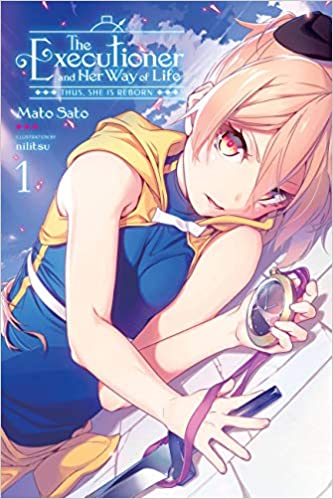
We are introduced to Menou, the titular executioner, when she meets a young man who was brought to this world from Japan… and then promptly kicked out. Not spoiling much, but… he is not our hero. Menou fills that role. The heroine is actually Akari, the girl who was brought to this world at the same time, and who Menou also kills… but Akari can control the element of Time, and this the clock rewinds her body back to being unhurt. She also doesn’t seem to remember Menou doing this, so Menou continues to pretend to be helping her while, in actuality, leading her to the Church, which apparently can do a better job of wiping her out. She’s helped by her assistant Momo, who is basically Shirai Kuroko from Index in pink, and, albeit inadvertently, by Ashuna, the princess of the royal family who started this whole mess. That said, Menou will rapidly find that there’s far more going on here than meets the eye.

Getting the bad out of the way, this book’s afterword sells itself as “grimdark”, and it’s not kidding. There’s lots of dead and eviscerated people in this, Menou’s backstory verges on terrifying, and the ending implies that the entire series may end in a tragedy. And, because this is a Japanese light novel, we’ve got to have lots of talk about Akari’s big breasts and art of them being big. This ends my negative comments. Everything about the book that is not those two things was fantastic. The magic system is well thought out, and integrates nicely with the world’s religion. The characterization of the four leads manages to make them all obvious “types” that anime fans will be VERY familiar with, but then also turn around and give most of those people (Ashuna does not get much to do here, to be fair) a depth that also works the way a good mystery does – after reading the ending, you want to go back and read the start again. When we first meet Akari, there’s a bit of her own narration that is 100% at odds with everything we get for the next 150 pages… until the climax, when it all comes together and you go “OOOOOOH!”. Love it. Even Momo, who I was sure would be the one character that irritated me throughout, gets a touching backstory, an actual reason for her behavior, and a terrific romantic afterword, though I have bad news for her if she hopes to be best girl.

So yes, definitely recommended. Even the title and subtitle have a sense of “grand epic” to it. Oh yes, and there’s also a tinge of yuri to it, so folks who enjoy that will also want to read it. Plus, anime coming soon! Basically, get in on the ground floor of this one.