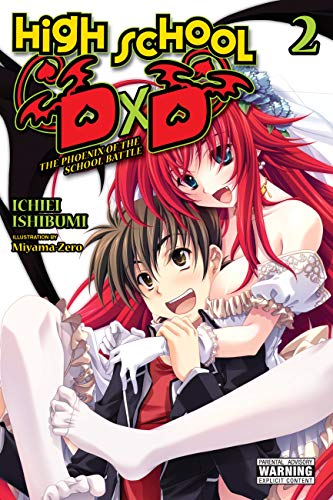
High School DxD: The Phoenix of the School Battle

By Ichiei Ishibumi and Miyama-Zero. Released in Japan by Fujimi Fantasia Bunko. Released in North America by Yen On. Translated by Haydn Trowell.

Sigh. The second volume of High School DxD, I’m pleased to say, has the same strengths that the first volume had. Unfortunately, the weaknesses the first volume had are also here, and they’re far more in your face. This is the perfect series for horny 15-year-old boys. There’s a likeable cast, a premise of “which of the many hot women who desire me shall I choose?”, a lot of very cool fights, and smug punchable villains who are basically the ‘evil’ version of your own fantasies. It’s shonen battle manga up the wazoo – in fact, when typing the title of the book I accidentally typed “Phoenix of the Old School Battle”. Unfortunately, its fanservice, which was present but not up to annoying levels in the first volume, has now reached annoying levels. Issei will not shut up about boobs, spends a page or so describing what it’s like to feel up the heroine, has powers that strip the villains of their clothing (provided they’re girls), and declares, and I quote, “Rias Gremory’s virginity belongs to me!”. YIKES.
The premise of this one is fairly simple: Rias has an arranged marriage she’s been avoiding, to Riser Phenex, a high-born noble demon. She very clearly does not want this, and would rather stay in high school with Issei and company. So a duel is arranged between Rias’ group and Riser’s – if Rias wins, she can keep doing what she wants, if Riser wins, they’ll get married. Issei, naturally, is ready to fight for Rias, both because he’s got the hots for her AND because he’s rather upset that she’s not being treated like a person. Unfortunately, Issei, as he is now, can’t beat anyone, as is made painfully clear. There’s only one thing for it: we’ve got to have a training arc. And even after that’s done, we have to deal with the fact that Riser has the abilities of the phoenix, making him basically unkillable. How do you defeat someone like that?

This book is very much content to take as long as it wants to to tell its story. We do get more of the rest of the cast here, but they’re still relatively one-dimensional – Akeno is the ojou and secret sadist, Koneko is the short grumpy one, and Kiba is an odd combination of Koizumi, Shirou and Saika. We are briefly threatened with some backstory for Kiba in the middle of one of the big fights, but threatened is as far as it gets. I assume we’ll get more depth to them in later books, but for now they’re pretty cardboard. As for Riser and his crew, he’s meant to compare with Issei’s own harem dreams – Riser has a harem, who it’s clearly implied he’s sleeping with, and which contains various cute fetishes – twins, sword chicks, etc. – even his own younger sister, because what’s a harem without incest? And, well, that gets me back to sighing, really.

Again, fans of this series will love this. And if you’re a teenage boy, feel free to read this, as the chance of actual sex happening in it is zero. For those of us outside the age range, though, High School DxD is a series with an interesting premise and characters that can’t resist being perverse in the exact way teenage boys are.
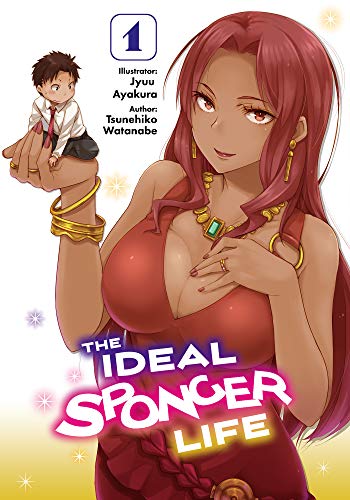
The Ideal Sponger Life, Vol. 1

By Tsunehiko Watanabe and Jyuu Ayakura. Released in Japan as “Risou no Himo Seikatsu” by Hero Bunko. Released in North America by J-Novel Club. Translated by MPT.

I had reviewed the first volume of the manga here two years ago, and we’ve had several volumes since then. Reading the light novel shows that the manga compressed quite a bit, probably sensibly. Anyone who is reading this book for the hot woman on the cover and hoping to get some nookie is going to be wildly disappointed by the 20-page discussion of hydroelectric generators, as well as the fact that the book pretty much cuts away whenever there is going to be some loving. That said, when this series first came out as a webnovel, it was SUPER popular, and there’s a hint of why that is here, as there’s some very nice political intrigue and worldbuilding, especially once we realize that our overworked salaryman hero, despite his stated intentions, is going to be proving that title wrong fairly quickly. Indeed, he does so almost immediately, as many of the things he has brought over from Earth are unknown here, ranging from glassworks to Microsoft Excel.

Our hero is Zenjirou, a young man in his mid-20s who works at a very busy Japanese company. On his off day, as he’s biking back home with food, he finds himself in a palace in another world – transported there by the beautiful young Queen, Aura. She’s looking for a husband and father to her children. As it turns out, due to various political reasons, she doesn’t want to marry any of the candidates in her own world. Plus Zenjirou does have royal blood in him, as it turns out his ancestors came from this world in the first place. After some questions and negotiations, he agrees to marry her, and the wedding comes off relatively well. That said, he may not be able to be a layabout for long. His own overly polite and deferential manners are greatly at odds with what people think a royal should act like. And those other marriage candidates aren’t going to stop trying to gain power just because the Queen married someone else.

This first volume is mostly setup, and it does drag a bit in places. There’s a point where Zenjirou returns to Japan for 30 days to settle his affairs (after this, he won’t be able to return for 30 years due to the way magic works), and we see why he would be so willing to cut ties with things, but I would happily have cut most of that to a 3-page montage. The main reason to get this is the worldbuilding and politics, both of which are quite good. Zenjirou manages to bring over a generator and several appliances with him, and so we see this medieval fantasy world getting used to fluorescent lighting and air conditioning. Aura picked an outsider as she wants to actually reign as Queen, and knows that in this patriarchal society anyone who marries her would immediately force her out of power. That said, she and Zenjirou fall in love fairly quickly, and even if he is sharper than she might have liked, I think she’s quite happy.

Zenjirou stays mostly cooped up with the Queen and servants this volume, but that can’t last. I suspect we’ll be seeing lots of ‘lets see how he handles this situation!’ plotlines in the second volume. Till then, this is a decent isekai title, less salacious than the cover and premise might suggest, and definitely worth a read.

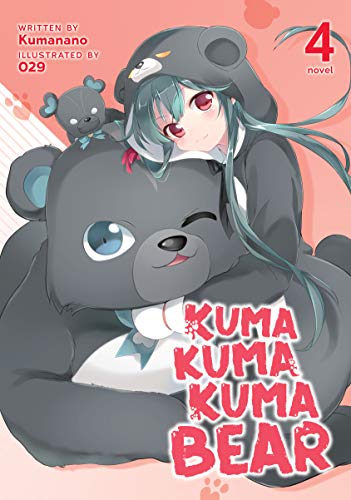
Kuma Kuma Kuma Bear, Vol. 4

By Kumanano and 029. Released in Japan by PASH! Books. Released in North America by Seven Seas. Translated by Jan Cash & Vincent Castaneda. Adapted by M.B. Hare.

This series remains very off balance, though I do enjoy it a great deal. It sells itself as a slow-life adventure with an OP girl doing cute things with other girls, and that’s what it is about half the time. But once every volume the author wants to remind us that this world (and, it’s implied, Yuna’s past) can be dark and horrible, and it’s always tonally dissonant. Here we see Yuna stopping a gang of bandits. First of all, the bandits are really adventurers paid by the villain to be bandits. Secondly, they go above and beyond their pay, as they apparently kill everyone leaving the city who isn’t a young pretty woman, and then keep the young pretty women in their cave as slaves and (it’s implied) rape them. There’s a horrific scene where, on finding the villain has among the things he’s stolen a ring she recognizes, one of the victims attacks the villain and demands her husband back. It’s… it feels like we jumped genres.

There’s two main plotlines here. First, Yuna returns to Crimonia with Fina and buys a mansion, then converts it into a bakery. This is the more typical Yuna plotline, with lots of OP ridiculousness, lots of cute girls, and tons of bear accessories, bear names, and beat statues. (But still no bear puns. The series is doing a good job at avoiding that.) In the second half of the story, Yuna goes to the ocean in search of seafood, but finds a city under attack on both sides: there’s a kraken in the ocean making it impossible to fish or get supplies, and there’s the aforementioned bandit gang. Yuna cleans up both, though the kraken seems to give her the first hard time she’s had to date, almost exhausting her mana trying to boil it up in the equivalent of a cliffside hot pot. Throughout it all, Yuna is as matter of fact and blunt as ever… except when she realizes the ocean city has rice. And miso. And soy sauce. Then she gets really emotional.

Yuna’s mindset is the best reason to read this book. the anime softened her a great deal. It adapted both of these plotlines, but also had a final episode not in this book where Fina is lonely and Yuna has to learn how to read emotions. That’s not really here, and it’s not just a matter of Yuna being callous, but an actual deliberate character flaw. Last review I said Yuna was trying to avoid getting too well-known or famous, but after this book I suspect Yuna will try to deflect and praise or thanks thrown her way, and is desperate to not have people get too close to her. She also tends to think about this world in terms of a game – of course, it’s a world she was brought into THROUGH a game – and situations like the bandits and their captives make her remind herself this is a real world with real people. It’s something that needs a bit more reinforcement, I think.

So yes, there’s a bit more here than cute girls doing cute things. There were also some great lines in this – Yunqa’s deadpan delivery helps sell them well. Next book Yuna starts a trade route, and I may see that Yuna and Fina scene that wasn’t here.