My Next Life As a Villainess: All Routes Lead to Doom!, Vol. 8

By Satoru Yamaguchi and Nami Hidaka. Released in Japan as “Otome Game no Hametsu Flag Shika Nai Akuyaku Reijou ni Tensei Shite Shimatta…” by Ichijinsha Bunko Iris. Released in North America by J-Novel Club. Translated by Marco Godano.

As always with Bakarina, it’s one step forward, two steps back. This volume is perfectly enjoyable, and I had a lot of fun reading it. But as for actual forward plot development, it’s pretty much “the pick of the best of some recently repeated Katarina hits again, Vol. II”, as most of the book has Katarina being incredibly kind and empathetic almost on reflex, followed by a different POV showing the affected person realizing how wonderful she is and far behind her they are in comparison. This is particularly true of Maria and Jeord, who get the bulk of the serious things happening to them… or because of them. Not everyone is as well characterized as I’d like (Mary and Sophia in particular suffer here, with Mary literally getting a nosebleed that forces her to be put to bed because she is thinking of Katarina naked), but if your goal is “pleasant silliness”, this will do nicely.

The subject of this volume is an International Assembly, an event that happens every two years, and this year Sorcie is hosting it. It’s a huge gathering of the higher nobles from many countries. Katarina cannot get out of it. What’s more, everyone is panicked that she will embarrass herself and everyone around her. So it’s time for history lessons, dance lessons, etiquette lessons, most of which she knows but it can’t hurt to be sure, right? That said, as readers know well, the issue is rarely Katarina when she has a prearranged agenda, it’s when she wanders off the agenda. That happens here when she’s caught lying on the grass one day by a dark-skinned young man. They bond very quickly, though Katarina has to pretend she’s a servant. Is *he* a servant? What’s more, why are Maria and Sora at the Assembly and what are they investigating?

There are many interesting things happening here beyond the surface of “Katarina charms everyone, they all love her”. She does gain a new love interest here, but he’s not making any moves while she’s engaged to Jeord, and he’s also from another country. He makes a cool new addition. There’s also a darker plot of slavery and kidnappings going on behind the scenes, leading to Maria almost getting assaulted at one point (Katarina climbs a tree – ruining her ballgown – to stop this) and a cliffhanger which implies a lot more action-packed thriller stuff next time. Perhaps most interesting is Jeord, a character who has not had a fun time of it with Western fandom, despite – indeed, because – being the primary love interest. His reaction to seeing Katarina besmirched, and near homicide he commits, horrifies him, and the fact that Katarina is not really all that appalled by it doesn’t really help matters. Please remember that you can burn people, Prince.

So it’s mostly fluff, but lovable fluff, much like our heroine. Next time might be more serious. Till then, hope you like Katarina making everyone’s life better by being an amazingly dense ball of sunshine.

The Saint’s Magic Power Is Omnipotent, Vol. 2

By Yuka Tachibana and Yasuyuki Syuri. Released in Japan as “Seijo no Maryoku wa Bannou desu” by Kadokawa Books. Released in North America by Seven Seas. Translated by Julie Goniwich.

A lot of being a fan of Japanese light novels is enjoying reading the exact same thing over and over and over again, and trying to find joy in how the author makes it very slightly different from everything that has come before it. The Saint’s Magic Power Is Omnipotent is no different, and so I found myself intrigued by the fact, hammered home several times here, that the “summoners” of the girls from another world really have no clue what it does or what it will do. They’re going by a legend. Other books have kids being trained by others, or at least have their situation explained a bit better, but when Sei asks about how her powers work here, no one knows, and when both Sei and Aira ask if there is any way for them to return to Japan, the answer is no, with a bit of a shrug. This helps explain why so much of what Sei does is just testing her magic and healing powers to see what they do.

In the first book, Sei succeeded in staying on the down low and enjoying her job as a researcher, but such halcyon days must come to an end here. The Grand Mage who summoned her has woken up, and he wants to experiment on her… I mean, get to know her. He is one of those cheerful sadists that we get so much of in shoujo titles, and it’s not a surprise that Sei is very reluctant to reveal to him that her holy magic level is “infinite”. That said, that isn’t her “Saint Power”, and can’t really help her level up her potions. What is her Saint Power? Well, when the army goes out to fight monsters, and brings her along, it becomes apparent to the reader what triggers it. But not to Sei or the others. Yet. It is, needless to say, strong emotions. Meanwhile, Sei also has to deal with the OTHER Saint candidate, who is having a very bad time at the academy.

The afterword says that the author had planned for Aira to be exiled with the prince, in a sort of “villainess” plotline, but decided not to because the readers asked for her to be saved. I’m glad she listened to the advice, as it makes Aira, who is set up to be a spoiled brat, a more interesting character – she isn’t spoiled at all, she is just relying on the only people around her that she can in a strange new world. She’s not the Saint – Sei is – but she clearly does have stronger powers than most everyone else there, and I hope we see her again. I also liked the reveal that Liz, the girl who Sei had been talking to in the library, is the prince’s fiancee – we’d guessed this, but Sei had not. Given Sei spends 90% of the book surrounded by hot guys, strong female friendships are important. The romance is a slow burn – Albert is clearly still in the lead, but it’s content to not worry about that right now.

It’s implied the next book will take place away from the main city, so we may not see as much of the regulars next time. Still, I’m content to walk along with Sei as she tests her theories, makes plants magical, and is generally super nice and lovable.

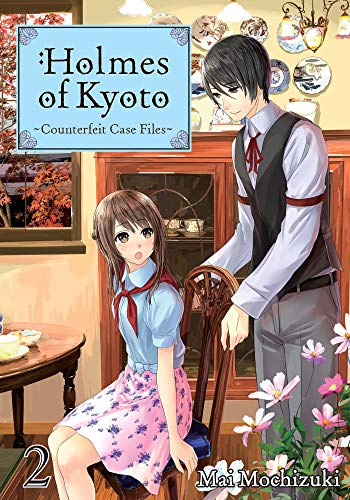
Holmes of Kyoto, Vol. 2

By Mai Mochizuki and Shizu Yamauchi. Released in Japan by Futabasha. Released in North America by J-Novel Club. Translated by Minna Lin.

I think the thing I find most amusing about Holmes of Kyoto is how it can’t seem to settle down in one particular genre. It’s supposed to be in the ‘light mystery’ genre, mostly involving forged antiques, and it definitely is that for a good deal of the book. The SOLUTION to said mysteries, though, is rarely the point and often an afterthought – at one point the book sets up an elaborate locked room mystery, complete with witnesses giving testimony that the reader is supposed to use to deduce the truth… and then solves the mystery immediately. There’s also the “let’s tour Kyoto and talk about how awesome it is” parts of the book, which are just as important as the mystery, and at times this seems like one of those travelogue style books where each chapter has the heroes at a new landmark. And of course it’s also a simmering slow-burn romance, one that actually seems to be on both sides this time, if still not going anywhere. The fact that the book balances all these sides perfectly is what makes it so fun.

These books are less novels and more collections of short stories, as we see Aoi and Holmes attend his grandfather’s birthday party (and deal with a smashed priceless antique); help a former art forger trying to make things right with his former victim; go to a temple where someone has theoretically stolen something precious… but they’re not sure what; tour a seemingly haunted house; and finally attend another party where they judge a series of paintings and antiques to show off their appraisal skills, only to find that the best among them may be our talented young heroine. The latter half of the book also introduces a new character who appears to be an ongoing antagonist to our hero… and while he’s not named Moriarty he’s certainly aware of the connection, and just as crafty as Holmes is.

I spoke last time that Aoi’s crush on Holmes was fairly one-sided, and that’s starting to change, and not just because everything they do together reminds people of a married couple. Aoi’s innocent and strong conviction is something that the usually too cynical Holmes needs in his life, and you get the sense that he might have told her so at the end of this book were it not for the presence of Akihito. I suspect Akihito’s appearances in this book might frustrate some readers. He is there to be comic relief, to be another person to have things explained to by Holmes, and to make sure that Holmes and Aoi don’t actually get closer than they already are – the author is well aware of the fact that Aoi is still in high school, and even has Holmes warn her when she’s forced to attend a mixer with university students. Still… man, they do make a REALLY good couple. It’s also nice to see Aoi’s instinctual brilliance at spotting “real” from “fake” coming to the fore so quickly.

So the main cast is expanding, and now we have a recurring villain. The series remains episodic, though, and I’m sure will continue to mostly concentrate on its light mysteries and the bond between Aoi and Holmes. And that’s a fine enough reason to read it.