My Brother’s Husband, Vol. 1

By Gengoroh Tagame. Released in Japan in two separate volumes by Futabasha, serialized in the magazine Gekkan Action. Released in North America by Pantheon Books. Translated by Anne Ishii.

This has been a book I’ve been waiting to see for a long time. I was at last year’s TCAF panel with the author, where he discussed his works and the challenges of a serialization like this one. It has since finished (at four volumes, meaning there will be one more omnibus), and this first omnibus is a handsome hardvoer with great reproduction and quality translation. But most importantly, the story and art are top notch. Fans of Gengoroh Tagame who know him for his Bara work (n.b. – Bara is gay manga, as opposed to yaoi/BL, whose primary audience is women) will love this, and those who aren’t into the gay bondage thing but want a good story about sexuality, grief, loss, and the intermingling of the three will also be delighted with this story.

The story deals with Yaichi, a single man raising his young daughter Kana. He’s a twin, and his twin brother has recently passed away. His twin brother was also gay, and his husband, a Canadian man named Mike, has come to visit Yaichi. What follows is partly slice-of-life – they go to visit places in the town, they make breakfast, they go to a gym – but there’s a lot more to it. Yaichi has inbuilt “ew, gay” prejudices that can’t simply be shrugged off, even if he is basically a nice guy at heart. Moreover, having a gay man living openly in their household is starting to make the neighbors talk, and the talk isn’t good. That said, Yaichi knows how he should be behaving despite his prejudices, and Kana simply adores Mike. As for Mike, he’s seemingly a happy-go-lucky guy, but is still dealing with grief over the loss of his husband, which is not helped by Yaichi being his identical twin.

My favorite thing about this release is how well the art and story complement each other. Tagame’s characters have amazing expressions, sometimes written all over their face (Yaichi), and sometimes seemingly poker-faced, but always drawn in a way that you know just what they’re thinking. The start of the story has an artistic conceit where the top half of a page has Yaichi acting out his (homophobic) thoughts, while the bottom half has the reality of his reserved Japanese response. I wasn’t expecting Yaichi to be as likeable as he is – yes, he’s a bit creeped out by the idea of Mike being gay at first, mostly due to how it ties into his brother, but he’s also prioritized being a good dad to his kid. (Taichi’s ex-wife shows up at one point – leading to a very funny reaction from Mike, who assumed she was dead by the photos in the house – and they get on quite well despite being divorced – it’s implied they broke up as she’s devoted to her work more than anything else.)

Mike can sometimes be a cipher, but that goes away as the book progresses, and we realize just how much he’s dealing with (and repressing, to a certain extent) his loss. His relationship with Kana is fantastic, as she’s constantly curious and trying to figure out things that adults haven’t really explained properly. And while some in the neighborhood call him a “negative influence”, that goes the other way as well, as he’s able to advise a young teen who comes to him and reveals that he’s gay. (This is right at the end of the volume, and I worry it may lead to bad things next time – I hope not, but the drama has been very low key so far.) And, as I said before, Tagame’s art is just terrific, giving added depth to characters just from a knowing look or a stressed out sigh.

To sum up, this book is simply compulsively readable, with its sole flaw being that we don’t know the date for the next volume yet. I was expecting to enjoy the series, but I was amazed at how much I enjoyed it, and how great all the characters were. And “being a gay foreigner in Japan” is treated just right. An absolute must-read.

Rokka: Braves of the Six Flowers, Vol. 1

By Ishio Yamagata and Miyagi. Released in Japan by Shueisha. Released in North America by Yen Press. Translated by Jennifer Ward.

(contains mild spoilers for the end of the novel, meaning I don’t use the guilty party’s name but still make it obvious who they are)

For a book that is supposed to be about the gathering of six warriors to traverse the country and defeat the evil demon lord, there’s surprisingly little fighting of demonic creatures in this first volume of Rokka (which is the one that was adapted into an anime). The reason for that is fairly simple; there’s actually seven brave warriors who show up, and thus one of them is a fake. What follows is pure mystery, as we spend time gathering clues, suspecting other people, and watching our hero get the ever-loving crap beaten out of him by the rest of the cast. Fortunately, as he tells us constantly, he’s the Strongest Man In The world, so he can take it. All of this, plus the series’ rather abstract art, makes it a nice change of pace in the ‘swords and dragons’ novels we’ve seen so much of in light novels lately.

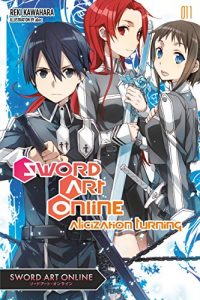
Adlet is the aforementioned Strongest Man, and is very much your prototypical shonen manga protagonist, being filled with confidence, pluck and a burgeoning optimism. He is joined by an eccentric princess and her sullen bodyguard; a cheerful yet immoral child who can control Earth (think Toph but slightly evil); a serious-minded priestess; a big, seemingly goofy cat-eared assassin; and the girl on the cover, Fremy, who is stoic and suffering and also half-fiend, which makes her everyone’s natural suspect as the seventh evil Brave. She isn’t, of course, but she is a bundle of complexes, and seeing her and the eternally perky Adlet banter and flirt is one of the high points of this book. The action is also well-told, showing off everyone’s abilities and superhuman strength and endurance, though honestly Adlet’s endurance stretches disbelief a bit by the end.

If there’s a flaw in the book it’s the actual mystery itself. It wasn’t too obvious, at least not for me, but I don’t think we had enough development of the character for it to really make an impact, especially given that the character is supposed to be somewhat schizophrenic to begin with. (Actually, the ‘I am a gadfly with no real sense of how to actually behave’ made them my favorite character for a bit, though it goes away when everyone has to act seriously and track down the mole.) It’s unclear whether we’ll see them again, and the cliffhanger is very much a “The End… OR IS IT?” situation, as we get ANOTHER Brave showing up late meaning there’s ANOTHER mole among them. That promises to be the main plot of book 2.

But overall I enjoyed myself reading it, though at times the back and forth betrayal accusations can get to be a bit much. It’s a serious book, but not as dour as some other light novels in this genre; you don’t get the sense that their lives will be terrible forever, even though they’re going to battle the Evil God. If you enjoy light novel fantasies, especially ones that aren’t ‘sent from another world’ sorts, this should meet your expectations.

Dreamin’ Sun, Vol. 1

By Ichigo Takano. Released in Japan originally by Shueisha, serialized in the magazine Bessatsu Margaret. New edition released by Futabasha. Released in North America by Seven Seas. Translated by Amber Tamosaitis, Adapted by Shannon Fay.

The manga orange was one of the big hits of the last couple years, and even spawned an anime. Therefore it’s no surprise that the company that put it out is dipping their toes into the author’s other works. Dreamin’ Sun is her other significant series, and so far, while it doesn’t have the immediate emotional heft that orange had, it makes up for it with quirky characters who are fun to read about. The basic premise may strain my suspension of disbelief a bit, but I’ll put that down to it being more acceptable in Japan and just roll with it. And of course there are love triangles galore, which are the main reason to read these sorts of shoujo titles. It’s a cute series.

When we first meet Shimana, she’s not entirely sympathetic, being wrapped up in the frustrations of youth. She hates her weird name. She hates that her father has remarried and had another child, seemingly moving on from her mother faster than she’d like. And the family doesn’t seem to pay attention to her anymore. But everything changes when she skips school and runs into a drunk guy passed out in the street, which (this being shoujo manga) immediately leads to him offering to put her up at his boarding house – provided that a) she tell him why she’s ACTUALLY upset, b) find his key, and c) get permission from her father. Through the course of the manga, she actually manages to do all three things, and we also meet the other students in the boarding house – hot guy Asahi, who Shimana falls for immediately, and goofball Zen, who presumably will get more depth later but for now is here entirely for comic relief.

If you’re thinking there’s something a bit Fruits Basket-ey about the setup, you’re not alone – in particular, Taiga’s vacillating between responsible adult (she’s a prosecutor, something Shimana is as yet unaware of) and goofy silliness is very Shigure, though he seems to lack Shigure’s more evil qualities. Asahi is less Yuki and more the stock Shueisha shoujo guy, clearly nice and thoughtful but a bit distant, and himself in love with someone who isn’t returning his feelings. As for Shimana, she can be frustratingly self-absorbed at times, but of course that’s the point, and it feels very realistic and teenage. It’s unclear who will be the winning guy in this reverse harem – she has the most chemistry with Taiga, as well as the “we’re not dating!” running gag, but I think he’s too old for her. On the other hand, Asahi is clearly trouble.

As with orange, this actually got licensed via Futabasha rather than Shueisha – when the author jumped publishers, she took this series with her as well, and the version we’re reading is a new release with an added afterword that mentions orange, as well as introducing the new characters who will pop up in future volumes. It’s very silly (silly afterwords in a shoujo manga? Inconceivable!), but also tells us that this title is going to play out across ten volumes. In other words, we’ve barely started, and I think that Dreamin’ Sun is one of those books I will feel more confident in liking once I’ve read more of it. For now, though, this is a cute start and shoujo fans should definitely check it out.