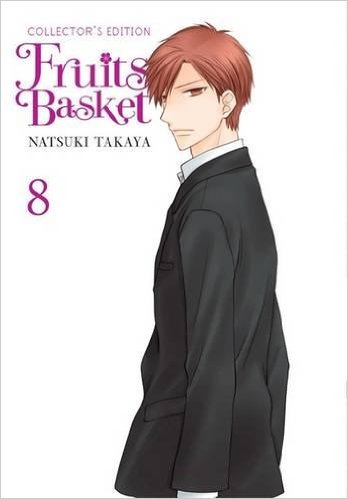
Fruits Basket Collector’s Edition, Vol. 3

By Natsuki Takaya. Released in Japan by Hakusensha, serialized in the magazine Hana to Yume. Released in North America by Yen Press.

The benefit of re-reading a series with so much going on like Fruits Basket is that things you hadn’t noticed before turn out to be signposted, whereas things that once held your attention don’t appear to be as relevant in the long run. We only get one new Sohma this time around, as we meet shy, bullied Kisa trying to escape from serious bullying at school and a somewhat hysterical mother at home. I remember being impressed at the time with the fact that Takaya had the characters take exception to the standard Japanese response for bullying, which is “if you were strong enough, they wouldn’t bully you”. Of course, this is sort of what happens – the newfound bonds with Tohru and, to a lesser degree Yuki, allow Kisa to find inner strength and return to school. So the message is a bit undercut, but it’s still a very good arc, I think.

fb3

Speaking of Yuki, he talks about his own past and that he once turned in on himself the way Kisa did, but the details are sketchy – no doubt to be saved up for later. Certainly he once again contrasts with Kyo – the head of the family, Akito, seems to have smothered Yuki a bit, whereas the opposite is true of Kyo. There’s also the love triangle, which at this point Takaya is still trying to keep as balanced as possible, but knowing the outcome as I do, it’s difficult not to see that she had Kyo and Tohru in mind as the endpoint even at this stage. And while most of the latter part of this omnibus deals with Kyo’s family issues, as he and his sensei Kazuma try to show affection while still somewhat not understanding the other person, it’s very clear that Tohru is why Kazuma showed up in the first place.

This will be deconstructed later in the series, but at this point it’s astonishing how straight it’s played that everything can be healed with the power of Tohru’s all-loving presence. Shigure is betting everything on Tohru being what finally breaks the curse. Kazuma arrives as he’s heard about Tohru and wants to make sure that she’s not going to run away if she sees the actual true form of what Kyo’s curse is. And her immediate “I love you!” to Kisa, even if it’s more in a “so cute!” way, is what starts her on the road to healing. In retrospect, of course, this really is setting us up for a fall – the arrival of Hiro next time around will help, but right now Tohru is being portrayed as a saintly goddess as that’s how most of the main characters are viewing her.

As with previous volumes, this is a good adaptation of the Japanese omnibuses. The interstitials are gone, replaced with simple SD-art, but it was like that in the Japanese reprint as well. and there’s nice color pages at the start. And the translation is smoother but also looser than the original Tokyopop one. Anyone wishing to upgrade should be quite happy.

Re: ZERO -Starting Life in Another World-, Vol. 1

By Tappei Nagatsuki and Shinichirou Otsuka. Released in Japan by Media Factory. Released in North America by Yen On.

Given the sheer number of ‘person goes to a world based on a game’ light novel plots out in Japan, a genre so oversaturated that some competitions have banned the premise, it’s not a surprise that we’re starting to see the genre poked fun at a bit. Re: Zero begins with our hero, who went out to get snacks, suddenly in a busy intersection of a fantasy world, complete with anthropomorphic creatures, noble princesses, and sneaky thieves. The joke is that this is exactly the sort of thing that he’s read about constantly, and (given that he’s sort of become an ungraduating loser NEET in our world, albeit a buff one who keeps in shape) he is absolutely ready to gain cool new powers and save the world through the power of being awesome. Thankfully, this is not that series.

rezero1

In fact, Subaru himself may be the weak point in the book – deliberately, to be fair. He’s meant to be the sort of character you want to give a swift kicking to for being so stupid, but that’s always a high wire act, particularly if it’s your protagonist. Subaru is a smartass, and not really in a good way – he’s there with a snarky response most of the time, but it almost feels overscripted, as if it’s a default he drops into when he’s not really sure how to act in a situation. When things get more dire and serious, as they inevitably do, he gets more interesting, though not necessarily more competent. Because his powers are the main title of the series: when he dies, he resets to zero, which is to say he returns back to the start of the day to try to avoid dying. He’s not particularly good at avoiding this.

The rest of the cast fares better than Subaru, as they merely have to be fairly standard fantasy types that will get development later. There’s the overearnest princess, who can’t help but worry about Subaru even though there’s no good reason to do so; the aforementioned sneak thief Felt, who the epilogue shows us is more than she seems (my money’s on missing royalty); and Reinhard, who is perfect in every way, and basically is the character that WOULD normally be our hero in most works – the best part of the book is when we figure out that the way Subaru saved the day and avoided getting himself killed is to call for help rather than fight, which indirectly lets Reinhard come in and save the day, something Subaru is simply ill-equipped to do.

I’m not sure where this will go in the future – I assume if he dies in Book 2 he’s not going to go back to that intersection, as that would quickly grow tedious. I do hope that he matures and acts a bit less of a doofus, though I have zero hopes of that coming true. That said, this is a fun series with a premise that can go in many different directions, and I want to see where it takes me.

Log Horizon: A Sunday in Akiba

By Mamare Touno and Kazuhiro Hara. Released in Japan by Enterbrain. Released in North America by Yen On.

Unlike Sword Art Online, which in many ways was less about the game itself and more about the romance between Kirito and Asuna, Log Horizon tries not to focus too hard on romantic pairings. This is not to say they aren’t there, of course, but they’re never going to take over the plot. The closest we get may be this book, in which Akatsuki and Minori both independently realize that they’re in love with Shiroe. This initially starts off being fairly mediocre – the cake eating scene is not as funny as it thinks it is, and reads as quite cliched – but it begins to get good when each of the two girls spies on the other bonding with Shiroe and is forced to deal with ugly feelings of jealousy and self-hatred. Minori, being a middle schooler, has never felt like this before. Akatsuki’s older, but she has a different issue – Minori sees the bigger picture better than she does. In fact, Akatsuki has trouble with the big picture in general.

loghorizon5

As you might imagine from the romantic sideplot, this is a bit of a ‘break’ volume for Log Horizon, with the crisis being less epic and more annoying. We get to see more of what we’ve enjoyed from prior volumes – Marielle being genki, Raynesia and Krusty snarking at each other, etc. The adventurers are holding a festival in their town, and people are coming from all over the area to join – both other adventurers and People of the Earth, many of whom have ulterior motives. The idea that these are just NPCs has long left town, and indeed the loathsome Lord Malves could hold his own with some of the other Adventurer villains we’ve seen before. But we save the true villain for the epilogue – we’d seen Shiroe worrying about another large town’s issues at the start o the book, and now we see why: it’s a dark mirror imagine of Akiba.

Nureha is clearly being set up as a major villain, though I’m not sure if she’s really the one manipulating everything here. She’s quite content to turn on her seductive wiles to lure Shiroe to their side, and they really, really want him – rewriting reality last volume to make Rundelhaus an adventurer was something that got noticed, and suddenly Shiroe, who was always the introverted social nerd – is dealing with unwanted attention. This is likely why he’s so comfortable making himself the ‘scary villain’ in Akiba, despite Minori’s protests. Being the center of attention, being wanted, is something that he desires, but makes him too uncomfortable. Not even Nureha’s manipulative sob story about her background (I do think it’s true, but it was still manipulative) or revelation that they may have a way back to the real world can sway him.

For a volume that seemed to be marking time, there was a lot going on here, and some good setup for future volumes. Log Horizon continues to be one of the best of the ‘people trapped in a game world’ books, and deserves attention.