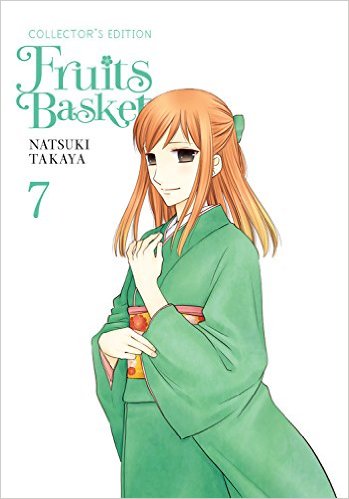
Fruits Basket Collector’s Edition, Vol. 7

By Natsuki Takaya. Released in Japan by Hakusensha, serialized in the magazine Hana to Yume. Released in North America by Yen Press. Translated by Sheldon Drzka.

I’ve discussed before how much Fruits Basket deals with abuse, and it also deals just as much with family. And while the two obviously intersect, especially in this volume, they aren’t always meant to coincide. Not everyone is the same, and no one can go through quite the same situation as someone else. This has shown up most obviously in Yuki and Kyo each being deeply envious of what the other has. In this volume we see Momiji, whose sister has been spying on him and seems to have a sense that they’re related even if she doesn’t know it for sure, choosing to remain apart from her to save his family, even though it hurts him. We also see Yuki, who has mostly repaired his relationship with Ayame (who gets the best entrance in the book here) dealing with the repressive control of his mother, and fighting back against it quite a bit. Yuki is finally growing up.
furuba7

And then there’s Rin, who’s life is so tragic she doesn’t even manage to get a front cover on the omnibus she most features in. Furuba does a good job, as I said, of showing how abuse affects everyone differently, and I won’t say Rin’s is worse than the others, but it’s certainly more explicit than the others, as we see her family, which had been putting on the facade of happy cheer, break apart with just one innocent question from her. If nothing else, it shows how fragile that facade was – even if she hadn’t asked, I doubt it would have lasted much longer. Rin’s flashback is heartbreaking, as she doesn’t even begin to understand where everything went wrong, and assumes it’s her fault – something her parents and Akito are happy to tell her is the case. Luckily, she has Haru, but she’s not in a headspace right now where she can accept her need for Haru, and so drives him away as well. Basically, Rin is fascinating and makes you want to hug her, except she’d run away.

Rin’s interaction with Tohru is also interesting. Like Hiro, she’s reluctant to accept Tohru as this sort of magical healing waif, which the start of the series may have led you to believe she was. Tohru has issues, though, and it’s in dealing with Rin, who’s actively asking her why, specifically, she wants to remove the curse, that Tohru begins to crack a bit. Rin so far is the only one who’s noticed Tohru is “quietly falling apart”, and the minimalistic look at Tohru’s flashbacks suggest it’s due to her mother and her burgeoning love for Kyo (she also reacts badly when he again implies he’s going to let her move on from him). Tohru has been an all-loving heroine, but not all love is the same, and I think Tohru needs a lesson in that before she can start to genuinely help to break the curse.

This being an omnibus, there’s so much more to talk about. Shigure’s self-analysis of his character, which is wonderful – Rin may hate Shigure, but no one hates Shigure the way Shigure hates Shigure. Akito pushing Rin out the window is the most startlingly violent the series has been to date, and the fact that Hiro saw it explains quite a bit from previous volumes. The student council actually do start to have a major impact on the story here, though they’re still somewhat hermetically sealed off from the rest of the cast, and we learn some of why Kakeru is the way he is – though there’s still his connection with Tohru, which remains mysterious. And then there’s Machi, who’s mostly a cypher, albeit a violent cypher. The joy of Fruits Basket is that the omnibus gives you endless time to reread the series and linger over your favorite parts. Also, Kimi is gloriously awful and I love her.

And next month, we get Sorta Cinderella!

Monthly Girls’ Nozaki-kun, Vol. 5

By Izumi Tsubaki. Released in Japan as “Gekkan Shoujo Nozaki-kun” by Square Enix, serialization ongoing in the online magazine Gangan Online. Released in North America by Yen Press. Translated by Leighann Harvey.

It’s a stretch to say that reading this series can teach you the ins and outs of how the manga industry works – this isn’t Bakuman, or Even a Monkey Can Draw Manga. But when it’s able to be mined for humor, anything is game. And so we get things like Nozaki trying to draw his shoujo heroine as a superdeformed character, or having a mascot for the series, much like Yukari’s endless tanukis (which litter the cover of this volume, so I can’t even make my tanuki joke at the end of the review). We also get a hilarious look at cover art, where the artist likely has to work with a different editor. There may be a seasonal theme. You may have to try to translate your editor’s art, which shows at a glance why they edit and don’t draw manga. So things are learned, but the humor comes first.

nozaki5

This series does not have plot and character development per se, but there are some amusing chapters that make it look as if things might develop. Mikoshiba discovers the tragic truth behind Wakamatsu’s crush on “Lorelai”, and is as horrified as you’d expect. Waka, meanwhile, continues to think that Kashima is a guy, though the beach episode may have cleared that up – it’s left up in the air. Actually, the beach episode is probably the highlight of the volume – the anime actually adapted it into a later OVA as it was too good not to animate. This features the famous “those are just lumps of fat, aren’t they?” line, Seo stealing the drawstrings of all the boys’ swimtrunks, Kashima and Mikoshiba continuing to be endlessly attractive to the same sex, “I’m wearing that lame pink bra you picked out!”, and more.

As for romance, as you’d expect, it’s status quo. Nozaki-kun is about the comedy. This volume, though, does show how natural Hiro and Kashima are with each other when she’s not driving him to violence, and has some lovely Seo/Waka tease, which is really all she wants from Waka at the moment. The majority of the shipping here, though, is Sakura’s seeming one-sided crush on Nozaki. She even admits to Mikoshiba she’s now too scared to confess as she knows it will just be used for manga fodder. She tries changing her attitude in order to get him to notice her more, but that just makes him worry. In the end, as we know, being herself is the best, even if it means Nozaki is still his oblivious self. The sweetest chapter in the book is the final one, where we flash back to Sakura first falling in love with Nozaki – as you’d expect, it was as much from him being a giant loser as it was his looks – and how she unconsciously influenced his heroine for the manga.

Nozaki-kun remains a wonderfully hilarious title, and now has finally gotten away from the anime, so fans of that will want to pick it up to read new material. Go read it, or the tanuki will be sad. (Oh look, I got to work in the joke anyway.)

Re: ZERO ~Starting Life in Another World~, Vol. 2

By Tappei Nagatsuki and Shinichirou Otsuka. Released in Japan by Media Factory. Released in North America by Yen On. Translated by ZephyrRz.

I always enjoy it when the second volume of a new series is stronger than the first, and that’s exactly what we have here. Subaru has managed to finally defeat death and get out of that crossroads, thus proving he is better than Robert Johnson. Now he’s recovering at the castle of Emilia’s eccentric mentor, who is apart of a series of strong new characters, including sarcastic twin maids, a grumpy loli that Subaru promptly labels as such, and, sadly, a new save point, as about 1/3 of the way through the book, Subaru dies… again. Only this time he dies in his sleep, and now has a harder job: figuring out who’s killing him and why.

rezero2

Of course, the book does still have its faults, chief among them still being Subaru. I mentioned while I was reading the series that he reminded me a bit of Bugs Bunny, mostly in the way that he enters a situation he knows very little about and responds with glib sarcasm and tsukkomi retorts. This makes the book a breezy, fun read, but at the expense of realism a bit – Subaru’s one-liners still feel overwritten, in a way that, say, the twins’ abuse does not. He’s doing much better when he’s emotionally stressed or panicking, which means the second half of the book is much stronger. Of course, this also means he’s failing downwards – he goes from blithely befriending everyone, to running away, to holing himself up in his room and avoiding everyone. Finally he even gets protection from a magic user, which saves him, but… at what cost?

We do learn a bit more about the world we’re now in here, though it’s a bit limited as the entire book remains right around the castle that the bizarre Roswaal lives in. His appearance and manner of speech scream out “I am secretly evil”, and while it would be refreshing if that proves not to be the case, I’m not holding my breath. Fandom, however, seems to have fallen in love with the two maids – well, to be more accurate, with one of the two maids. Ironically, Rem gets the lesser focus in this volume, as Subaru finds it far easier to bounce off the more outwardly vindictive Ram than her meeker, but just as vindictive sister. An afterword tells us that the two maids are based off Ran and Lum from Urusei Yatsura, redesigned for the modern age. Given much of this volume implies they are more than they seem, don’t be surprised if horns come up in the next book.

And there will be a next book to resolve this, as this has a cliffhanger ending – well, really, the opposite of a cliffhanger ending, but I meant metaphorically. I assume that Subaru will learn he can survive more than 3 deaths, and we’ve also found that even if he gets past the predestined time of his death, horrible things can still happen. We also learn, in the creepiest scene in the book, that he’s not allowed to tell anyone about his power. Basically, Subaru has his work cut out for him, but I suspect he will blunder into success somehow in the third volume. This is an excellent read, depending on your tolerance of the hero being flip every other line.