Sabikui Bisco, Vol. 2

By Shinji Cobkubo and K Akagishi. Released in Japan by Dengeki Bunko. Released in North America by Yen On. Translated by Jake Humphrey.

Last time I had asked myself how the first volume, which was excellent but felt very much complete in one volume, would become a long-running series. The answer, at least judging from this second volume, is to do more of the same. More mushrooms, more relationships that end up in betrayal and then reverse betrayal, more of Bisco and Milo being as gay as possible, and more love interests who could also function as family who are there to reassure the macho Dengeki Bunko reader that it doesn’t have to be TOO gay if they don’t want. Fortunately for all concerned, there’s one other thing which is the same as last volume: it’s just as good. This is a rollicking action piece, with lots of violence, some death, and a lot of fun dialogue. Plus it gets a move on faster than the first volume. Of course, there’s also the problem that Bisco and Milo accidentally release the man who will become the book’s main villain, but let’s face it, he was gonna get out of there soon anyway.

Now that Bisco is both a wanted criminal and very famous, he not only has to watch out as he and Mlo travel the land, but he also has to deal with a score of two-bit hoodlums pretending to be him in order to shake down others. While dealing with one of these idiots, they end up headed towards the Six Towers of Izumo, where they hope to find an answer to Bisco’s immortality. What they do end up finding is the old man who they rescued from the earlier two-bit hoods has literally cut out Bisco’s stomach, because liver and lights turns out to be a lot more religious and magical in this particular city. Teaming up with Raskeni, a grim but determined doctor, as well as her apprentice, teenage Amli, they try to figure out how to stop Kelshinka, get Bisco’s stomach back, and also perhaps stop the entire city from turning into a tower of death and destruction.

The best part of the book is probably Amli, who is a bundle of sunshine and joy, but who also has a bit of a tragic core that comes out more and more as we get further into the book. She also fills the role that Pawoo played in the first book, which is to say she gets a massive crush on Bisco, though she’s not sure if she wants him as a big brother or as a romantic partner. That said, she has a ways to go to get to the level of Milo, whose love for Bisco, and vice versa, is becoming a literal religious experience. If you told me that this author read Reborn, Gintama, Kuroko’s Basketball, and no other Jump manga, I would not be the least bit surprised. Oh yes, and there are an awful lot of fights, mostly involving mushrooms, and an awful lot of death and gore, also mostly involving mushrooms. It can get very dark. But fear not, it’s Shonen Jump. Sort of.

If you wanted exactly what the first book did, only more of it, great news. This series does not disappoint.
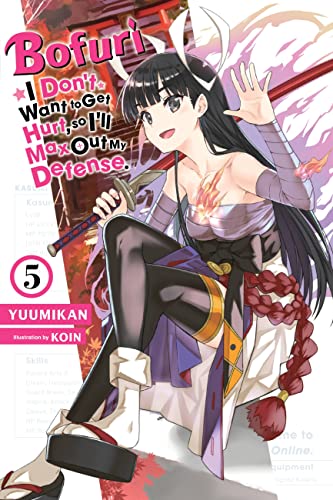
Bofuri: I Don’t Want to Get Hurt, So I’ll Max Out My Defense, Vol. 5

By Yuumikan and KOIN. Released in Japan as “Itai no wa Iya nano de Bōgyoryoku ni Kyokufuri Shitai to Omoimasu” by Kadokawa Books. Released in North America by Yen On. Translated by Andrew Cunningham.

This is the fist volume to take place post-anime (while a 2nd season was immediately announced, there has been no word about it ever since), and as such I imagine it has a few folks reading the series for the first time to try to see what happens next. That said… does Bofuri have an ongoing plot? We’re still entirely inside the game, with the most important real-life event in this volume being Kaede getting the flu. The plot of the books is basically “watch everyone slowly move to new levels and see what they do”. This volume has a weather-based level, with lots of clouds, lightning, and the like. If there is an ongoing plot that might affect future volumes, it’s Sally’s. She’s always taken the lead in gaming with Maple,. and has now found a game that Maple is not only intuitively better at but a LOT better at. Sally doesn’t want to play like Maple does… but she wants to be cool for Maple.

While this is not a “short story” volume per se, the book feels more scattered than usual, mostly as we’re having various groups team up with each other. Having faced off against Mii and Pain’s groups in the last event, there’s no similar guild war this time around. So Maple can team up with Mii for one day, getting to see more of her “real” self when she’s not putting up a front. She can also team up with Pain, who discovers, as he knew, that Maple can be a terrifying monstrosity, but also (as he didn’t know) that she can also be amazingly dense in equal measure. However, she *is* learning slowly how to game the “normal” way as well, and how to use new skills to bet suit her playset. Which is good, as the GMs are not making things any easier for her.

For those who go to Bofuri for the humor, there are definitely fun examples. Kasumi, the straight man samurai of the group for the most part, turns out to have a weakness for antiques, and on this level that mostly consists of getting quests by buying things at shops, she ends up spending FAR too much money. As for Maple, her defense – or more accurately her lack of everything other than defense – means that she’;s advancing far slower than anyone else in Maple Tree, and when she recovers from her flu she finds they all fought a boss without her. They’re pretty sure she can solo it, so she goes to do so… only to accidentally fight the LAST boss. Which she does of course beat, but it’s easily the most difficult fight we’ve seen her have since the first book, and it’s fun watching her throw everything at the enemy and seeing it not work.

Bofuri is fun and relaxing, and while it may not appeal to fans of the anime’s quicker comedic style, it’s a good read in and of itself. And good luck trying to show off for your girlfriend, Sally. At least there’s still Frederica if you can’t keep up.

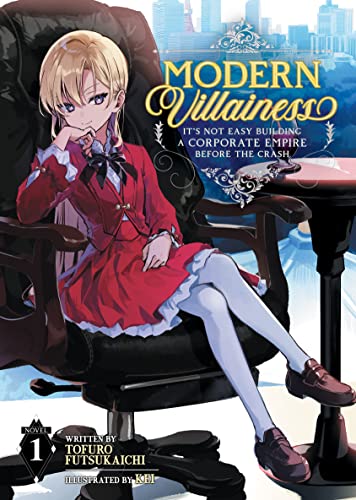
Modern Villainess: It’s Not Easy Building a Corporate Empire Before the Crash, Vol. 1

By Tofuro Futsukaichi and Kei. Released in Japan as “Gendai Shakai de Otome Game no Akuyaku Reijou wo Suru no wa Chotto Taihen” by Overlap Novels. Released in North America by Seven Seas. Translated by Alexandra Owen-Burns.

One of the most common afterwords in light novels, particularly when a book was originally published on the web, is the author talking about how they were only writing this book to amuse themselves and they had no idea it would get fans, or get published, or get an anime, etc. Usually I take this with a grain of salt, particularly when the book ends up having all the most popular cliches that are currently selling. With Modern Villainess, though, I 100% believe the author was not writing this for anyone but themselves, because it really does not seem to care about the common cliches. Our reincarnated-as-a-child heroine does not bother to act childish except to occasionally say “yay, pudding!”. About the only cliche that remains in place is the heroine believing that, no matter what changes she makes, she is doomed. But the answer in this case is not to learn magic and swordplay (non-existent), or make friends (though she does do that). It’s to become a tycoon.

As you’d expect by now, our heroine has been reborn into the life of a villainess from an otome game. Only this otome game is set in an alternate-world modern Japan, and she ends up ruined by the bubble bursting in 2008. In order to avoid that, she’ll need to invest wisely. Shame that she’s just a little kid. Also, both her parents are dead. And she’s sort of exiled from the family due to various scandals. Oh, and she might be descended from Russian royalty. And, yes, her family’s finances are in danger. Fortunately, she has a savvy butler who simply accepts that this girl is a genius, and so she sets out to fix her life via mergers, investments, buying up debt, and making herself a Very Important Person to the government of Japan. Unfortunately, that also attracts the attention of other countries.

The goal here was to write a villainess book that was not like others, which this mostly manages to do. She still has a mini-harem of young, brilliant boys, all of whom are set to “betray her” at the end of the otome game. But for the most part, this book is about economics. So much economics. The glossary at the end of each chapter, when added up, runs to about 25-30 pages. It can be difficult to keep track of the bankers, lenders, oil barons, and politicians who come into Runa’s life, but it’s also a lot of fun seeing her managing to outflummox everyone with the power of her Swiss bank account. (Those who don’t like capitalism will want to skip this, trust me.) Despite essentially being the star of Monopoly, Runa is surprisingly likeable, and we do occasionally see her making mistakes, which is refreshing. It’s a lot of fun if you can get through the pages and pages of money, power, and the combination therein.

Our heroine is still in elementary school at the end of this volume, so we’ve got a ways to go before we get to the ominous prologue (where we also see the heroine, who otherwise doesn’t show up). If you want something different in your villainess books, give this a shot.

(Also, kudos to her friend Hotaru, who actually does seem to have magic powers in an otherwise magicless book. And also looks exactly like Hotaru from Sailor Moon.)