One Piece, Vol. 82

By Eiichiro Oda. Released in Japan by Shueisha, serialization ongoing in the magazine Weekly Shonen Jump. Released in North America by Viz. Translated by Stephen Paul.

This is another one of those volumes of One Piece in which so much happens that you begin to wonder where to begin when writing the review. There’s revelations about Sanji’s family’ discussion of Gold Roger and Raftel, the final destination where One Piece lies; the aftermath of what happens on Zou, and the splitting of the crew (again!) to deal with the myriad problems; a meeting of fifty Kings and Rulers from all over the Grand Line, which means we get to see Vivi sailing again; and starting off a new arc as the reader, of course, follows Luffy, who takes his merry band to rescue Sanji from his impending wedding. Which, amusingly, Sanji wants to have no part of, though seeing the amazingly pretty bride to be might change his mind. And this is all mixed in with the usual One Piece humor and fighting.

It is rather interesting seeing Vivi on the cover in the background there, given she doesn’t really get all that much screentime (though she certainly flaunts the time she gets). One of the drawbacks of Oda writing a constant pirate’s journey is that it’s very difficult to go back and visit anyone again, which is why we only see Kaya, Nojiko, etc. in occasional “what are they doing now?” scenes. But the upcoming meeting will, I suspect, give an opportunity for Vivi at least to rejoin the Straw Hat Crew, which would be awesome, even though the crew itself continues to be unwieldy. In Dressrosa we had Nami, Sanji, Chopper and Brook sidelined for volumes at a time. Therefore, for this new adventure, Luffy takes Nami, Chopper, and brook with him to go bring back Sanji, leaving the others behind to deal with the other threads of plot that will involve less of Luffy rushing in where rubber doesn’t really to treat. And what’s more, he adds some people from Zoul, some on purpose (Pedro, Pekoms), and some by accident (Carrot, who I suspect is there for comic relief).

But Sanji and his family are currently where Oda is directing attention, and luckily that coincides with the arrival of the Big Mom Pirates. Big Mom may be stereotypical, but she’s certainly dangerous, especially given the final vision of the volume, as she parties along with the Worst Teletubbies Episode Ever. We also meet two of Sanji’s siblings (one outrageous, one sensible, in the best tradition of meeting siblings), and find out a bit more about their family, including their being used as the basis for a group of comic strip villains popular all over the Grand Line. And we meet Charlotte Pudding, Sanji’s fiancee, who seems nice and sweet and makes chocolate, and I think I’ll leave it at that, as the volumes are a good year behind the Weekly Shonen Jump chapters released every Monday.

So it’s all over the place, but in a good way, and Luffy gets to be monumentally stupid, which we haven’t seen for a while, and Nami upgrades her weapon in a very amusing scene and… look, it’s just a good volume of One Piece, OK? That said, read the other 81 first, as this is a bad volume to jump off from.

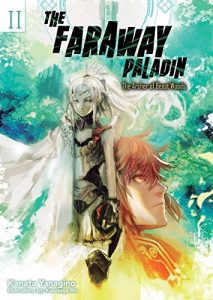
The Faraway Paladin: The Archer of Beast Woods

By Kanata Yanagino and Kususaga Rin. Released in Japan as “Saihate no Paladin” by Overlap. Released in North America digitally by J-Novel Club. Translated by James Rushton.

I’d mentioned in my review of this first volume of this series that it had more of a high fantasy feel to it than a light novel feel, and that continues in the second volume, which sees William making his way back to civilization and discovering what said civilization actually is. (Also as I said in the first volume review, the fact that he’s a reincarnated Japanese guy is completely irrelevant to the story. I suspect it was added in order to draw in fans of that genre.) He immediately runs into the character we see on the cover page (and in the title), a half-elf who is both bemused and amazed at Will’s combination of superpowers and stunning naivete. In fact, mentioning superpowers, I am reminded of what Will feels like in this second book. He feels like Superman.

There are, obviously, a lot more characters in this book than the last one, as Will and Menel are going around saving villages, battling monsters, and meeting up with Antonio from Shakespeare’s Twelfth Night, who I was rather surprised to find in the middle of a light novel. (It gets even worse later in the book when Bishop Beesley from Michael Moorcock’s Cornelius series arrives, though thankfully this is a less evil version.) It helpfully shows off how bad Will can be at not only actual human interaction, but understanding consequences in this new world – he needs to be bailed out several times by his companions. Fortunately he’s aware of this, as he keeps worrying about social ostracism, but that doesn’t make him any less bad at it. His pureheartedness may also remind the reader of Dudley Do-Right at times.

The writing on this book continues to be excellent, with the better scenes towards the back half of the book. William has a bit of a breakdown near the end as he realizes the distance between himself and his colleagues, and the way that we get to see this happen from his narrative point of view and scream “no, stop, you’re being an idiot!” is really well done. Luckily, he is stopped for being an idiot, and other characters get to show off that just because he’s super pure and strong does not always mean he saves the day – cunning and experience still has its place. There’s also a bit more humor this time around as well, mostly due to a) Will’s po-faced reaction to things, b) Menel being a massive tsundere; and c) the presence of Bee, a hobbit (in all but name) who regales everyone with song and stories. This also leads to the most touching moment in the book, where she narrates an epic song that turns out to be about Blood, Mary, and Gus – Will is so happy they weren’t forgotten he starts to cry.

In the end, this remains a very good fantasy novel, with a distinct lack of harems, little sisters, or other light novel cliches, and the main character’s overpowered nature is balanced out enough in the text that I don’t think it matters. To me, this remains the J-Novel Club release to read for those who don’t like J-Novel Club releases. That said, we’re almost caught up with Japan, so I’m not sure when the next release will be.

My Brother’s Husband, Vol. 1

By Gengoroh Tagame. Released in Japan in two separate volumes by Futabasha, serialized in the magazine Gekkan Action. Released in North America by Pantheon Books. Translated by Anne Ishii.

This has been a book I’ve been waiting to see for a long time. I was at last year’s TCAF panel with the author, where he discussed his works and the challenges of a serialization like this one. It has since finished (at four volumes, meaning there will be one more omnibus), and this first omnibus is a handsome hardvoer with great reproduction and quality translation. But most importantly, the story and art are top notch. Fans of Gengoroh Tagame who know him for his Bara work (n.b. – Bara is gay manga, as opposed to yaoi/BL, whose primary audience is women) will love this, and those who aren’t into the gay bondage thing but want a good story about sexuality, grief, loss, and the intermingling of the three will also be delighted with this story.

The story deals with Yaichi, a single man raising his young daughter Kana. He’s a twin, and his twin brother has recently passed away. His twin brother was also gay, and his husband, a Canadian man named Mike, has come to visit Yaichi. What follows is partly slice-of-life – they go to visit places in the town, they make breakfast, they go to a gym – but there’s a lot more to it. Yaichi has inbuilt “ew, gay” prejudices that can’t simply be shrugged off, even if he is basically a nice guy at heart. Moreover, having a gay man living openly in their household is starting to make the neighbors talk, and the talk isn’t good. That said, Yaichi knows how he should be behaving despite his prejudices, and Kana simply adores Mike. As for Mike, he’s seemingly a happy-go-lucky guy, but is still dealing with grief over the loss of his husband, which is not helped by Yaichi being his identical twin.

My favorite thing about this release is how well the art and story complement each other. Tagame’s characters have amazing expressions, sometimes written all over their face (Yaichi), and sometimes seemingly poker-faced, but always drawn in a way that you know just what they’re thinking. The start of the story has an artistic conceit where the top half of a page has Yaichi acting out his (homophobic) thoughts, while the bottom half has the reality of his reserved Japanese response. I wasn’t expecting Yaichi to be as likeable as he is – yes, he’s a bit creeped out by the idea of Mike being gay at first, mostly due to how it ties into his brother, but he’s also prioritized being a good dad to his kid. (Taichi’s ex-wife shows up at one point – leading to a very funny reaction from Mike, who assumed she was dead by the photos in the house – and they get on quite well despite being divorced – it’s implied they broke up as she’s devoted to her work more than anything else.)

Mike can sometimes be a cipher, but that goes away as the book progresses, and we realize just how much he’s dealing with (and repressing, to a certain extent) his loss. His relationship with Kana is fantastic, as she’s constantly curious and trying to figure out things that adults haven’t really explained properly. And while some in the neighborhood call him a “negative influence”, that goes the other way as well, as he’s able to advise a young teen who comes to him and reveals that he’s gay. (This is right at the end of the volume, and I worry it may lead to bad things next time – I hope not, but the drama has been very low key so far.) And, as I said before, Tagame’s art is just terrific, giving added depth to characters just from a knowing look or a stressed out sigh.

To sum up, this book is simply compulsively readable, with its sole flaw being that we don’t know the date for the next volume yet. I was expecting to enjoy the series, but I was amazed at how much I enjoyed it, and how great all the characters were. And “being a gay foreigner in Japan” is treated just right. An absolute must-read.