Category Archives: reviews

Even Exiled, She’s Still the Beloved Saint! St. Evelyn’s Weird and Wonderful Friends, Vol. 2

By Harunadon and Kurodeko. Released in Japan as “Tsuihousareta Seijo desu ga, Jitsu wa Kunijuu kara Aisaresugitete Kowain desu kedo!?” by Earth Star Luna. Released in North America by J-Novel Heart. Translated by Camilla L.

It can be difficult for me to do a review of a title that relies so much on just being funny. We aren’t really going to get much in the way of ongoing plot, and while there is character development, it’s not really why folks would want to read this book. This book is read for the laughs. Watching Evelyn suffer, seeing her misunderstand, seeing everyone else just completely losing their minds when she supposedly vanishes, and of course everything about the curse and its aftereffects that we get in this volume. The translator must have had a ball, as there a whole lot of puns that will make even the most inveterate jokester feel a bit sheepish. (Ahem.) Fortunately, there is a dramatic nugget to grab a hold of here, and it’s actually very interesting. It also involves a new character who is, rest assured, just as weird as the others, but can also give Evelyn something she desperately needs – a mother figure.

Evelyn is going through some tough times. She’s trying to learn how to be a proper noble lady, after years of only having to be The Saint. The problem is, she’s not very good at dancing, posture, etc. The bigger problem is all her tutors insists she’s perfect, they have nothing to teach her, and then they quit. Kira is the only one who seems to recognize that she’s upset at all this. So she decides to run away for a bit, taking Kira with her and leaving a note to explain things. Unfortunately, she tried to write the note in poetic language, which means folks think she ran off to commit suicide. She actually ends up at the shore of a lake, one with gorgeous scenery, a mysterious curse, and Europa’s mother, who has a tendency to pass out at the drop of a hat but is otherwise exactly what you’d expect from a light novel mother. She’s called Mamaropa, because of course she is.

There’s some other interesting things in this book, particularly the unexpected friendship (and maybe more? Yuri?) between Theodore’s younger sister Karin and Evelyn’s evil sister Mary, who is still a bit of a brat but is now far less evil thanks to Karin’s tutelage. But the main reason I enjoyed this is seeing Evelyn and Mamaropa interact. Evelyn’s issues in this book stem from one very specific problem – almost everyone in her life puts her on a pedestal, and refuses to tell her she’s doing anything wrong. She needs family guidance, and her family are either dead or mostly still bad people. Mamaropa is very silly (it is a comedy book), and the Mommy jokes can wear a bit thin, but she doesn’t talk to Evelyn like she’s The Beloved Saint, and may even manage to teach her – we’ll see, a third book is coming. Technically there’s also Kira, and he does function as a little brother, but he has to be there to be the tsukkomi when Evelyn can’t do it herself, so he’s too busy.

I think I enjoyed this a bit more than the first book. Assuming you don’t mind – I emphasize once more – this being very, very silly, it’s a fun read.

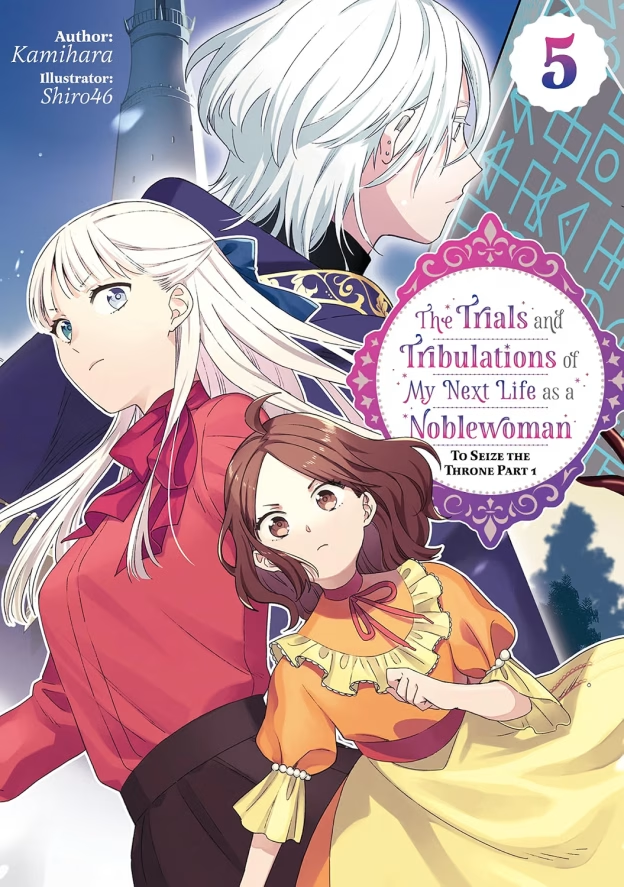
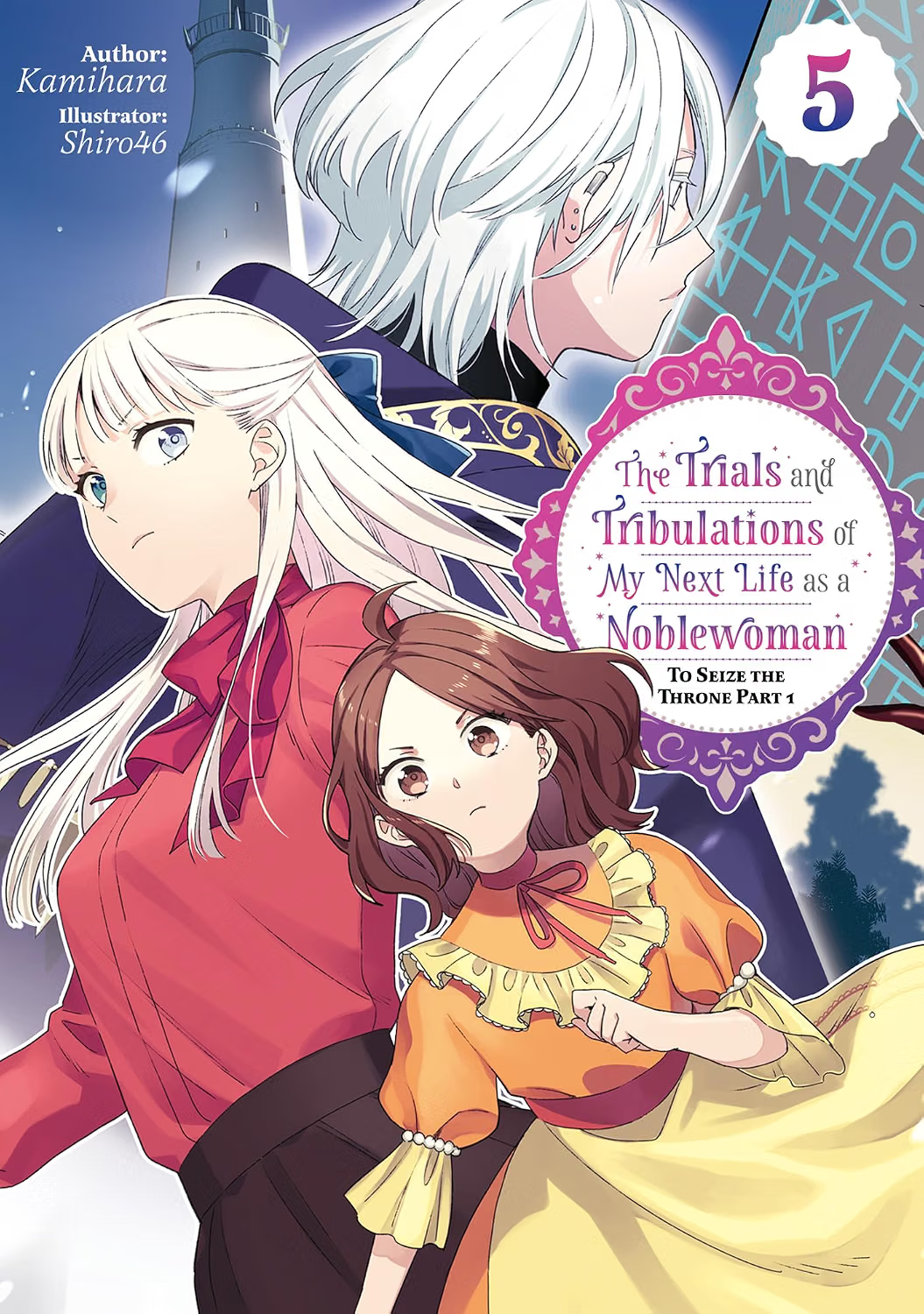
The Trials and Tribulations of My Next Life As a Noblewoman: A Ray of Hope, Part 1

By Kamihara and Shiro46. Released in Japan as “Tensei Reijo to Sūki na Jinsei o” by Hayakawa Shobo. Released in North America by J-Novel Heart. Translated by Hengtee Lim.

The one thing that I think has surprised me most about this series is its dedication to the “My Next Life” part of the title. Let’s face it, in a LOT of these types of series with, if not a villainess, at least a villainess shape, the actual reincarnated from Japan part sometimes gets forgotten. Deliberately so, in many cases – like the male counterparts, a lot of writers write villainess books because people will read that. Trials and Tribulations, though, has quietly continued to point out Karen and Ern’s isekai life, even when it already has a ton of other plot that it could more simply focus on. Last time we saw that Ern was bringing modern guns and gunpowder into a world not ready for it, and the genie really isn’t going back into that bottle. This time, we see there was a country of reincarnators. It even talks about how the original soul “dies” and is replaced with the otherworld one. This series remains a LOT.

As you’d expect, Karen is not doing well after the events of the last book, and ends up in her bedroom basically falling deeper and deeper into depression. Fortunately, she has an angry but kind-hearted tsundere to drag her out and force her to deal with life again. And she also has Reinald, who is not angry or tsundere but is still quietly very interested in her, though she does come far behind his ultimate goal. Karen, though, has far TOO much to deal with. Ern’s parents are being banished for being the parents of a traitor, and while they understandably are a bit pissed at Karen, they also give her a secret message. This allows Karen to discover Ern’s legacy, which can be seen on the cover art but which we’re not quite sure what’s it’s for yet. Six definitely seems to think it’s for him, though. Oh yes, and she’s getting honored by the Emperor for blowing her best friend’s brains out. As one does.

This book is filled with my favorite thing in the series, which is Karen’s matter of fact narration about herself and everything else, followed by someone asking if she could possibly have reactions like a real person. They’d love to see the part early on when she finally gets a delivery of rice, and she’s so overjoyed when she eats she starts to cry. Again, this series has not forgotten its isekai beats. As for Karen and Reinald, I do still think the series is working its way towards them being, if not married, at least engaged by the end. But wow, it’s making me work for that, as that’s quite a Napoleonic goal Reinald has. And it’s so very, very Karen for her advice to him being “why stop there?”. These two absolutely deserve each other. And that’s terrible.

The main flaw of this book is that it is, of course, only half a book. Presumably the subtitle will make more sense after the second part. Still great, though.

The Tiny Witch from the Deep Woods, Vol. 3

By Yanagi and Yoh Hihara. Released in Japan as “Mori no Hashikko no Chibi Majo-san” by TO Books. Released in North America by J-Novel Club. Translated by Nathan Macklem.

There’s a famous early episode of M*A*S*H where Hawkeye tries to save a patient but fails, and is despondent about it. Henry Blake, in a rare serious turn, says that the first thing he learned in the war was two rules. Rule #1: Young men die. Rule #2: Doctors can’t change Rule #1. This third volume of Tiny Witch is very much about teaching Misha that lesson, as she goes through all the worst things a doctor – sorry, apothecary – can go through. There’s a pandemic that she finds near impossible to solve, people blame her for it and even attack her at one point, and even once she helps to find an answer, some people still die from it and her relationship with the survivors will never be the same. Being an apothecary is not just handing out magic medicine that makes everyone better. Sometimes people die. Misha does learn this lesson, but there are a lot of tears and breakdowns afoot here.

Misha is having a lot of fun at the Kingdom of Redford. She’s helped the princess regain some of her health, she’s made friends with the local children, and she even gets to walk around a town festival. Unfortunately, then those same kids come to tell her that one of them is sick. Along with her grandmother. And the sickness turns out to be very familiar – it’s the plague that almost destroyed the kingdom a generation ago. Now she has to try to solve what others couldn’t before, and without any other help… or so she thinks, but fortunately, some allies arrive to remind her that while the elves (cough) sorry, People of the Forest are loners who tend not to get involved in other people’s business, they will actually help her if she needs help. Even more fortunately, friends she made along the way in the first book turn out to be more valuable than she thought.

This is very much both a “Misha grows up” volume and also a reminder that Misha is not grown up yet, and also has had a lot of trauma in the past. As it turns out, and I’m sure this won’t become relevant in a later book, the woman who set up the death of Misha’s mother, who was confined to an asylum, has escaped. Her friend tries to ask if it’s OK to tell her the information, but the mere reminder of the incident sends Misha into a panic attack. Because she’s good at remaining outwardly nice and friendly, it’s hard to tell sometimes how she’s barely holding it together, and the plague absolutely does not help. By the end of the book, she’s the definition of sadder but wiser, especially with the children she made friends with, who now see her and can’t help but think “she promised to save my granny but did not”. Misha, think of those you did save as well.

The end of this book suggests that we will spend the next several books stuck in the People of the Forest’s closed-off village, and I am 100% sure that’s not going to happen, so it will be interesting to see how that gets derailed. Till then, this is a very solid fantasy.