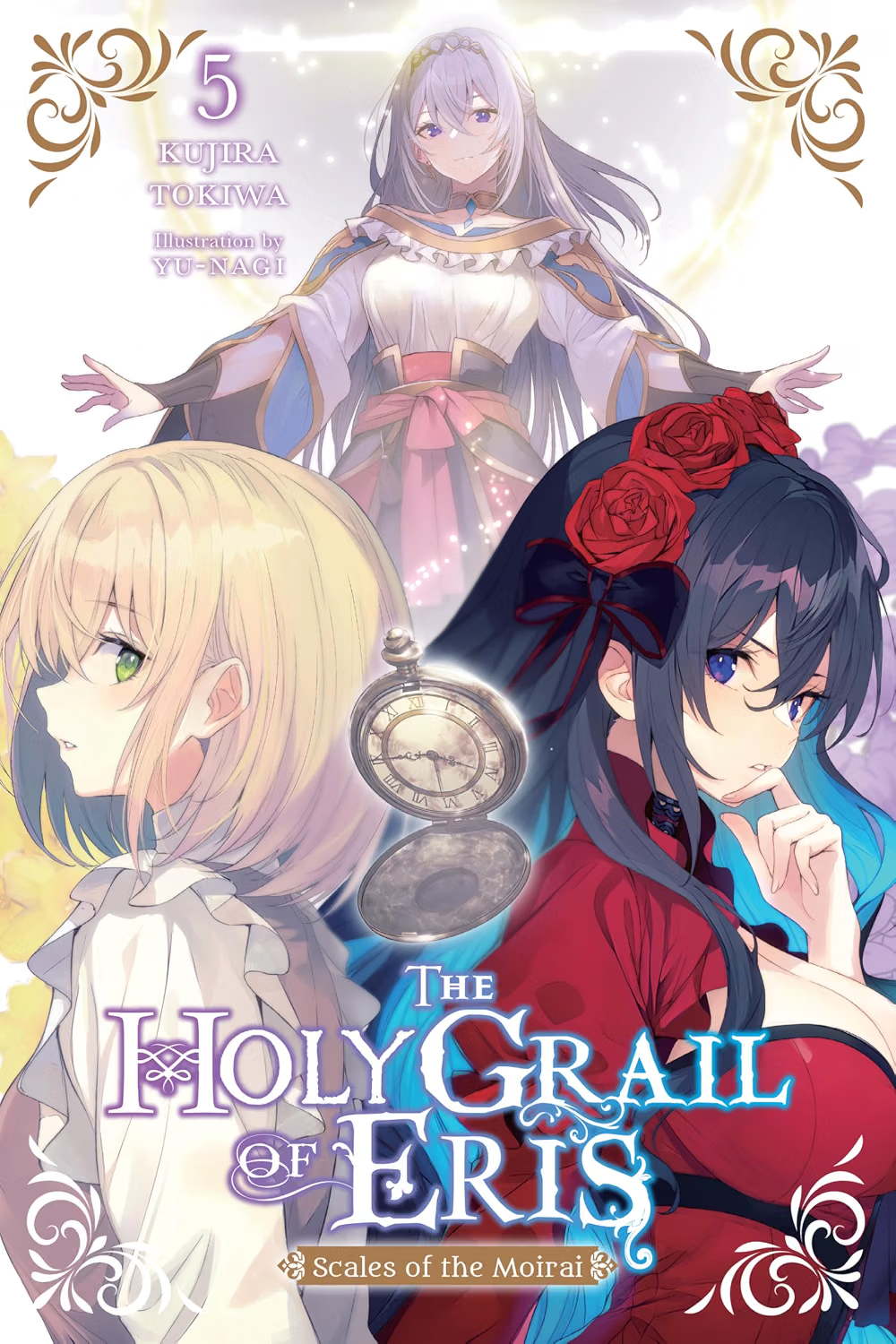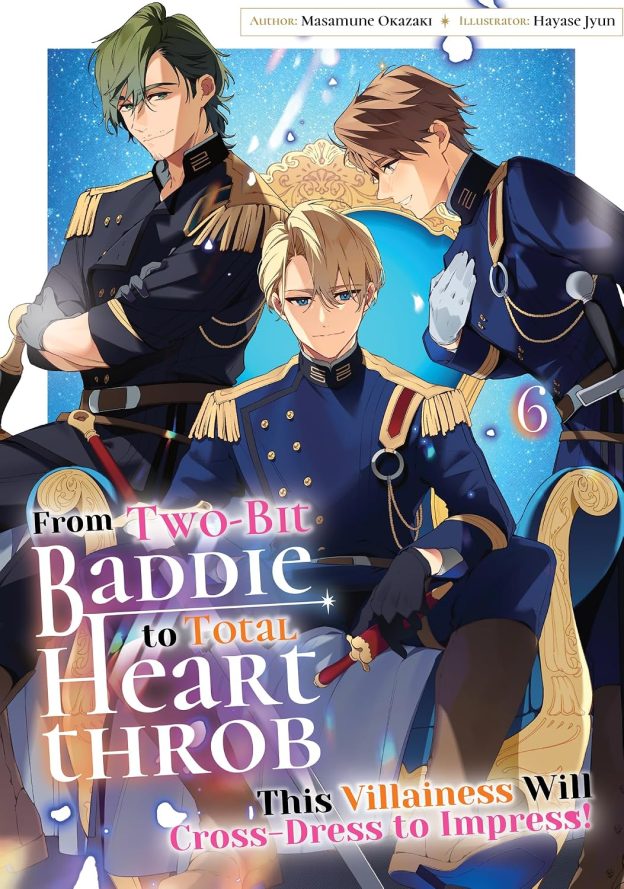
Reign of the Seven Spellblades, Vol. 14

By Bokuto Uno and Miyuki Ruria. Released in Japan as “Nanatsu no Maken ga Shihai suru” by Dengeki Bunko. Released in North America by Yen On. Translated by Andrew Cunningham.

The previous books have been packed with stuff, so many plots that it was hard to remember them all. What’s more, we were leisurely strolling through the years at school. Those days are gone now. Not only are Oliver and Company now 5th years (yes, it’s graduation for Tim Linton, though don’t worry, he’ll be around), but there is no leisurely strolling in this book – it’s war. Even worse, the war looks to continue into the next book. This means that the book is almost entirely battle scenes, with some no-names dying, some people we know getting grievously injured, and our heroes all getting the chance to show off both how cool and powerful they are and also that they are the biggest weirdos and freaks in the school. But that’s fine – it’s Kimberly, so everyone’s used to that. The trouble is that most of the powerhouse teachers were suckered away from the school, and the school itself is lacking powerhouse teachers as SOMEONE keeps killing them off.

It’s time for the war against the Gnostics, but fear not – everything has been foretold, and the teachers have gone to the most likely incursion spots. Unfortunately, the foretellers were compromised, and the Gnostics’ true plan becomes clear – attack and wipe out Kimberly. That means the students have to battle it out, led by student council president Vera Miligan, who is staying behind for an unheard of eighth year just so that she can whine about why this is happening to her. Katie and Nanao are sent to the front lines, while the other four (well, OK, other three, Pete is barely in this except for the cliffhanger setup) stay behind to battle the soldier/mages that will inevitably get through. All our old familiar friends and enemies chip in – even Teresa’s group, who find themselves in the midst of an attack from within. Can everyone show off why they’re awesome?

Of course they can, that’s the whole point of this book. Oliver, for once, is merely normally amazing, having lightning fast reflexes taught to him by a supposed traitor, and he does well enough but it’s not jaw-dropping. Same with Chela. Nanao gets the best action set piece, with what can only be described as “death from above”, and I liked the tie-back to Ashbury’s broom arts. But let’s face it, the best scene in the book, and one of the best scenes in the series, is Katie forcing an enemy general to explain why they’re fighting, and then trying to see how she could improve on it. Katie is regarded as a walking time bomb even by her friends, and we know that she’s got demi-human rights on the brain, but I have to tell you that when I saw “I just thought it’ll be my turn next“, I both shuddered and howled with laughter. Chela, Pete, your goal of a six-person harem living happily ever after is severely hampered by the other four.

As I said, cliffhanger, so we’ll have to see who lives and who dies next time. Thrilling stuff.

Agents of the Four Seasons, Vol. 6

By Kana Akatsuki and Suoh. Released in Japan as “Shunka Shūtō Daikōsha” by Dengeki Bunko. Released in North America by Yen On. Translated by Sergio Avila.

So the first two-part arc of this series involved the past and present trauma of Hinagiku, the Agent of Spring. The second two-parter gave us even more trauma, mostly present, for the twin Agents of Summer. Now, after a one-volume “break”, we’re ready to dip into Autumn. Nadeshiko has been involved quite a bit in the last few books, both as a victim of kidnapping and as an Agent in her own right. That said, she’s still an eight-year-old girl who has been through far more than most eight-year-olds should. And, as is pointed out several times in this book, she’s much more mature than someone of her age should be when confronted with all this. She should be more like… well, like Ruri, to use an example Ruri herself would probably get mad at. In this book, though, we hear more about Nadeshiko’s life before she became an Agent… and it’s a very depressingly familiar tale. There’s no supernatural forces or twisted destiny here, just a young girl whose parents quickly realize they don’t want a child after all.

Nadeshiko is not having a great time at the moment, though it’s certainly better than it’s ever been for her. Rindo is running himself ragged trying to avoid having to answer a summons from Kyokoku, which is this world’s equivalent of the United States. There used to be a mutual aid policy between countries to help out when an Agent needed it. This is no longer the case, for many reasons, some of which might be that Kyokoku is a very dangerous country filled with religious fundamentalists whose Agents live fast and die young. (If you are looking for light, subtle political commentary, this is not the series for you.) Eventually Rindo realizes that he can’t avoid this, so Nadeshiko is going to not-America… along with a passel of guards and aides, as well as the Agent of Winter and his Guard, the Agent of Summer (Ruri version) and her guard, and Tsukihi, the National Security Agent we last saw with the Agent of Twilight. They expect treachery. They get it.

The author of this series has been talking with the author of My Happy Marriage, I expect, as they included in the Afterword a bit about how readers who would like all the trauma to stop soon are reading the wrong title. “It is a story for the scars you bore back then.” It certainly is, as Nadeshiko’s past of neglectful parents goes down like you’re choking, and her present is worse. The two on the cover are the Kyokoku Agent of Autumn, who is a year younger than her, and his Guard. They’re both unable to fight back against the Church. (Anyone reading this series who loves American unconditionally or is deeply religious may want to drop it here.) I also warn that there is the most dreaded of literary devices here, which is the overheard and misunderstood conversation. That said, when you have so little regard for yourself as Nadeshiko does, it’s hard not to misunderstand that people might care about you.

On the bright side, Ruri is fantastic in this, and I love the banter between her and Rosei. They’ve both grown so much. I hope Nadeshiko is allowed to do the same. In any case, we need to wait for Book 7, which… yeah, is not yet scheduled by Yen. Essential reading for fans of the series or those who love to read about good people overcoming suffering.

A Misanthrope Teaches a Class for Demi-Humans, Vol. 3

By Kurusu Natsume and Sai Izumi. Released in Japan as “Jingai Kyōshitsu no Ningen-girai Kyōshi: Hitoma-sensei, Watashi-tachi to Mirai ni Susundekuremasuku…?” by Media Factory. Released in North America by Yen On. Translated by airco.

In the long interim between the second and third volumes coming out over here (there was a gap in Japan as well, plus a translator change), we had the anime version of this title, and while I’m not sure if it was a success in Japan, I do know that it went down over here like a lead balloon. I didn’t watch it, but a lot of folks made it sound like it was a romantic fantasy of a nebbish guy meeting a smorgasbord of supernatural monster girls, rather than what the novels make it clear that it actually is, which is another in the long line of “teacher arrives at school and proceeds to make the kids’ lives better whether they like it or not”. That said, there was a past trauma that made it sound like maybe he had a teacher student romance in his past? This third volume makes it clear that it was a lot more ordinary than that… while also maybe making you think the anime had a point.

It’s a new year, with two new students, who as usual appear on the cover. What’s that? No, the third girl is a human… and Hitoma’s new assistant teacher. Which is a problem as Haruna is also the high school girl who caused him to resign and become a shut-in for two years as well. The bulk of the book is in the present, but each chapter ends with a past flashback to the two of them in their previous school, and why things happened the way they did. (Spoiler that isn’t one: bullying is omnipresent, and teachers who try too hard to stop it get destroyed.) As for the new kids, Wakaba is a cool elf girl with a surprising past, and Okonogi is a gyaru-type oni girl with a depressing past. That said, we’ve had one graduation per book so far, and given that Haneda isn’t going anywhere, the end of the book becomes “what’s going to happen with Usami?”.

The Usami plotline is easily the best part of the book, to be honest, which makes sense given she’s the student we’ve known the longest who’s still there. As for the new folks, Wakaba’s origins are a terrific idea that ended up being less interesting than I expected, and she doesn’t really feature after her spotlight. Ononoki provides some nice drama, but I was a little uncomfortable with the reverse of the usual blonde vampire rule – instead of “she’s 800 years old but looks 8”, here we have a girl who looks like a 16-year-old high school girl who’s much younger. And then there’s Haruna. I clocked what was going on with her long before Hitoma did. That said, I’m not sure how I feel about her feelings for him even though she’s now a colleague. We see Hitoma rejecting Ryuzaki here as well, so I don’t know if he’d go for it regardless, but… it does make me wonder if this was meant to be a romantic fantasy after all.

I had assumed that the series would end with the third book, and it definitely wraps up the major plotlines from the start. But there’s two more to go, and I think we get a seed of that when we see Hitoma telling the director that his goal for next year is to see Haneda graduate. This is an awkward series that either doesn’t do enough or missteps, but you end up liking it a lot anyway. Much like its main character.